
For IB students sitting exams in May 2028 (started DP1 in August 2026).
The best revision methods May 2028 students can use are spaced retrieval, exam-style question practice, self-explanation, interleaving and regular timed papers. Start with short recall and topic practice in DP1, then gradually shift toward mixed, timed and full-paper work during DP2.
The difficult part is not discovering another study technique. It is matching each technique to the right stage of the two-year IB journey.
A flashcard can strengthen your memory of a definition, but it cannot teach you to structure a History essay under time pressure. A full mock exam can reveal pacing problems, but it is wasteful when you have not yet learned half the syllabus. Good revision is less about finding one perfect method and more about building a sequence in which memory, understanding and performance support one another.
The evidence offers a useful starting point. A major review of learning techniques rated practice testing and distributed practice as having high utility across different learners and tasks. Self-explanation and interleaving received moderate utility ratings, while passive rereading and highlighting were rated lower. For IB students, that points toward a simple principle: revision should repeatedly require you to retrieve, choose, explain and apply knowledge.
Your May 2028 revision checklist
A strong system should include:
- spaced recall for facts, terminology, formulas, quotations and processes
- topic questions soon after learning each unit
- an error log that turns mistakes into future practice
- mixed practice once several related topics are secure
- timed sections before complete papers
- full mock exams under realistic conditions in DP2
- syllabus and assessment checks for every subject
- protected time for internal assessments, the extended essay and core requirements
Before building resources, confirm that they match the course you are actually studying. The IB lists curriculum updates with first teaching in August or September 2026 and first assessment in May 2028 for relevant revised subjects. Your teacher, current subject guide and official IB materials should therefore take priority over older online advice.
Comparing the best IB revision techniques
| Revision method | Evidence and purpose | Best fit for IB papers | When to use it |
|---|---|---|---|
| Spaced retrieval | Strong general support for durable memory | Definitions, vocabulary, formulas, case studies and key evidence | From the first weeks of DP1 until the exams |
| Topic questions | Retrieval plus application and feedback | Calculation steps, source analysis, short responses and structured answers | After each topic in DP1 and DP2 |
| Self-explanation | Helps expose gaps in reasoning | Scientific processes, mathematical methods and essay arguments | While learning and correcting mistakes |
| Interleaving | Trains selection between similar methods or concepts | Mixed Mathematics, sciences and concept-heavy subjects | After individual topics are reasonably secure |
| Timed sections | Builds pacing and decision-making | Essays, data responses and multi-part problems | Mainly from late DP1 onward |
| Full mock exams | Tests endurance, timing and paper strategy | Complete assessment performance | Selectively in DP2, especially near school mocks |
| Rereading and highlighting | Useful for orientation but weak as a complete method | Initial review before active work | Briefly, before retrieval or questions |
No method wins every category. The useful question is not, “Does this technique work?” It is, “What problem does this technique solve?”
Spaced retrieval should form the foundation
Spaced retrieval means attempting to recall information after increasing intervals rather than repeatedly reviewing it in one sitting. The effort matters. When an answer feels slightly difficult to produce, you are learning more about the strength of that memory than you would by simply recognizing it on a page.
RevisionDojo Flashcards make this practical across a long programme. Use cards for one precise prompt at a time, then review them over multiple weeks. The approach described in RevisionDojo's guide to spaced repetition for IB is particularly helpful when you need to retain DP1 material well into 2028.
Cards should test useful knowledge, not reproduce entire notes. A Biology card might ask for the stages of a process. A Language B card might require production of a phrase in context. A Mathematics card can test a formula and the conditions under which it applies, although formula recall must eventually lead into problem solving. The guide to remembering Mathematics formulas with IB Flashcards explains that transition.
Question practice turns knowledge into marks
Knowing something and using it under assessment conditions are different skills. IB papers ask students to interpret command terms, select relevant knowledge, show reasoning and manage limited time. That is why question practice should begin long before the final months.
After finishing a topic, use the RevisionDojo Questionbank to answer a small set without notes. Check the answer and marking guidance, then classify each mistake:
- knowledge gap: you did not know the required content
- application gap: you knew the content but could not use it
- interpretation gap: you misunderstood the command term or stimulus
- communication gap: your reasoning was incomplete or unclear
- timing gap: you spent too long for the available marks
Repair each category differently. Study Notes and Flashcards can address missing knowledge. AI Chat can help you question an unclear concept, while grading tools can provide another layer of feedback on a response. Neither replaces your teacher or official marking guidance, but both can make the feedback loop faster. RevisionDojo's explanation of the best way to revise for IB exams shows how notes, recall and questions can operate as one cycle.
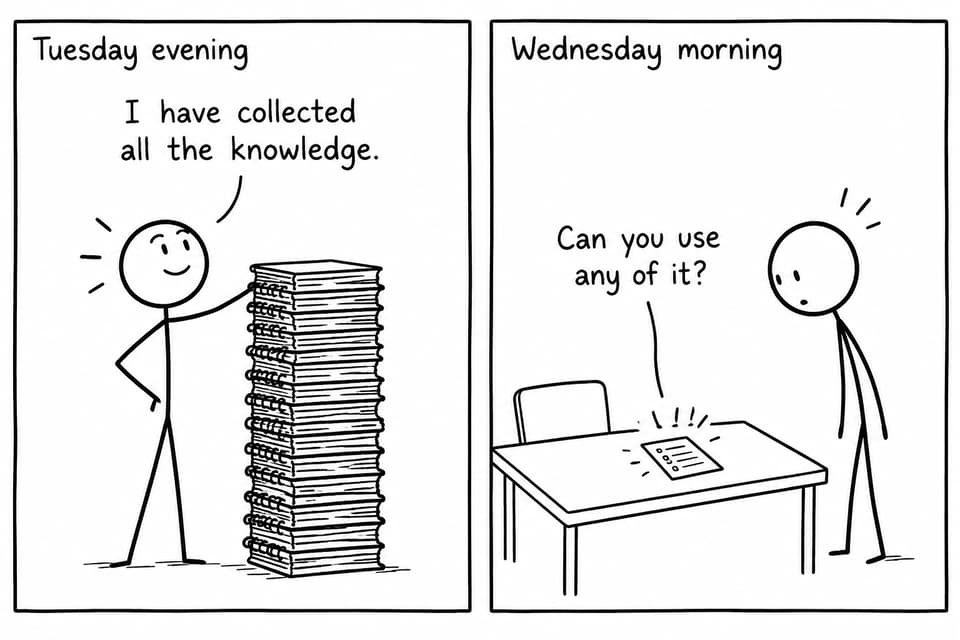
The uncomfortable moment when stored information has to become usable knowledge.
Self-explanation reveals whether you understand
Self-explanation means describing why a step, argument or relationship is valid. It is especially useful when a correct answer could hide weak understanding.
After solving a Mathematics problem, explain why that method fitted the question. In Chemistry, justify why a change affects equilibrium rather than merely stating the direction. In an essay subject, explain how a piece of evidence supports the exact claim being made. If the explanation becomes vague, you have found a revision target.
This technique also improves correction. Do not copy the model response and move on. Write one sentence explaining why your original approach failed, then solve a similar question without assistance. This converts feedback into a decision you may remember next time.
Interleaving prepares you to choose
Blocked practice gives you ten questions using the same method. Interleaved practice mixes several question types, forcing you to identify which method applies.
That distinction fits IB assessment well. The paper does not normally announce the exact mental procedure you should use. You must recognize it from the wording, data or context. Once you can solve individual topic questions reliably, mix related areas through the Questionbank. For example, combine several calculus techniques or alternate genetics, ecology and molecular Biology questions.
Do not interleave too early. Beginners benefit from some focused practice while a method is new. Mixing becomes valuable after you understand the component topics, because the learning goal changes from performing a procedure to selecting the right one.
Notes are a bridge, not a destination
Notes help you organize unfamiliar material, but polished pages can create an illusion of progress. The test is whether the notes later produce retrieval and application.
Use concise RevisionDojo Study Notes to clarify a topic, then close them and reconstruct the main ideas from memory. Compare your reconstruction with the source and convert omissions into cards or questions. RevisionDojo's guide to effective IB note-taking systems can help you avoid spending hours formatting information you never test.
The same rule applies to highlighting. Marking a key sentence can guide attention during an initial read. It becomes revision only when you subsequently explain, retrieve or apply that sentence.
How to revise IB 2028 across the two years
DP1: August 2026 to mid-2027
Build small habits while the volume is still manageable. After each lesson or topic, clarify your notes, create a limited number of high-value cards and answer a few topic questions. Review older material every week rather than waiting for an end-of-term test.
Keep the workload modest. A sustainable routine might combine 10-15 minutes of Flashcards with one focused question set. The purpose is to preserve what school has already taught, not to study the entire syllabus early. RevisionDojo's practical daily revision routine offers a useful model for short recall, questions and mistake review.
The break before DP2
Use the break to consolidate rather than race ahead. Audit each DP1 topic as secure, uncertain or weak. Revisit uncertain concepts with Study Notes and AI Chat, test them through the Questionbank, and update your error log.
This is also a sensible point to organize coursework. The RevisionDojo Coursework Library can help you understand the characteristics of structured academic work, while Tutors can provide individualized guidance within your school's academic integrity rules. Use examples to understand expectations, never as material to copy.
DP2: late 2027 to early 2028
Continue spaced recall, but increase mixed and timed practice. Complete essay plans, timed sections and multi-topic question sets. Use grading tools to identify repeated weaknesses, then take those weaknesses back into targeted study.
Predicted Papers can offer additional unfamiliar practice, but they are not forecasts of exact exam content. Treat them as opportunities to apply the syllabus under pressure. Mock Exams are most useful when completed realistically and followed by detailed correction. The value lies less in the score than in the decisions the score reveals.
The final 6-8 weeks
Shift the balance toward performance. Complete timed sections and full papers, practise choosing questions where relevant, and rehearse your timing plan. Keep Flashcards active for facts you are still likely to forget, but do not let card reviews consume time needed for extended responses and calculations.
Avoid attempting a complete resource overhaul. The final weeks reward diagnosis: find the weakest high-value area, repair it, test it and move forward. The collection of proven study techniques for IB students can help you keep that process active rather than passive.
Build a revision system that becomes more realistic
The best two-year plan changes shape. Early revision protects memory. Middle-stage revision builds connections. Late revision rehearses performance.
RevisionDojo brings those stages together through Study Notes, Flashcards, the Questionbank, AI Chat, grading tools, Predicted Papers, Mock Exams, the Coursework Library and Tutors. That makes it the ultimate IB resource not because one feature replaces disciplined work, but because each feature supports a different part of the same learning cycle.
Your specific next step is simple: open RevisionDojo Flashcards today, choose one topic taught this week, and complete a 10-minute recall session without consulting your notes.