
Math formulas don’t usually disappear because you “didn’t study enough.” They disappear because exam pressure changes the question from Do you recognize this? to Can you retrieve it right now, cleanly, with the right symbols, in the right order? That gap matters in IB exams, where time, accuracy, and method marks all compete for your attention.
If you’ve ever stared at a calculus question and felt your mind go strangely quiet, you’ve met the real enemy: retrieval.
Flashcards sound almost too simple for something as heavy as IB Math. But that’s exactly why they work. They don’t negotiate with your brain. They ask one honest question: Do you know it, right now? And if the answer is no, they come back later, at the perfect time, until the formula starts to feel familiar again.
A quick IB flashcards checklist (start here)
Before you build your system, keep it small and repeatable. A good IB flashcards routine is boring in the best way.
-
Pick your course and paper style (AA vs AI, SL vs HL) so your formulas match what you’re actually assessed on.
-
Use a ready-made deck first, then add custom cards only for your weak spots.
-
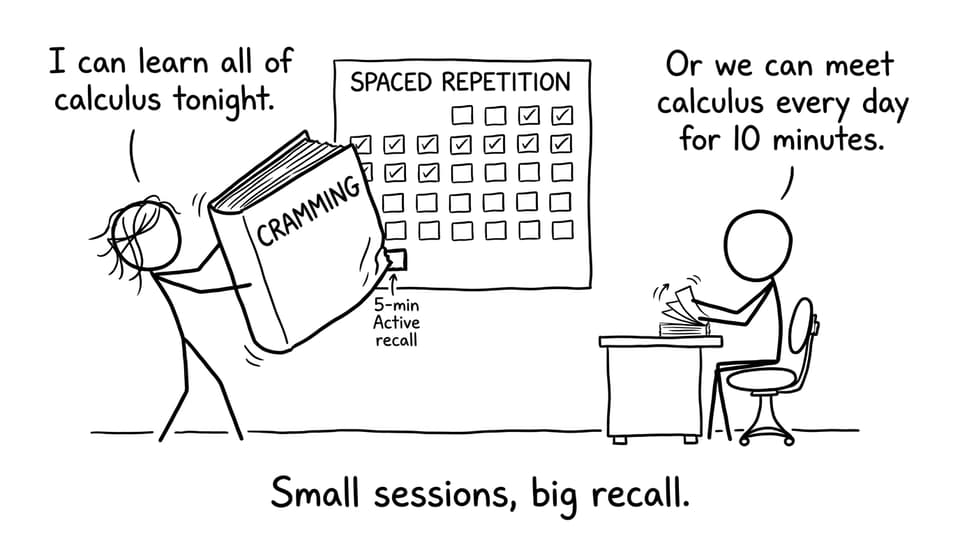
Study daily for 7-15 minutes. Consistency beats intensity.
-
Pair flashcards with application practice, not instead of it.
-
Review weekly analytics: accuracy, most-missed topics, and your “hesitation list.”
To keep this loop in one place, RevisionDojo gives you dedicated IB Flashcards with Spaced Repetition (SRS) built around the syllabus, plus the tools to turn recall into marks.
Why IB students forget formulas at the worst time
There’s a quiet trap in math revision: rereading notes feels productive because it feels familiar. Familiarity is comforting. But IB exams don’t reward comfort. They reward retrieval.
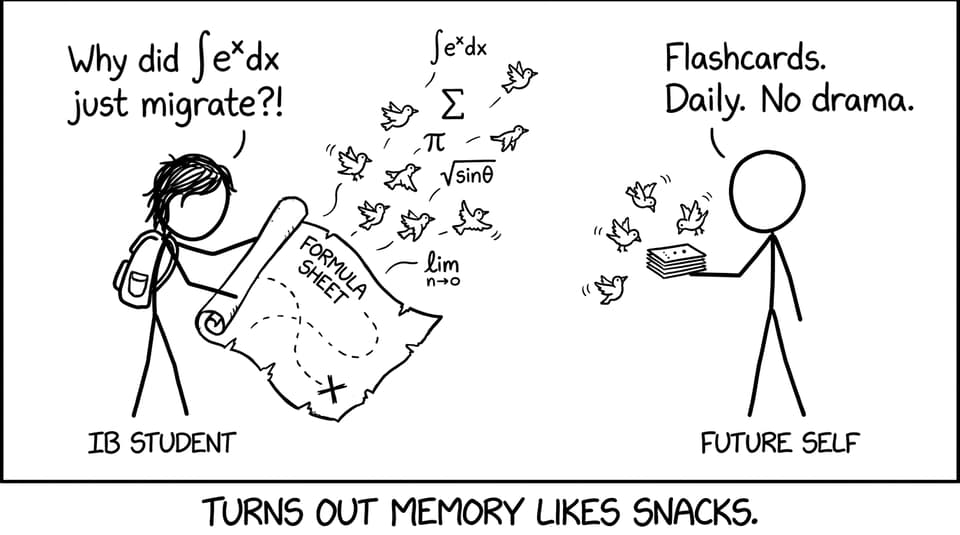
Flashcards work because they force two things most students avoid:
-
Active recall: you try to produce the formula from scratch.
-
Spaced repetition: you revisit it right before it would have faded.
That’s why flashcards often beat an extra hour of “review.” They train the exact skill you need on Paper 1 when you have no time to warm up.
If you want a structured place to start specifically for formulas, use How to Use RevisionDojo Flashcards for Formula Mastery as your setup guide.
Flashcards for IB Math formulas: the simplest system that actually sticks
A strong flashcard system has three layers: the formula, the meaning, and the trigger.
Start by sorting formulas by topic (not by chapter)
In IB Math, formulas behave like tools. You don’t store tools by the day you bought them. You store them by what they do.
Good flashcard topic buckets include:
-
Algebra and exponent rules
-
Functions and transformations
-
Trigonometry identities
-
Calculus rules (derivatives, integrals, common forms)
-
Statistics and probability distributions
If you’re in AA, you can anchor your coverage using the IB Mathematics Analysis and Approaches Resources hub. If you’re in AI, the AI pathway and resources sit inside the broader International Baccalaureate (IB) library.
Use the “two-sided recall” method (IB flashcards in both directions)
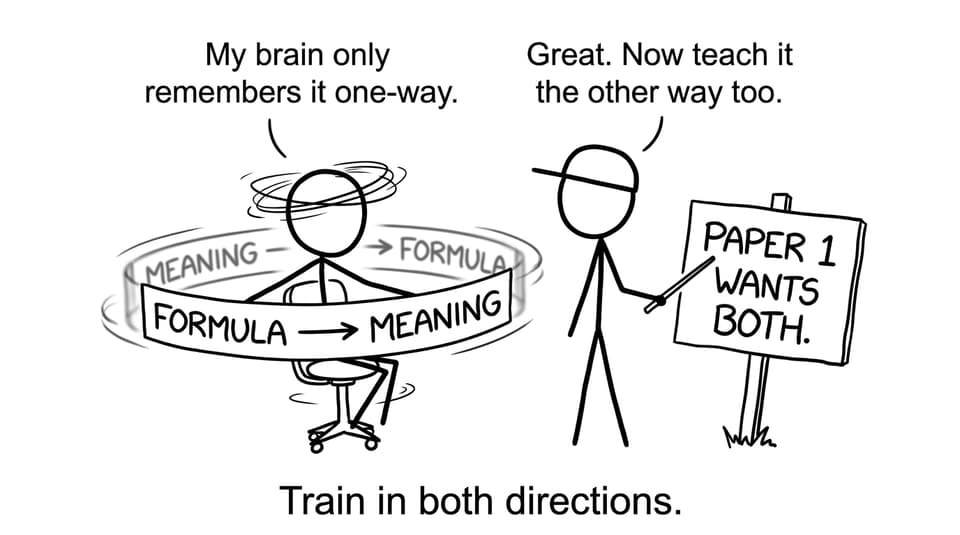
Most students only train one direction: formula -> meaning. That’s not enough.
Train both directions:
-
Formula -> meaning/use: You see (\sin^2x + \cos^2x = 1), and you recall it’s the Pythagorean identity and when it helps.
-
Meaning/use -> formula: You see “Pythagorean trig identity,” and you produce the exact equation.
This matters because IB questions often give you the meaning indirectly: a diagram, a context, a transformation, a “show that.” If your recall is only one-way, you hesitate.
Build a daily loop: learn, remember, apply
Flashcards should never live alone. In IB Math, the fastest progress comes from a tight loop:
-
Clarify with Notes (short, focused).
-
Remember with IB flashcards (active recall).
-
Apply with exam-style questions (so the formula earns its keep).
RevisionDojo is designed around that loop: Study Notes, Flashcards, a Questionbank, and AI Chat when you get stuck mid-session.
A practical way to apply right after recall:
-
For AI students drilling algebra fundamentals, use Number and Algebra - IB Questionbank.
-
For functions practice, jump into Functions - IB Questionbank.
The 10-minute IB flashcards routine (that survives busy weeks)
The best routine is the one you still do on tired days.
Try this:
-
2 minutes: review your “due today” flashcards.
-
3 minutes: add 2-4 new formula cards (only from what you studied or missed).
-
5 minutes: do one short Questionbank set and convert one mistake into a new card.
That last step is where memory becomes marks. If you want a bigger schedule that still stays realistic, see The Ultimate IB Math Study Routine for Busy Students.
Turn mistakes into custom IB flashcards (your highest ROI habit)
Prebuilt decks save time. Custom decks save marks.
Here’s the rule: if you lost marks because of a formula, it becomes a flashcard within 60 seconds.
Example:
-
You miss an optimisation question because you forgot the derivative condition.
-
You create a card: Front: “Optimisation setup: what equation identifies stationary points?” Back: “Set (f'(x)=0); then test with second derivative or sign changes.”
Over time, your flashcards become a map of your personal weaknesses, not someone else’s syllabus list.
RevisionDojo makes this easier because your flashcards live next to your Questionbank, your Study Notes, and your performance stats, so the loop stays tight.
Use the rest of RevisionDojo to make flashcards actually pay off
Flashcards build recall. But IB results come from recall under constraints.
That’s why students who improve fastest combine flashcards with:
-
Questionbank: to practice exam-style methods and mark allocation.
-
AI Chat: to resolve a confusion immediately instead of losing an hour.
-
Grading tools: to understand how marks are awarded and why steps matter.
-
Predicted Papers and Mock Exams: to rehearse timing and pressure, so recall stays stable.
-
Coursework Library and Tutors: when you need exemplars or human strategy, especially alongside IA deadlines.
If you want the full platform loop in one guide, use RevisionDojo App: The Smarter Way to Prep for IB Exams.
Closing: make IB formulas feel boring (that’s the point)
The secret isn’t that flashcards are magical. It’s that they’re honest.
They turn IB math formulas from something you “covered” into something you can retrieve on command. And once recall becomes boring and automatic, your brain has room for the real work: interpreting the question, choosing a method, and showing it clearly.
If you want one simple next step, open IB Flashcards with Spaced Repetition (SRS), pick one topic deck, and do 10 minutes today. Then pair it with a short Questionbank set. Do that loop for a week, and formula panic starts to fade, replaced by something quieter and more useful: confidence you can access what you know when it counts.