

A term can feel busy without feeling measurable. You complete a source analysis, research an unfamiliar issue, write explanations, receive feedback, and move on. By the final week, the individual tasks blur together.
The best way of reflecting on MYP Individuals and Societies progress is to compare evidence from your work across Criteria A to D, identify one repeated strength and one repeated obstacle, and turn that obstacle into a practical action. Reflection is not a long diary entry or a judgment about whether you are simply "good" at the subject. It should reveal what to repeat, repair, and practise next.
Your term reflection checklist
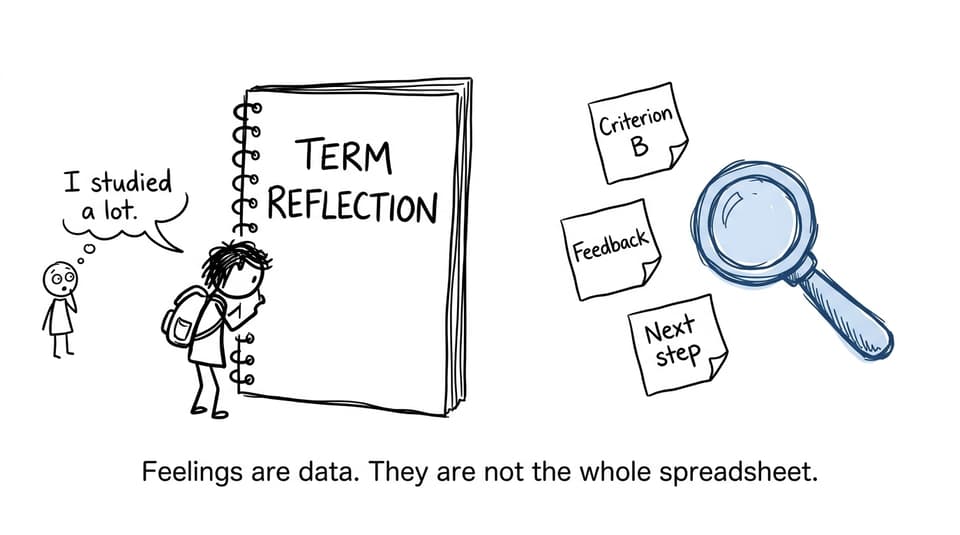
Collect two or three assessed tasks, their criteria descriptors, teacher feedback, and one early piece of work. Then:
- Record the achievement level for each assessed criterion.
- Compare an early response with a recent one.
- Highlight repeated teacher comments.
- Separate knowledge gaps from process problems.
- Name one strategy that worked.
- Choose one priority criterion.
- Schedule a specific first-week action.
This review can take 20-30 minutes. Its value comes from the evidence, not the length of what you write.
Begin with evidence, not impressions
Memory is an unreliable editor. One disappointing assessment can make an entire term seem unsuccessful, while one strong result can conceal a recurring weakness. Place your work in chronological order and look for change.
For each task, note the topic, criterion, achievement level, feedback, and preparation method. Your school may not assess every criterion on every assignment, so compare like with like. A Criterion D result is not direct evidence of your Criterion B research skills.
MYP Individuals and Societies uses four equally weighted criteria:
- Criterion A: Knowing and understanding
- Criterion B: Investigating
- Criterion C: Communicating
- Criterion D: Thinking critically
Each criterion has a maximum achievement level of 8. Teachers make best-fit judgments using age-appropriate descriptors, so the number matters less than what your work consistently demonstrates. RevisionDojo's guide to MYP Individuals and Societies criteria translates these expectations into practical study actions.
Reflect on each criterion differently
Each criterion describes a different kind of progress. Asking more precise questions produces a more useful reflection.
Criterion A: Can you use knowledge purposefully?
Look beyond remembered facts. Did you use vocabulary accurately, explain concepts, and support ideas with suitable examples? Compare an early answer with a recent one and ask whether your writing moved from listing information to explaining causes, relationships, or consequences.
If vocabulary is the obstacle, use MYP Individuals and Societies revision notes and Flashcards for retrieval practice. If you know the content but struggle to apply it, Questionbank practice may be more useful than rereading.
Criterion B: Did your investigation become systematic?
Review how you formed research questions, planned the investigation, selected information, and reflected on your method. A polished report can conceal a rushed process, so inspect research logs, deadlines, notes, and source choices.
Ask what you did after encountering weak, irrelevant, or conflicting evidence. Your next step might be to justify each source, create a plan before searching, or schedule a midpoint review rather than waiting until submission week.
Criterion C: Could someone follow your thinking?
Communication includes clarity, organization, presentation, and source documentation. Look for repeated comments about paragraphing, labels, citations, audience, or format.
Outline one recent response after writing it. If the outline seems confused, the reader probably had the same experience. Next term, plan each paragraph's purpose before drafting. RevisionDojo's guide to Individuals and Societies interdisciplinary learning also shows how evidence and perspectives can be connected rather than placed beside one another.
Criterion D: Is your thinking more critical?
Critical thinking is not disagreement for its own sake. It means analysing ideas and sources, supporting arguments, considering perspectives, and examining implications.
Review your conclusions. Do they follow from the evidence, acknowledge limitations, and answer the exact question? Mark where one paragraph presents evidence, explains its significance, considers another perspective, and reaches a judgment. Missing stages show you what to practise.
Convert feedback into a pattern
Feedback becomes powerful when several comments are placed together. One note saying "explain further" may reflect a difficult topic. The same note across three units probably reveals a transferable skill gap.
Sort repeated comments into four categories:
- Knowledge: inaccurate vocabulary, missing examples, or weak understanding
- Reasoning: unsupported claims, limited analysis, or unjustified conclusions
- Communication: unclear structure, unsuitable format, or incomplete citations
- Process: rushed research, weak planning, or limited revision
Rewrite each comment as an action. "Needs more analysis" could become: "After presenting evidence, I will add two sentences explaining its significance and effect on my argument." This reflects the principle behind balancing formative and summative assessment in MYP: feedback should change the next attempt, not remain attached to the previous one.
Protect motivation with one priority
A reflection that produces twelve weaknesses usually produces avoidance. Choose one priority criterion and one maintenance goal. Your priority should improve several future tasks; your maintenance goal should preserve something already working.
For example, evaluate the value and limitations of one source each week to strengthen Criterion D, while continuing to review ten key terms every Friday. This supports MYP Individuals and Societies motivation because progress becomes visible and manageable. If starting remains difficult, use RevisionDojo's practical guide to staying motivated while studying for MYP.
Build an improvement loop
A productive MYP Individuals and Societies mindset treats results as information about methods, not permanent labels about ability. "I am bad at source analysis" closes the discussion. "I identify origin and purpose but rarely explain value and limitations" provides a starting point.
RevisionDojo can support the complete loop. Study Notes and Flashcards repair knowledge gaps. The Questionbank tests application. AI Chat can challenge your reasoning, while Grading tools help you compare work with criteria language. Mock Exams and Predicted Papers, where available, reveal timing patterns. The Coursework Library offers structural models, and Tutors can help diagnose difficult obstacles. The MYP revision guide can turn these tools into a weekly routine: learn, attempt, check, reflect, and retry.
Finish with one concrete step
Complete this sentence:
In the first week of next term, I will complete ___ to improve Criterion ___, and I will check my progress by ___.
Put the action in your calendar. Reflection without a scheduled next step is observation. Reflection followed by deliberate practice becomes progress. Open two assignments, circle the comment that appears most often, and choose the RevisionDojo resource that will help you act on it.