


The best way to approach reflecting on MYP History progress is to review evidence from the term, compare it with the relevant assessment criteria, identify one recurring pattern, and turn that pattern into a specific action for next term.
A useful reflection explains what changed, why it changed, and what you will do differently.
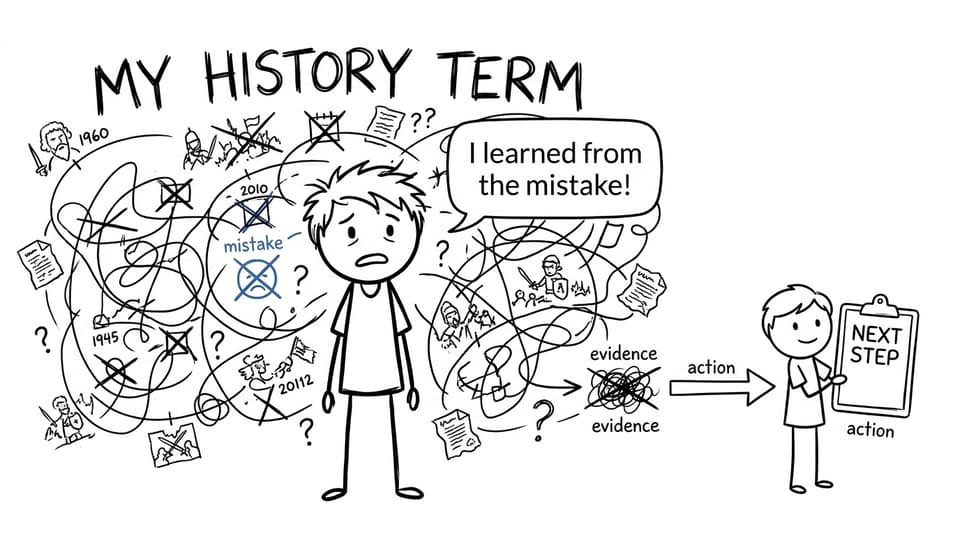
Think of the process as historical inquiry. You would not make a claim about an empire or revolution without examining evidence. Your judgment about your own progress deserves the same care.
A quick term reflection checklist
Collect these before you begin:
- Two or three assessed tasks
- Teacher comments and criterion scores
- One early response and one recent response
- Notes, research plans, or source analyses
- Evidence of study habits, such as practice records
- The criterion descriptors supplied by your school
Then answer five questions:
- What can I do now that I could not do confidently before?
- Which assessment criterion improved most?
- Which weakness appeared more than once?
- What strategy contributed to the result?
- What measurable action will I take next term?
Begin with evidence, not your latest grade
A final grade is a summary, not a diagnosis. A disappointing result could reflect weak knowledge, an unfocused investigation, unclear structure, limited source evaluation, or poor time management. Each cause requires a different response.
Create three evidence groups:
- Results: criterion levels and changes across tasks
- Feedback: repeated words or instructions from your teacher
- Work samples: sentences, plans, citations, and source evaluations showing what you did
Look for repetition. One weak conclusion may be an isolated mistake. Three conclusions that introduce new evidence reveal a pattern.
The RevisionDojo guide to reflection in MYP assessments offers prompts for turning these observations into actionable reflections.
Reflect through the four MYP History criteria
MYP History sits within Individuals and Societies. Assessment uses four equally weighted criteria, each with a maximum achievement level of 8.
| Criterion | Question to ask | Possible evidence |
|---|---|---|
| A: Knowing and understanding | Did I use accurate terminology, explanations, and examples? | Tests, explanations, vocabulary |
| B: Investigating | Did I follow an effective inquiry process? | Research question, plan, source selection |
| C: Communicating | Did my structure, style, and referencing suit the task? | Organization, presentation, bibliography |
| D: Thinking critically | Did I analyse evidence, perspectives, and arguments? | Source analysis, comparisons, judgments |
The MYP Individuals and Societies criteria guide explains progression across these areas. Use it with your school materials to translate a score into a skill.
Ask whether your evidence is precise, your inquiry focused, your structure clear, and your judgments analytical.
“My analysis improved” can then become: “In my final response, I compared two perspectives and explained why their contexts produced different interpretations.”
Separate knowledge gaps from skill gaps
History can feel like one enormous memory test, but progress has several layers. You may know the chronology while struggling to explain causation. You may understand competing interpretations but communicate them in an unfocused paragraph.
Label each recurring problem:
- Knowledge: missing events, terminology, chronology, or examples
- Command term: describing when the task asks you to evaluate
- Evidence: making claims without precise support
- Analysis: narrating events without explaining significance
- Communication: unclear organization or inconsistent citations
- Process: rushing, delaying research, or ignoring feedback
Once the category is clear, choose the matching tool. Use MYP History resources and Study Notes for knowledge gaps. Use Flashcards to retrieve terms and examples. Practise application through the MYP History Questionbank, then use AI Chat or Grading tools to investigate why an argument remains weak.
The distinction matters because rereading notes will not automatically improve source evaluation. Practice must resemble the skill you want to strengthen.
Protect motivation with visible progress
A constructive MYP History mindset does not mean pretending disappointing feedback feels good. It means treating feedback as information about a method rather than a verdict about your ability. Replace “I am bad at History” with “My judgments need clearer evidence and qualification.” The second statement gives you somewhere to go.
Track one indicator next term, such as claims supported with precise evidence, sources evaluated for value and limitations, paragraphs connected to the question, or tasks begun before the final week. RevisionDojo’s guide to staying motivated while studying for MYP can help you make progress observable while keeping the next action small.
Turn reflection into a next-term experiment
A reflection is unfinished until it changes future behaviour. Choose one weakness, one strategy, and one way to check whether the strategy worked.
Use this sentence frame:
This term, the evidence shows that I improved in ____. My recurring difficulty was ____ because ____. Next term, I will ____ once each week. I will check progress by ____.
For example, a student who makes general comments about source bias could evaluate one source each week by connecting its origin and purpose to a specific value and limitation. After four attempts, the student could compare the first and latest responses using Criterion D feedback.
RevisionDojo supports this complete loop: Study Notes and Flashcards for knowledge, the Questionbank for application, AI Chat for clarification, and Grading tools for feedback. Mock Exams and Predicted Papers, where available, can test timing. The Coursework Library can reveal effective organization, while Tutors offer human guidance when a persistent pattern is difficult to diagnose.
The MYP revision guide can place your target inside a weekly routine. To connect content with broader concepts, review the guide to topics covered in MYP History.
Your concrete next step
Open your most recent History task. Highlight one teacher comment that has appeared before, identify the related criterion, and rewrite one paragraph or source evaluation in response. Then record the action you will repeat next term.
Good reflection does not ask you to become a different student overnight. It helps you make one better decision and gives you a way to repeat it. With RevisionDojo connecting your notes, practice, feedback, and progress, the end of a term becomes the starting evidence for what happens next.