
Every IB student knows the feeling: you submit an assessment, you get a level, and then life moves on.
But the strange truth of the MYP is this: the grade is often the least useful part.
The useful part is the moment after. The pause where you notice what actually happened inside your head: where you guessed, where you froze, what you did when a plan failed, and what you did when it worked.
That pause is reflection. And in MYP assessments, reflection is the difference between repeating the same mistakes and building a system that gets you better every week.
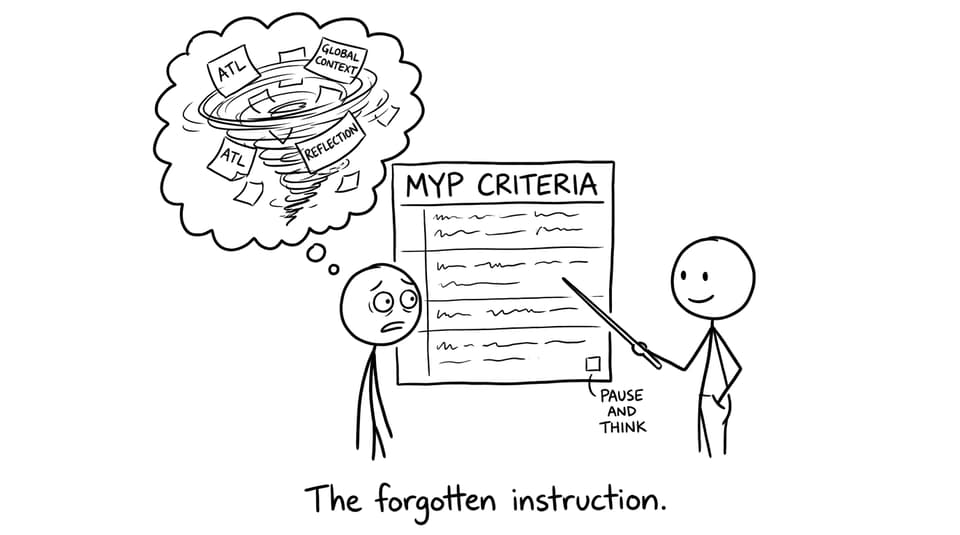
Quick reflection checklist (save this)
Use this MYP checklist for any assessment: test, project, performance task, or timed practice:
-
Before: Write one sentence on what “success” looks like in criteria language.
-
During: Stop once and ask what is working, and what is costing time.
-
After: Identify one mistake pattern and one strategy worth repeating.
-
ATL link: Name 1-2 ATL skills you used, with evidence.
-
Next step: Set one micro-goal for the next task (small enough to do tomorrow).
If you want a broader routine that fits exam season, pair this with MYP eAssessments: 30-Day Study Plan That Works.
Why reflection matters in MYP assessments (and not in a cheesy way)
Reflection in the MYP is not journaling for journaling’s sake. It’s a performance tool.
When you reflect well, you do three practical things:
You build metacognition
You get better at noticing how you learn. That includes the unglamorous stuff: when your concentration drops, when you rush conclusions, when you rely on memorized phrasing instead of understanding.
You learn to speak “criteria”
The MYP rewards students who understand what quality looks like. Reflection pushes you to name the target clearly, not vaguely.
If criteria language feels confusing, it helps to practice self-evaluation explicitly. This breakdown is a strong start: Using Rubric Language to Improve Student Self-Evaluation.
You turn feedback into a loop
Feedback only matters if it changes your next attempt. Reflection is the bridge.
For more on what good feedback looks like in the MYP, see Feedback Strategies That Build Confidence and Growth in the MYP.
How to embed MYP reflection before, during, and after an assessment
Most students treat reflection like a post-game interview: quick, polite, and mostly useless.
In the MYP, the best reflection is built into the whole process.
Before: set intentions that are specific enough to measure
Try prompts like:
-
In this MYP task, which criterion am I most likely to underperform in, and why?
-
What is one strategy I will use when I get stuck?
-
What will “top-band” work do (not just include)?
A practical way to train this is by looking at task types across subjects. Use Sample MYP Assessment Tasks for Every Subject Group and practice predicting which skills the task will reward.
During: run a 60-second mid-task check
Set a timer halfway through and write two lines:
-
What’s working?
-
What needs to change right now?
This is where MYP reflection becomes exam preparation. Under pressure, you don’t need more content. You need better decisions.
After: evaluate growth, not vibes
Aim for evidence-based reflection:
-
What did I learn about my process?
-
Where did I lose marks (or time), and what pattern caused it?
-
Which ATL skills showed up, and what proof do I have?
-
What is my next micro-goal?
If you want examples of reflection that actually earns credit, the Personal Project articles are packed with concrete templates, even if your assessment isn’t the project itself: MYP: How to Get a 7 in the Personal Project and MYP Personal Project: Common Reasons Students Lose Marks.
Reflection strategies that work (even when you’re busy)
Here are four MYP-friendly strategies you can actually maintain during exam season.
Use “three-sentence reflections” after practice
After any Questionbank set, quiz, or timed response, write:
-
I lost points/time because…
-
Next time I will…
-
A phrase/step I will reuse is…
This is the simplest habit that compounds.
Build a small reflection prompt bank
If your reflections are always “I need to manage my time,” you don’t need motivation. You need better prompts.
Use a prompt list like Creating Actionable Reflection Prompts for IB Students and keep 6-10 favorites in your notes.
Tie reflection to ATL skills (with receipts)
In the MYP, ATL skills are the “how,” not the “what.” Reflection becomes stronger when you connect to a skill and show evidence.
For example:
-
Self-management: “I planned with two checkpoints; the first failed, so I shortened my outline.”
-
Thinking: “I tested two interpretations and rejected one because it didn’t fit the evidence.”
-
Communication: “I changed paragraph structure to make my argument easier to follow.”
To understand the categories clearly, use Linking ATL Skills to Conceptual Understanding in the MYP.
Use tools that make reflection easier, not harder
Reflection gets skipped when it feels like extra work. The trick is to make it part of the workflow.
RevisionDojo is built for that loop:
-
Study Notes to clarify the concept you misunderstood.
-
Flashcards to stop relearning the same definitions.
-
Questionbank to practise under realistic constraints.
-
AI Chat to ask “why is my reasoning weak here?” and get guided follow-ups.
-
Grading tools to translate rubric language into concrete next steps.
-
Mock Exams and Predicted Papers to simulate pressure and then reflect on pacing.
-
Coursework Library to see what “good” actually looks like.
-
Tutors when your reflection identifies a pattern you can’t fix alone.
If you want a general revision structure that already includes reflection, bookmark MYP Revision Guide: Study Tips for Success.
Closing: make MYP reflection your competitive advantage
In the MYP, the students who improve fastest aren’t the ones who never make mistakes. They’re the ones who can explain their mistakes clearly, without drama, and then change one behavior next time.
If you want that kind of progress, build a simple routine: practise with RevisionDojo’s Questionbank, use Study Notes to fix gaps, run your writing through Grading tools, and finish with a two-minute MYP reflection that names one repeatable rule.
That’s how assessments stop being endpoints and start becoming training.