


Exam anxiety often grows in the space between what you know and what you fear you might forget. For MYP English students, an unfamiliar text, a ticking clock, and a blank response box can make that space feel especially wide.
The most effective approach to reducing exam anxiety for MYP English Language and Literature is not eliminating every nervous feeling. It is building a repeatable process that tells you what to do next. You can begin today with focused revision, gradual timed writing, and a simple reset routine for anxious moments.
Your quick anxiety-reduction checklist
Use this as your minimum plan:
- Identify the exact English skill making you anxious
- Complete one short, manageable practice task
- Review your work using the relevant MYP criteria
- Rewrite one weak section instead of restarting everything
- Practise a 60-second physical reset
- Increase time pressure gradually
- Protect sleep and stop studying at a fixed time
- Speak to an adult if anxiety becomes overwhelming
The goal is not to feel perfectly calm. It is to know your next move even when you are nervous.
Understand what the eAssessment is testing
The IB describes MYP Language and Literature eAssessment as an externally marked, on-screen examination for eligible MYP year 5 students. It assesses transferable language and literary skills rather than rewarding the memorisation of a large collection of notes.
You are preparing to analyse choices, organise ideas, produce purposeful texts, and use language effectively. Your school should confirm the current arrangements for your examination session, but your central revision question is simple: Can I demonstrate these skills with an unfamiliar prompt under time pressure?
Review the MYP Language and Literature assessment criteria so that analysis, organisation, production, and language control become concrete targets. Once the assessment feels less mysterious, anxiety has less uncertainty to feed on.
Use this same-day CALM method
The CALM method turns a vague instruction like “revise English” into four actions you can complete today.
Clarify one weakness
Set a timer for five minutes and finish this sentence:
I become most anxious when I have to...
Your answer might be analysing an unseen image, comparing texts, selecting evidence, writing an introduction, or finishing on time. Choose only one weakness. One target creates direction.
If you cannot identify the problem, complete a short task from the MYP English Language and Literature resource hub. Notice where you hesitate as well as where you make mistakes.
Attempt a 15-minute micro-task
Choose a short literary, visual, or non-literary text. Spend three minutes identifying purpose, audience, tone, and one important authorial choice. Then spend twelve minutes writing one analytical paragraph.
Use this chain:
Choice --> evidence --> effect --> purpose
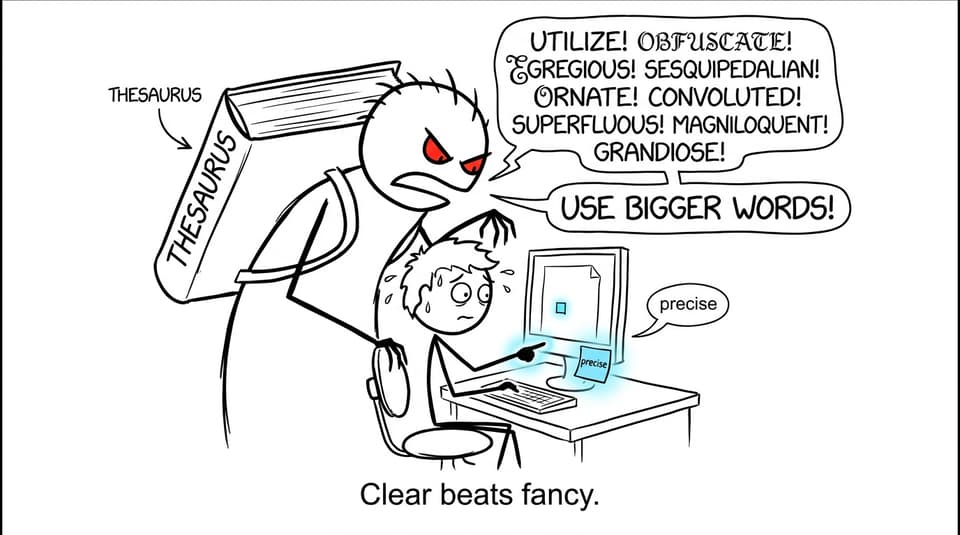
Do not stop at “the writer uses repetition.” Explain what is repeated, how it shapes the audience’s response, and why that response supports the creator’s purpose.
This is one of the most useful MYP English Language and Literature revision techniques because it demonstrates your ability without forcing you into a complete examination immediately. RevisionDojo’s guide to effective MYP revision strategies offers more skill-based drills when you are ready.
Learn from one error
Review the paragraph against one relevant criterion. Select the single change that would improve it most, such as using more precise evidence or explaining the audience effect.
Write an error rule:
Next time I identify a technique, I will explain why it matters before moving on.
Rewrite only the weakest two or three sentences. RevisionDojo’s Grading tools can help you interpret criteria-aligned feedback, while AI Chat can question incomplete reasoning. The essential final step is yours: close the feedback and produce the improved version independently.
Make pressure slightly more familiar
Repeat the task two or three days later with slightly more pressure. You might move from 15 minutes to 13, use a less familiar text type, or write without checking your notes.
Do not leap from untimed practice to a complete simulation if that causes panic. Progress from one paragraph to two, then a longer section and eventually a Mock Exam. RevisionDojo’s Questionbank supports targeted repetition, while Mock Exams and Predicted Papers, where available, can make the digital environment and time limit more familiar.
Choose revision techniques that create proof
Anxiety asks, “Have I studied enough?” Active practice offers better questions: “Can I explain this effect?” and “Can I improve this paragraph?”
Build each session around three stages:
| Stage | What to do |
|---|---|
| Clarify | Review one concept in Study Notes or test terminology with Flashcards |
| Apply | Answer a Questionbank prompt or write a short response |
| Correct | Use criteria or Grading tools, record one error rule, and rewrite |
The guide to scoring a 7 in MYP Language and Literature explains how precise claims, evidence, and analysis connect to stronger performance. Focused notes on analysing bias in MYP texts can repair a specific gap without hours of unfocused reading.
Flashcards help you recall terms such as tone, juxtaposition, register, and symbolism, but they cannot replace writing. Knowing the definition of imagery feels reassuring; explaining its effect in an unfamiliar passage demonstrates the skill.
Train a reset before you need it
A calming technique becomes more reliable when rehearsed during ordinary study. Before every timed task, practise this 60-second sequence:
- Place both feet on the floor and release your shoulders.
- Inhale gently for four seconds and exhale for six.
- Repeat three or four times without forcing your breath.
- Name three neutral things you can see.
- Read the command term and write one small next action.
Evidence on breathing exercises for test anxiety is mixed, and breathing cannot replace preparation or professional support. Its practical value is providing a repeatable pause before you act. RevisionDojo’s explanation of the psychology of test anxiety explores how physical reactions, worried thoughts, and avoidance reinforce one another.
If anxiety rises during the eAssessment, pause, exhale slowly, reread the command term, and type a rough claim or several keywords. Momentum often returns after a concrete action. The guide to staying calm in timed exams can also help you create a move-on rule for difficult questions.
Follow a simple seven-day plan
Use this schedule during any revision week:
| Day | Focus |
|---|---|
| Day 1 | Diagnose one weakness and complete a 15-minute paragraph |
| Day 2 | Review Study Notes and use Flashcards for key terminology |
| Day 3 | Complete another short response and record one error rule |
| Day 4 | Rest or do ten minutes of light recall |
| Day 5 | Write a timed comparison, analysis, or production plan |
| Day 6 | Complete a longer on-screen practice block |
| Day 7 | Review errors, rewrite one section, and plan the next week |
Keep your resources limited. The Coursework Library can help you examine structure and control in model work, but use examples to notice decisions rather than copy phrasing. If a weakness keeps returning, a RevisionDojo Tutor can help diagnose it.
Protect the final evening
Last-minute overload often increases uncertainty. Complete one light active-recall session, pack anything your school requires, check your morning plan, and stop at a fixed time. The night-before anxiety guide offers a practical routine for winding down without abandoning preparation.
Reducing anxiety is rarely one dramatic breakthrough. It is usually the quieter result of familiarity: you have encountered unfamiliar texts, practised a reset, and recovered from weak paragraphs. RevisionDojo brings that process together through Study Notes, Flashcards, Questionbank practice, AI Chat, Grading tools, Mock Exams, Predicted Papers, the Coursework Library, and Tutors. Confidence grows from the loop you repeat: attempt, review, correct, and return.