

The most useful questions to ask an MYP Individuals and Societies teacher go beyond, “What grade is my child getting?” Ask what the class is studying, which assessment criterion needs attention, what improvement would look like, and how you can help without taking over.
MYP Individuals and Societies may include history, geography, economics, politics, sociology, environmental systems, or an integrated combination. Students learn content while investigating questions, evaluating sources, communicating arguments, and considering competing perspectives.
A focused conversation can turn an unclear result into a manageable next step. You do not need to become a humanities teacher at home. You need enough clarity to help your child stay organized, independent, and willing to seek support.
A quick parent checklist
Try to establish:
- What the current unit covers
- Which MYP criteria are being assessed
- Where your child is performing well
- Which specific skill needs attention
- What appropriate home practice looks like
- Which deadlines are approaching
- How your child can request feedback
- Whether organization, confidence, or wellbeing is a concern
Two or three precise questions often reveal more than a long conversation about grades alone.
Ask how the subject is structured
Begin with: “How is Individuals and Societies structured in this year group?”
One school may teach integrated units combining history and geography, while another organizes the course around separate disciplines. The guide to MYP Individuals and Societies topics provides an overview, but the teacher remains the best source for your child’s exact curriculum.
Useful follow-up questions include:
- “What is the central concept of the current unit?”
- “What should my child understand rather than simply remember?”
- “Which command terms should they recognize?”
Remembering facts supports an answer, but students may also need to explain causes, analyse evidence, compare perspectives, or reach a justified conclusion.
Ask which assessment criterion needs attention
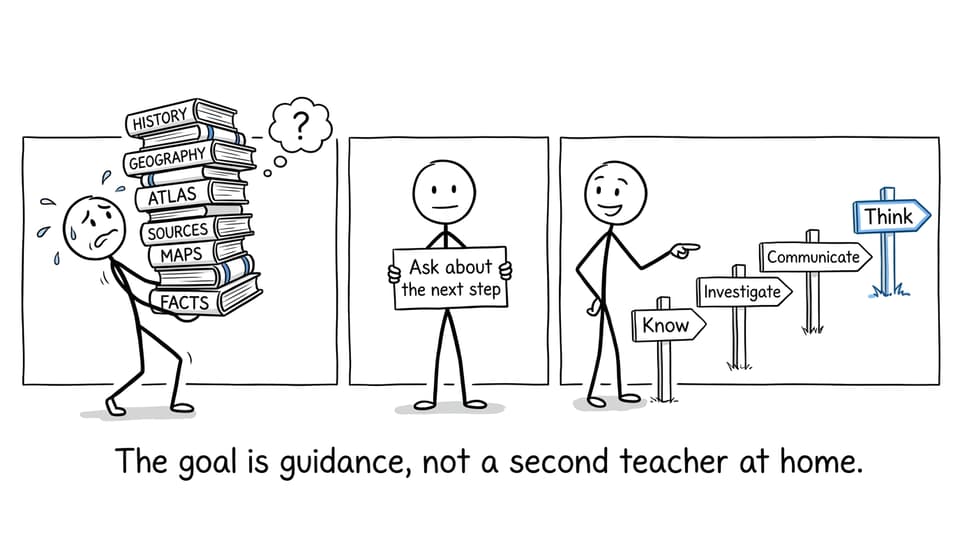
MYP Individuals and Societies uses four broad criteria: knowing and understanding, investigating, communicating, and thinking critically. The descriptors are adapted for different stages of the MYP, so ask which year-specific expectations apply.
A productive question is: “Which criterion is currently limiting my child’s work, and what would the next level look like?”
This moves the discussion from judgment to action. A student may know the content but struggle to organize an argument. Another may communicate clearly without evaluating the evidence. A disappointing result does not automatically mean the student failed to study.
Ask the teacher:
- “Can you show me feedback that explains the result?”
- “Is the difficulty knowledge, research, communication, or critical thinking?”
- “What one change should appear in the next task?”
The guide to common geography and history response errors explains why an informed response may still need stronger reasoning.
Ask how your child approaches investigations
Investigation means more than collecting information. Students may need to formulate a focused question, create a plan, gather relevant evidence, document sources, and reflect on their process.
Ask whether your child can:
- Develop a focused research question independently
- Plan before gathering information
- Select relevant and credible sources
- Reflect honestly on strengths and limitations
Then ask where the process usually breaks down. A student who begins late may appear to have a research problem when the underlying difficulty is planning. Another may collect numerous sources without deciding which evidence answers the question. These situations require different support.
At home, spend ten minutes identifying the task, next milestone, and one likely obstacle. Do not choose the argument, locate every source, or rewrite the work. The aim is to make the path visible while leaving ownership with the student. The guide to appropriate parent involvement in MYP coursework offers further boundaries.
Ask what progress looks like over time
One assessment is a photograph, not the complete journey. It may capture a difficult topic, unfamiliar format, weak time management, or a developing skill.
Ask: “What pattern do you see across my child’s recent work?” Clarify whether the same criterion causes repeated difficulty, whether feedback appears in later work, and whether classroom discussion shows stronger understanding than written responses.
Also ask whether the concern involves skill, effort, organization, or confidence. These can produce similar results but need different responses. Finish by agreeing on one improvement to look for during the next unit.
Ask how to help without creating pressure
Supporting a student is usually less about teaching and more about creating calm conditions for independent work. Ask: “What can we do at home that would genuinely help, and what should remain at school?”
The answer might involve reviewing terminology, discussing an event from multiple perspectives, practising source analysis, or creating a manageable schedule. The MYP homework guide for parents recommends structure and coaching questions rather than supplied answers.
A weekly check-in can be simple:
- “What are you trying to demonstrate?”
- “Which criterion matters here?”
- “What is the smallest useful next action?”
- “Would you like planning help or some space?”
If your child routinely avoids the subject, works very late, or becomes distressed, ask what the teacher has observed. The parent guide to supporting a child in the MYP can help families decide whether broader support is needed.
Ask about resources and responsible practice
Parents should ask which resources are appropriate and how feedback or AI may be used under school rules.
The MYP Individuals and Societies resource hub brings together RevisionDojo Study Notes, Flashcards, and a Questionbank for active practice. Individuals and Societies cheatsheets support concise review before students attempt questions independently.
AI Chat can clarify concepts and command terms, while Grading tools can highlight possible improvement areas when permitted. Predicted Papers and Mock Exams offer structured rehearsal. The Coursework Library helps students notice characteristics of effective work without copying, and Tutors provide focused human guidance when confusion persists.
Tools may support thinking, but the student must remain the author. Confirm the school’s expectations for disclosure, citation, and academic integrity.
Turn the answer into one next step
A useful teacher conversation should end with one clear action. Your child might annotate two sources, check the criterion before writing, practise an analytical paragraph, or ask about unclear feedback.
Keep the action small enough to repeat and specific enough to observe. The MYP revision guide connects understanding, recall, practice, feedback, and reflection. RevisionDojo supports that complete cycle, helping families replace vague worry with informed questions and steady progress.