


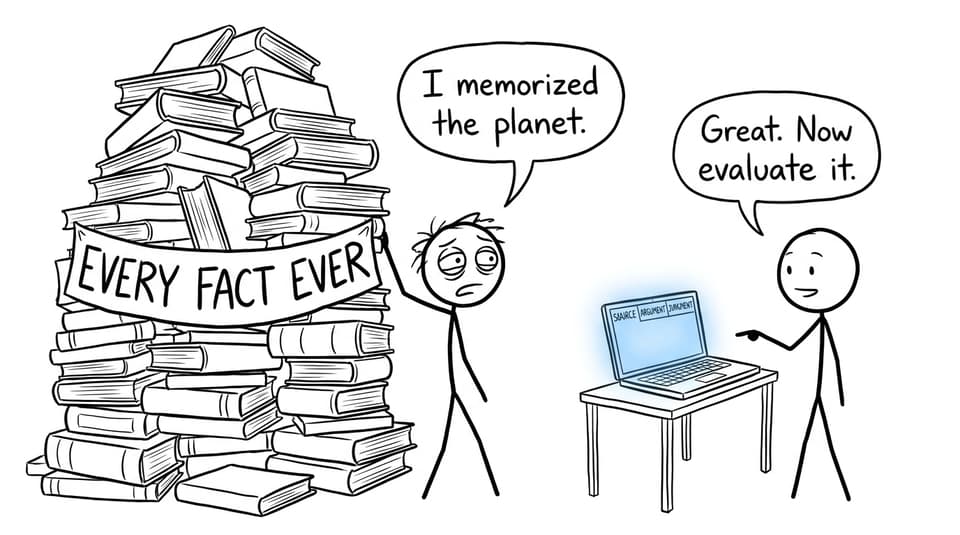
Preparing for MYP Individuals and Societies eAssessment is best approached as skills training, not a race to memorize every course page. You need enough subject knowledge to recognize what matters, but marks also depend on investigating effectively, communicating for a purpose, evaluating evidence, and constructing a supported judgment.
The most effective method is a repeating loop: retrieve one topic, apply it to an unfamiliar question, compare your response with the criteria, correct one weakness, and try again under time pressure.
Your preparation checklist
Confirm that your plan includes:
- Current examination information supplied by your school
- Criteria A, B, C, and D and their relevant strands
- Accurate terminology, concepts, and adaptable examples
- Research questions, investigation plans, and source evaluation
- Writing for different audiences, purposes, and formats
- Analysis of arguments, evidence, perspectives, and limitations
- Timed practice completed on a computer
- An error log with specific actions for your next attempt
The RevisionDojo MYP revision guide offers a broader framework for organizing these habits across your subjects.
Understand what the eAssessment asks you to do
The MYP Individuals and Societies on-screen examination is available in history, geography, and integrated humanities. Your school determines the subject for which you are registered, so follow its current guidance rather than assuming every course covers identical material.
Official IB materials describe a two-hour examination containing three tasks:
| Task | Main criteria assessed | Marks |
|---|---|---|
| Investigating | A and B | 26 |
| Communicating | A and C | 18 |
| Thinking critically | A, C, and D | 36 |
The examination totals 80 marks. Thinking critically is the largest task, but neglecting investigation or communication would still leave a substantial share of the assessment unprepared.
Translate each criterion into an observable question:
- Criterion A: Can I use accurate terminology and explain concepts with relevant examples?
- Criterion B: Can I formulate a focused research question, plan an investigation, and evaluate its process?
- Criterion C: Can I organize information for the specified audience, purpose, and format?
- Criterion D: Can I analyse sources, examine perspectives, synthesize evidence, and reach a supported conclusion?
Effective MYP Individuals and Societies revision techniques focus on what assessors need to see, rather than vague goals such as “revise geography.”
Use this step-by-step method today
A useful plan should survive contact with an ordinary school day. Set aside 60 minutes and complete this cycle.
Choose one precise weakness
Spend five minutes reviewing teacher feedback, marked work, or a diagnostic question. Select one weakness, such as evaluating source limitations, interpreting a graph, planning an investigation, or writing a balanced conclusion.
“Evaluate the usefulness of two sources” is a task you can complete. “Revise migration” is not.
Retrieve knowledge without notes
For ten minutes, write what you remember about the chosen topic. Include vocabulary, concepts, examples, and useful processes. If you are practising source evaluation, recall the questions associated with origin, purpose, value, and limitations.
Only then consult the MYP Individuals and Societies Study Notes. Repair meaningful gaps instead of copying entire explanations. Notes work best as a diagnostic tool, not a place to hide from questions.
Apply your knowledge
Spend 20 minutes answering one or two questions without assistance. Use the RevisionDojo Questionbank to target the skill, or choose a source-based task supplied by your teacher.
Underline the command term and translate it into an action:
- Describe: provide relevant characteristics or details.
- Explain: show how or why something occurs.
- Analyse: break evidence into parts and explain relationships.
- Evaluate: consider strengths and limitations before judging.
- To what extent: weigh a claim and establish how far it is valid.
For extended writing, create a one-sentence position and two paragraph claims before typing. Two minutes of planning can prevent ten minutes of directionless writing.
Check by criterion, not by feeling
Compare your response with the relevant criterion. Ask whether the required evidence is visible. A thoughtful idea hidden behind vague language cannot receive the recognition given to a clear, developed argument.
RevisionDojo's Grading tools and AI Chat can identify unclear reasoning, although feedback should guide rather than replace your judgment. Review these common errors in MYP Geography and History responses to recognize recurring problems.
Rewrite and record one rule
Rewrite only the weakest paragraph, plan, or source evaluation. Then add one instruction to an error log:
- “I will connect a source's origin to its usefulness for this question.”
- “I will identify a data pattern, support it, and explain its significance.”
- “I will consider a counterargument before judging extent.”
Schedule a five-minute retest within 48 hours. This turns feedback into learning rather than a comment you understand once and forget.
Train each task deliberately
Investigating
Practise turning broad topics into focused, answerable research questions. Outline an action plan covering the information required, suitable methods, possible source types, and how the process could be evaluated.
Avoid generic observations such as “the source may be biased.” Explain why its creator, date, audience, or purpose creates a specific value or limitation for the investigation. The notes on evidence and scientific worldviews can reinforce this habit.
Communicating
A report, speech, article, presentation outline, and formal argument address audiences differently. Before writing, identify the intended audience, purpose, and required format.
Try converting the same evidence into two formats, such as a policy briefing and an informative article. This forces deliberate choices about organization, vocabulary, emphasis, and tone.
Thinking critically
Critical thinking begins where summary ends. After presenting evidence, ask: What does this show, why does it matter, what alternative explanation exists, and how convincing is the evidence?
Build paragraphs around a claim, specific evidence, explanation, qualification, and link to the question. Explore how subjects connect through Individuals and Societies interdisciplinary learning.
Build a flexible evidence bank
One of the most useful MYP Individuals and Societies study tips is to know fewer examples more deeply. For each case taught by your school, record:
- The central concept or issue
- Two accurate supporting details
- A cause and consequence
- Two contrasting perspectives
- One limitation in the available evidence
- Another context connected to the example
Use RevisionDojo Flashcards for terminology and compact evidence, but follow retrieval with application. A remembered definition matters only when you can use it to interpret an unfamiliar situation.
Add on-screen practice gradually
Do not wait until the final week to discover that reading, planning, typing, and editing on screen feel different. Begin with 15-minute tasks, progress to complete sections, and eventually attempt full simulations.
The guide to succeeding in MYP eAssessments explains digital habits and pacing. Mock Exams and Predicted Papers, where available, can provide realistic pressure practice. Use them after targeted work has addressed your largest weaknesses.
During each timed session, preserve a checking buffer. Confirm that every response addresses its command term, uses supplied material accurately, and reaches a conclusion when required.
Make RevisionDojo your preparation system
Strong preparation is rarely one dramatic study day. It is a sequence of honest loops: learn, retrieve, apply, check, rewrite, and return.
RevisionDojo brings that loop together as the ultimate IB resource. Study Notes clarify content, Flashcards maintain recall, the Questionbank develops application, and AI Chat challenges weak explanations. Grading tools make criteria visible, while Mock Exams and Predicted Papers support timed rehearsal. The Coursework Library models effective structure without inviting copying, and Tutors can diagnose recurring problems when independent correction stalls.
Start with the RevisionDojo review for MYP Individuals and Societies, choose one precise weakness, and complete the 60-minute cycle. Confidence usually arrives after evidence of progress, not before it.