


Preparing for MYP assessments can feel like standing before a crowded desk: every subject appears important, every unfinished task feels urgent, and nothing tells you where to begin. A 30-day plan replaces one large worry with a small decision for each day.
To prepare a 30-day study plan for MYP, identify your assessments and weakest areas, divide the month into four training phases, and schedule specific tasks rather than vague subjects. Move from diagnosis to focused revision, timed application, and a lighter final review. You can build the first version in about 45 minutes.
This structure works for classroom assessments and can be adapted for Year 5 eAssessment preparation. Because arrangements differ between schools, confirm subjects, deadlines, criteria, and formats with your teachers before finalizing the calendar.
Your 30-day MYP planning checklist
Collect the information that determines what deserves your time:
- Assessment dates, school deadlines, topics, formats, and criteria
- Recent teacher feedback and recurring mistakes
- Available weekday and weekend study time
- Personal Project or ePortfolio responsibilities
- Materials for learning, recall, practice, and feedback
- One weekly rest or catch-up block
Start with the RevisionDojo MYP resource hub to compare your subjects with available notes, questions, flashcards, and worked examples. The MYP syllabus and subject overview can help locate topics, but your teacher's current course outline remains the authority.
Build your plan in five steps
List every assessment and topic
Create a row for each subject and add its assessment date, tested topics, format, and criteria. If your school offers MYP eAssessment, distinguish on-screen examinations, ePortfolio work, and the Personal Project. Prepare for each according to its actual demands.
The MYP is criterion-related, so revision should prepare you to demonstrate knowledge and skills, not merely recognize material in your notebook. Remembering a scientific definition and evaluating an investigation require different practice.
Rate each area honestly
Use three confidence ratings:
- Red: I cannot explain or apply this yet.
- Amber: I understand parts of it but make recurring mistakes.
- Green: I can answer an unfamiliar question without help.
Close your materials and explain a topic, solve one question, or outline a response. Evidence is more useful than familiarity. Assign roughly 50% of study blocks to red areas, 30% to amber areas, and 20% to green areas. Strong topics still need spaced review, but should not consume time needed to repair gaps.
Decide how many sessions fit your life
Count realistic study blocks. A sustainable weekday target might be one 35-to-50-minute session, with one or two longer weekend blocks. Leave at least one flexible block each week for rest, schoolwork, or overruns.
If you have 24 usable sessions, distribute them with this guide:
| Days | Main purpose | What to do |
|---|---|---|
| 1-3 | Diagnose and organize | Map assessments, test knowledge, rank topics, and gather feedback. |
| 4-10 | Rebuild foundations | Repair red topics with notes, retrieval, examples, and short questions. |
| 11-20 | Apply and connect | Complete mixed questions and practise command terms in unfamiliar contexts. |
| 21-26 | Rehearse performance | Attempt timed tasks and analyze errors by criterion. |
| 27-29 | Target weaknesses | Redo weak questions and practise concise explanations. |
| 30 | Taper and prepare | Complete light recall, organize materials, and protect sleep. |
A priority score combining urgency, confidence, and assessment importance can help divide sessions. The point is not mathematical precision; it is preventing one comfortable subject from taking over your calendar.
Turn subjects into visible actions
“Revise mathematics” is not a usable task. “Complete six algebra questions, check each solution, and rewrite two explanations” is. Every entry should name a topic, activity, output, and time limit. Outputs might include a question set, a diagram drawn from memory, an analytical paragraph, a source evaluation, or an updated error log.
Make the plan visible
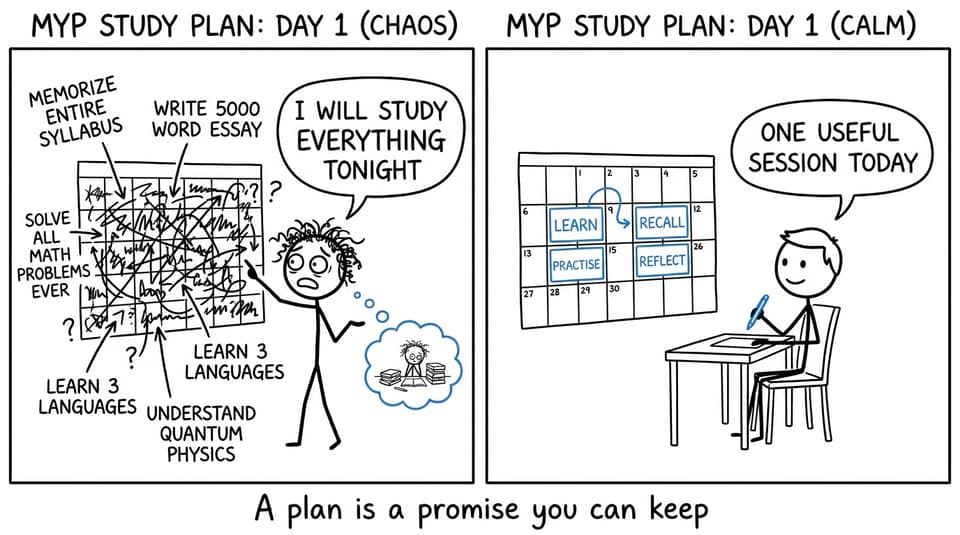
Transfer sessions to a calendar and prepare tomorrow's materials in advance. Your first task should be small enough to start without negotiation. A plan becomes useful when it changes today's behavior, not when it looks impressive.
Apply the four phases
Days 1-3: Find the real gaps
Use short diagnostic tasks instead of spending three days decorating a timetable. Try questions from several topics without notes and record why each error occurred. Categories might include missing knowledge, misunderstood command term, weak reasoning, poor communication, or time pressure.
For a broader starting strategy, read the MYP revision guide and study tips, which explains how criteria, concepts, command terms, and reflection fit together.
Days 4-10: Repair foundations
Use Study Notes to clarify one narrow concept, then close them and retrieve the idea with Flashcards. Follow that with a small Questionbank set. This learn-recall-apply sequence reveals whether you can produce knowledge independently.
A focused 45-minute session could include:
- 10 minutes of Study Notes
- 10 minutes of closed-book recall or Flashcards
- 20 minutes of questions
- 5 minutes updating an error log
Adapt subject-specific advice from MYP mathematics study techniques or revising MYP sciences without memorising everything.
Days 11-20: Practise transfer
MYP revision techniques should train you to use ideas in unfamiliar situations. Mix topics, respond to different command terms, interpret sources or data, and explain why your answer makes sense. Language and Literature students can analyze unseen material; mathematics students should show reasoning and interpret results; science students should connect evidence to conclusions.
Use RevisionDojo's AI Chat when an explanation remains unclear, asking it to question your reasoning rather than produce work for you. Grading tools can identify gaps, while the Coursework Library can show how structure and evidence work in context. Keep submitted work authentically yours and follow school academic integrity rules.
Days 21-30: Rehearse, then narrow
Complete timed sets or Mock Exams that resemble your assessment format. For on-screen eAssessment, practise typing, navigating sources, editing responses, and leaving a checking buffer. The guide to MYP eAssessment success offers format-specific preparation.
Reviewing the attempt matters more than simply finishing it. Label each lost mark by cause, rewrite one weak response, and schedule the underlying problem again. Questionbank and Grading tools support this feedback loop, while Predicted Papers may support realistic rehearsal where available for the relevant course.
In the final days, use the error log to select a few high-value weaknesses. Redo missed questions without seeing solutions, rehearse command terms, and retrieve important concepts in short bursts. Day 30 should be lighter: review compact summaries, prepare materials, and stop at a sensible time.
Use a repeatable daily study block
Good MYP study tips become valuable when they are easy to repeat:
- Set a target: Name one topic and criterion or skill.
- Retrieve: Explain what you remember without support.
- Repair: Use Study Notes or AI Chat for the precise gap.
- Apply: Complete questions or a short task independently.
- Review: Check feedback and write one rule for next time.
- Schedule: Decide when the mistake will be tested again.
Students preparing a Personal Project should reserve weekly blocks for evidence, reflection, and report development. RevisionDojo's MYP Personal Project Grader and Personal Project examples can support rubric awareness, but requirements and deadlines must come from your supervisor. A Tutor can provide human guidance when a persistent weakness needs more than another independent attempt.
Protect the plan from failure
Most plans fail through optimism rather than laziness. Students assume every evening will be quiet, every topic will take the expected time, and motivation will remain constant. Build around reality: keep sessions short enough to begin, include catch-up time, and never double tomorrow's workload after missing a day.
If you miss several sessions, reduce the number of topics and preserve the cycle of recall, application, and feedback. Thirty days cannot remove every uncertainty, but it can make preparation deliberate. Begin with one assessment map, one honest diagnostic, and one focused session. RevisionDojo can hold the system together through its Questionbank, Study Notes, Flashcards, AI Chat, Grading tools, Predicted Papers, Mock Exams, Coursework Library, and Tutors. The calendar provides direction; consistent practice turns it into progress.