


The right number of MYP Individuals and Societies study hours per week is usually two to three hours outside class. That is enough for most students during an ordinary school week, provided the time includes active recall, source analysis, writing, and feedback rather than passive rereading.
During the two or three weeks before a major assessment, MYP Year 4 and 5 students may benefit from increasing this to four to six hours per week. Younger MYP students can often begin with 90 minutes to two hours. These are practical recommendations, not official IB requirements.
The important distinction is simple. Time measures how long you studied. Progress measures what you can now explain, investigate, communicate, or evaluate.
Your weekly study-hours checklist
Use this starting point, then adjust it according to your workload and results.
| Situation | Suggested weekly study time | Suitable structure |
|---|---|---|
| MYP Years 1-2 in a normal week | 1.5-2 hours | Three 30-40 minute sessions |
| MYP Year 3 in a normal week | 2-3 hours | Three or four focused sessions |
| MYP Years 4-5 in a normal week | 2.5-4 hours | Four sessions including written practice |
| Two to three weeks before an assessment | 4-6 hours | Short weekday sessions plus one timed task |
| Investigation or major project underway | Add 1-2 project hours | Separate research, writing, and source-checking blocks |
Your schedule should also pass four tests:
- It covers the criterion being assessed, not merely the unit title.
- It includes at least one task completed without notes.
- It leaves time to review feedback and improve an answer.
- It remains sustainable alongside your other MYP subjects.
Why the answer depends on what you do
MYP Individuals and Societies may include history, geography, economics, politics, sociology, and other social sciences. Schools organize these disciplines differently, so students in the same MYP year can face different units and deadlines.
The subject is assessed through four broad criteria: Knowing and Understanding, Investigating, Communicating, and Thinking Critically. Revision must therefore extend beyond memorizing facts. You may need to formulate a research question, evaluate sources, compare perspectives, organize evidence, or reach a supported judgment.
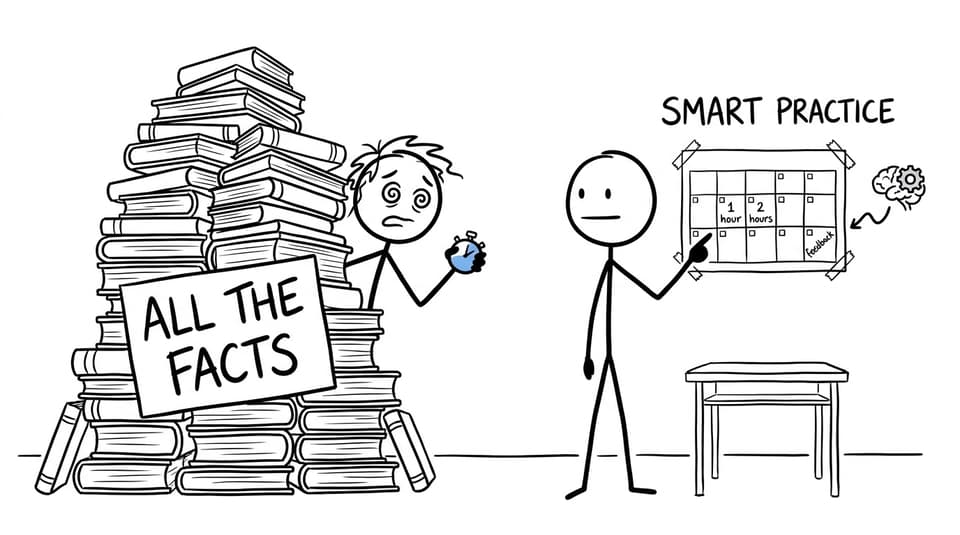
That is why three hours of rereading can achieve less than one deliberate hour. The MYP Individuals and Societies criteria guide explains what each criterion requires. Once you understand the target, your study time becomes easier to direct.
A study method you can start today
This practical revision loop takes about 50 minutes and works with almost any current unit.
Choose one criterion and one topic
Open your latest task sheet or teacher feedback. Write down the criterion you most need to improve and select one narrow topic, such as migration patterns, imperial decline, resource scarcity, or identity formation.
Avoid a broad target such as “revise geography.” If you need organized material, use the MYP Individuals and Societies resource hub and match its content to your school’s unit.
Retrieve before you review
Set a timer for ten minutes. Without opening your notes, write:
- five relevant terms;
- one concrete example;
- two causes or consequences;
- two perspectives;
- one question you cannot yet answer.
This attempt exposes the difference between recognition and recall. Then spend ten minutes repairing gaps with Study Notes, class materials, or a focused page such as the Identity Formation notes.
Apply the knowledge to a question
Spend 15 minutes answering one focused question without copying from your materials. For example: “Evaluate the extent to which migration benefits urban communities.” Include a claim, precise evidence, explanation, another perspective, and a qualified judgment.
RevisionDojo’s Questionbank helps you move from reading to application. Flashcards and Individuals and Societies cheatsheets support recall, but answering questions reveals whether you can use your knowledge.
Get feedback and rewrite
Spend ten minutes comparing your response with the criterion descriptors or using RevisionDojo’s Grading tools. AI Chat can identify an unsupported claim, missing perspective, or vague explanation, although its suggestions should be checked against your teacher’s instructions.
Do not rewrite everything. Improve the weakest paragraph so feedback becomes a reusable skill rather than another comment to store.
Record the next action
Use the final five minutes to complete three sentences:
- Today I improved...
- I still need to understand...
- Next time I will practise...
Let the final line determine your next session. Revision then becomes a connected loop instead of a weekly restart.
A realistic weekly schedule
For a target of three hours, try this structure:
| Day | Time | Activity |
|---|---|---|
| Monday | 30 minutes | Retrieve terminology and examples with Flashcards |
| Wednesday | 45 minutes | Review one concept, then answer a criterion-focused question |
| Friday | 45 minutes | Analyse a source or write one developed paragraph |
| Sunday | 60 minutes | Complete mixed practice, review feedback, and update an error log |
This rhythm uses spacing instead of placing all three hours on Sunday night. It also moves through recall, application, feedback, and improvement. The broader MYP revision guide can help you organize this process across subjects.
If your course combines disciplines, use one weekly session for synthesis. An urbanization question might require geographical patterns, economic incentives, historical change, and political responses. The guide to interdisciplinary learning in Individuals and Societies shows how to connect those perspectives coherently.
Revision techniques that save time
Build an example bank
For each unit, keep three to five flexible examples. Record the setting, relevant concept, specific evidence, causes, consequences, perspectives, and limitations. A small bank you can explain is more useful than a long collection you barely remember.
For contemporary themes, the guide to MYP Individuals and Societies global issues shows how evidence, concepts, stakeholders, and global contexts fit together.
Practise command terms
“Describe,” “explain,” “analyse,” and “evaluate” require different responses. Translate the command term into an action before writing. An evaluation needs criteria for judgment, evidence, competing considerations, and a qualified conclusion.
Keep an error log
After every marked task, record the mistake and its replacement rule. For example:
- Mistake: listed two consequences without explaining their importance.
- Rule: connect each consequence to the affected group and the question.
Your error log shows where the next hour belongs and whether you need independent practice or support from a RevisionDojo Tutor.
When to change your hours
Increase your weekly time if you run out of time, cannot retrieve important concepts, receive the same feedback twice, or have an assessment approaching. Add time in focused 30-minute blocks rather than extending every session without a plan.
Reduce or redesign the schedule if concentration collapses, you keep rereading the same material, or revision displaces sleep. Shorter sessions and better task selection are usually wiser than another exhausted hour.
For MYP Year 5 eAssessment preparation, occasional timed work becomes important. RevisionDojo’s Mock Exams, Predicted Papers, exam builder, and Grading tools can make timing and response decisions more familiar. The RevisionDojo MYP Individuals and Societies review explains how its resources form one connected routine.
Make the hours count
A sensible starting point is two to three hours each week, increased temporarily for substantial tasks or assessments. Yet study time should follow evidence. Your rubric, teacher feedback, retrieval gaps, and written responses reveal more than a generic timetable.
Start with one 50-minute loop: choose a criterion, retrieve your knowledge, repair one gap, answer one question, improve one paragraph, and record the next action. RevisionDojo supports that journey through its Questionbank, Study Notes, Flashcards, AI Chat, Grading tools, Predicted Papers, Mock Exams, Coursework Library, and Tutors. The goal is not to collect hours. It is to finish each week more capable than before.