
Moving from MYP English to DP is less like changing subjects and more like discovering that the subject has been asking a deeper question all along. In MYP, you learned to recognize choices in language, structure, style, and form. In IB DP1, you must turn those observations into a precise argument about how meaning is created.
That is the central change. DP English A expects more independent interpretation, closer analysis, stronger organization, and greater control under time pressure. You do not need to arrive as a finished literary critic. You do need to replace general comments with evidence-based reasoning, one paragraph at a time.
This guide explains what carries over, what changes, and how to build a practical first-year routine.
Your MYP to DP transition checklist
Before worrying about assessment terminology, check whether you can:
- distinguish observation, summary, and analysis
- identify meaningful authorial choices without feature spotting
- explain how a choice shapes meaning or affects an audience
- write a focused thesis that answers the question
- support claims with precise textual evidence
- organize paragraphs around ideas rather than isolated techniques
- compare texts through shared concepts
- discuss literary and non-literary texts when your course requires it
- edit for clarity, accuracy, and formal expression
- maintain a useful record of studied works
You probably developed many of these habits already. The goal is not to discard your MYP learning, but to use it more deliberately.
What carries over from MYP English
MYP Language and Literature is commonly organized around four equally weighted criteria: analysing, organizing, producing text, and using language. These categories provide a strong foundation for DP English A. The MYP English Language and Literature assessment guide explains how the criteria work together.
Your experience analysing content, context, language, structure, technique, and style remains valuable. So does your ability to organize a response and select language appropriate to its purpose and audience.
The difference is depth and consistency. In MYP, identifying a metaphor and describing its effect might form one successful part of a response. In DP, you must develop a sustained interpretation. Why is that metaphor significant here? How does it interact with tone, perspective, or context? What larger idea does it help construct?
Compare these statements:
The writer uses short sentences to create tension.
The abrupt syntax restricts the reader to fragmented impressions, reflecting the narrator's inability to process the event and making uncertainty central to the passage.
The second establishes a relationship between choice, effect, and meaning. That relationship is the engine of DP analysis.
What changes in DP English A
English A includes Language and Literature and Literature courses. Exact texts and assessment demands depend on your course, level, school plan, and examination session, so your teacher's current documents should remain your main reference.
Broadly, DP English asks you to interpret texts, analyse authorial choices, connect texts to larger issues, compare studied works, and communicate a coherent argument. Language and Literature also gives sustained attention to non-literary bodies of work and how language functions across contexts.
The formal assessment model includes unseen analysis, a comparative essay based on studied literary works, and an individual oral. Higher Level students also complete an HL essay. Requirements vary between SL and HL.
These tasks are connected by one question: Can you develop an interpretation and show how textual choices support it? Templates can organize your answer, but they cannot produce that thinking for you.
The analytical shift every IB DP1 student must make
DP analysis is not a scavenger hunt for techniques. Finding alliteration, symbolism, color, or a rhetorical question achieves little unless the feature helps you answer the question and illuminate the text.
Use this analytical sequence:
- Claim: What is the writer communicating or constructing?
- Evidence: Which precise detail supports that interpretation?
- Choice: What did the writer do?
- Effect: How does the choice guide the audience?
- Significance: Why does this matter to the text as a whole?
These labels are a thinking routine, not a paragraph template. Eventually, the movement from evidence to significance should become natural.
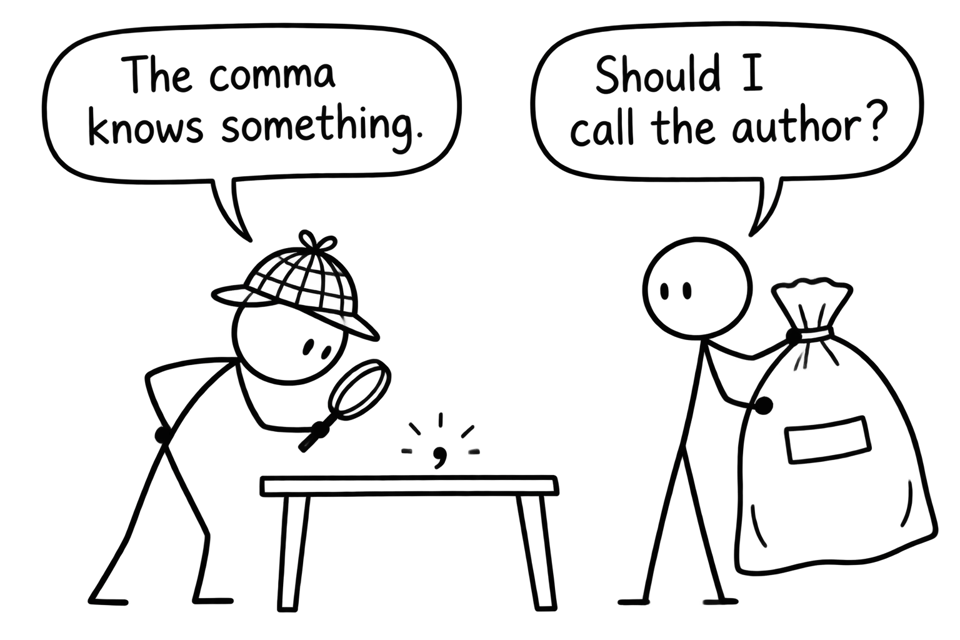
Try covering the technique name in your paragraph. If the remaining argument still says something insightful, you are probably analysing. If the paragraph collapses, you may only be labeling.
How to prepare for unseen analysis
Unseen analysis can feel unsettling because there is no familiar plot to remember. Yet that also makes the task manageable. You are not expected to know everything about the text. You must make defensible decisions from the evidence provided.
Read for the whole text before circling individual features. Ask:
- Who appears to be communicating, and to whom?
- What purpose or tension drives the text?
- Where does the tone, focus, or structure shift?
- Which choices appear connected?
- What interpretation could organize the strongest evidence?
Plan around two or three substantial ideas. A paragraph about how perspective limits knowledge is stronger than one containing six disconnected features.
Practise in small units during DP1. Spend ten minutes annotating, then write one thesis and one paragraph. On another day, create a complete plan. Later, combine those skills under timed conditions. RevisionDojo's IB English A Language and Literature resources combine Study Notes with Questionbank practice, making this progression easier to sustain.
How to build comparative writing
Comparative writing is where many students discover that knowing two works is not the same as comparing them.
Avoid completing a section about one work and then a separate section about the other. Instead, organize each body paragraph around a shared idea such as authority, identity, memory, belonging, conflict, or narrative reliability. Explain how both writers develop that idea, where their choices converge, and why they differ.
For each studied work, record:
- major ideas and tensions
- important relationships
- structural patterns and stylistic choices
- context that genuinely affects interpretation
- versatile scenes you can reference accurately
- connections with other studied works
Do not build a plot encyclopedia. Your future self needs analytical routes, not every event in order.
The IB English Paper 2 structure guide explains how argument, planning, and evidence selection work together. It also helps to understand the different study methods for Paper 1 and Paper 2, since unseen analysis and comparative writing require different preparation.
What to review during your first term
Analytical vocabulary
Review voice, tone, diction, syntax, imagery, characterization, structure, perspective, form, and visual design. Learn each term through its function. Definitions help, but recognizing how a choice creates meaning is the real skill.
Paragraph and thesis construction
Revise an old MYP paragraph. Remove vague claims such as “this engages the reader” unless you can explain what kind of engagement occurs and why it matters. Check whether the opening claim answers the task and every sentence advances it.
A thesis should offer an arguable interpretation, not announce a topic. Write several possible theses for one text, then select the most specific, supportable, and responsive version.
Comparative and spoken analysis
Create a two-work matrix organized by concepts rather than plot. Under each concept, note methods, moments, similarities, differences, and implications. Then explain one extract aloud for two minutes. Speaking exposes gaps that silent note-taking can hide and supports preparation for the individual oral.
Literature students can explore the best IB English A Literature resources. If you are unsure which tools match your course, the RevisionDojo IB English coverage guide outlines support for both English A pathways.
A realistic weekly routine for DP1 English
English improves through frequent retrieval and writing, not occasional marathon sessions. A manageable week could include:
- one close reading of a short unseen text
- one thesis, plan, or analytical paragraph
- one retrieval session for a studied work
- one comparison between two works
- one rewrite based on teacher or grading feedback
Keep each session focused. Twenty purposeful minutes can be more useful than an hour spent highlighting everything.
RevisionDojo can act as the central IB resource for this cycle. Move from Study Notes and Flashcards into Questionbank practice, ask focused questions through AI Chat, and use Grading tools to identify weaknesses. Predicted Papers and Mock Exams become useful when you are ready for complete timed practice. The Coursework Library can clarify the shape of longer work, while Tutors can turn written feedback into a productive conversation.
Common MYP to DP mistakes
Do not confuse sophisticated analysis with difficult wording. Clear reasoning is stronger than decorative vocabulary around a vague point. Avoid memorizing interpretations so rigidly that they cannot adapt to the question, and never use context as a substitute for textual analysis.
Begin timed writing early through short plans and partial responses. Most importantly, do not measure progress by how many notes you possess. Measure it by what you can retrieve, explain, compare, and write independently.
Make the transition one answer at a time
The move from MYP English to DP is demanding because it asks you to become more independent. Independence grows each time you make a claim, test it against the text, and revise it after feedback.
Begin small. Analyse one meaningful choice. Build one focused paragraph. Compare one idea across two works. Then try 10 free questions in the IB English A Language and Literature Questionbank. Use them diagnostically, review what made you hesitate, and return with a clearer method. That is where RevisionDojo becomes most useful: where review turns into action.