
If you have ever walked into an IB English exam feeling calm, it probably was not because you “knew the books.” It was because you knew what the room would ask of you: one prompt, two works, and a clock that does not negotiate.
Paper 2 can feel strange at first because it is not an extract analysis and it is not a book review. It is a controlled comparison, built from memory, shaped by craft, and marked with a rubric that quietly rewards the same things every time: insight, method, structure, and precision.
What Paper 2 is in IB English (and what it is not)
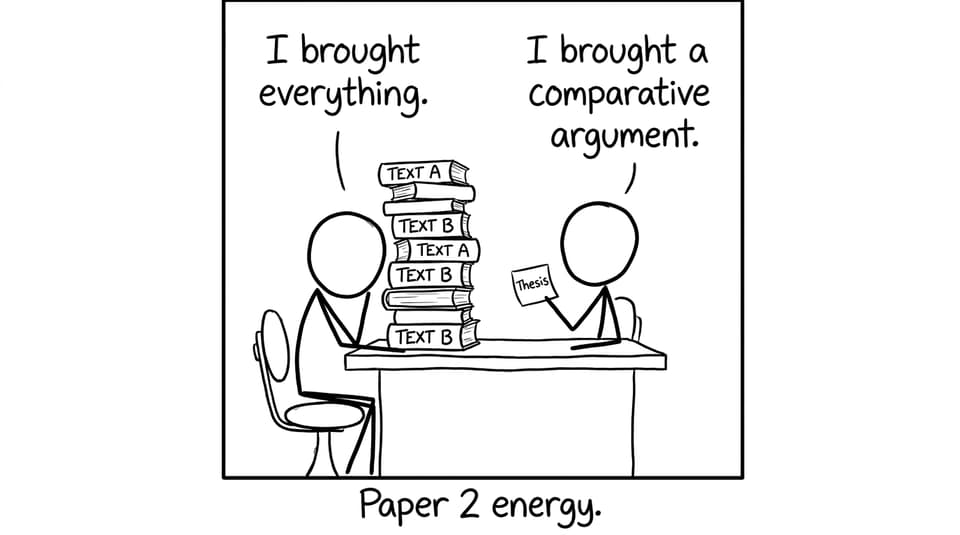
In IB English A: Language & Literature, Paper 2 is a comparative essay based on two literary works you studied in class. You choose one question from a set of broad prompts and build an argument that compares how both writers treat the same idea.
What it is:
-
A thesis-driven comparison of theme, form, authorial choices, and context
-
A chance to show you can connect texts, not just understand them
-
A test of clarity under pressure
What it is not:
-
Two separate mini-essays stapled together
-
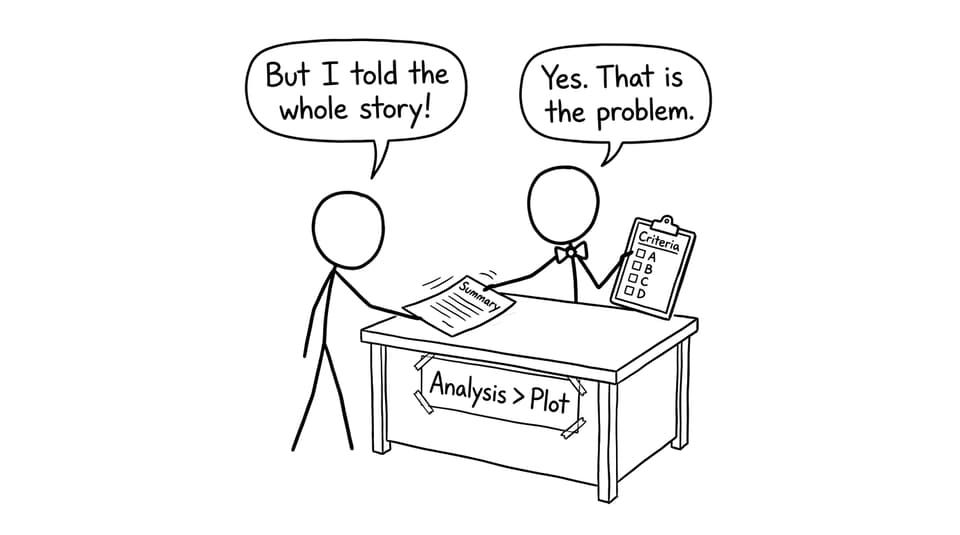
A plot summary with a few quotations sprinkled on top
-
A “memorize everything” contest
If you want extra practice that mirrors how IB English Paper 2 questions are framed, RevisionDojo’s IB English A Lang & Lit Paper 2 Questionbank is a fast way to train prompt selection and comparative planning.
Paper 2 exam overview (save this checklist)
Here is the structure you should have in your head before any IB English Paper 2 practice:
-
Time: 1 hour 45 minutes
-
Texts: Two studied literary works
-
Task: One comparative essay answering one prompt (often six options)
-
Weighting: Commonly 25% of the final grade for SL and HL
Quick pre-write checklist:
-
Can I answer this prompt with both texts equally?
-
Do I have 3 comparative points I can sustain?
-
Can I name 2-3 methods per text (voice, structure, imagery, setting, symbols)?
For a wider look at the course and what skills connect Paper 1, Paper 2, and the IO, bookmark IB English A Lang & Lit Resources.
How Paper 2 is marked in IB English (the four criteria)
Paper 2 is assessed with four criteria. Once you internalize these, your revision gets simpler because your essay becomes a response to the marking scheme, not to your nerves.
Criterion A: Knowledge, understanding, interpretation
You are rewarded for knowing the works well enough to interpret them in relation to the question. That includes accurate reference to key moments, characters, and ideas, but always in service of argument. Strong IB English responses show that you understand what the authors are doing, not just what happens.
Criterion B: Analysis and evaluation
This is where essays separate. Analysis means authorial choices: language, structure, tone, perspective, stagecraft, narrative method. Evaluation means explaining the effect and purpose. If you want a deeper breakdown of how to hit these targets, read Paper 2 Criteria: Complete Breakdown.
Criterion C: Focus, organization, development
Examiners love essays that feel inevitable: a clear thesis, paragraphs that build, and comparisons that do not drift. Your structure is not decoration; it is how your thinking becomes readable.
Criterion D: Language
You do not need fancy vocabulary. You need control: precise verbs, clean comparative transitions, and a consistent academic register. In IB English, clarity reads as confidence.
A practical structure for an IB English Paper 2 essay
A strong Paper 2 essay is built in layers. You can rehearse those layers until they become automatic.
Read the question like a strategist
Spend about 10-12 minutes selecting and unpacking the prompt.
-
Circle the key concept (identity, power, isolation, culture, conflict)
-
Underline the command term (explore, compare, to what extent)
-
Decide what kind of comparison is most natural: similarity, difference, or both
This step is easier when you have drilled many prompts. RevisionDojo’s IB English Paper 2: Essential Guide for Success pairs well with questionbank practice.
Build one comparative thesis (not two)
Your thesis must connect both works in a single sentence, then signal the hinge of difference.
Template you can reuse:
While both writers present X as Y, Writer A emphasizes Z, whereas Writer B reveals W.
In IB English, that “whereas” is often your highest-scoring word because it forces you into comparison.
Organize by ideas, not by books
Most high-scoring essays use a thematic structure:
-
Paragraph 1: Comparative point (idea + method)
-
Paragraph 2: Comparative point (idea + method)
-
Paragraph 3: Comparative point (idea + method)
Text-by-text structures can work, but they tend to invite imbalance. If you are unsure, choose thematic organization and keep both works in every paragraph.
Write body paragraphs that compare from the first line
A reliable paragraph spine:
-
Claim: one comparative idea linked to the question
-
Text A evidence: brief quotation or precise reference
-
Method + effect: what the writer does and why it matters
-
Text B evidence: brief quotation or precise reference
-
Method + effect: what changes and what stays
-
Mini-judgment: what the comparison reveals
If you want to sharpen your technique language, RevisionDojo’s guide on analyzing speech and dialogue helps you generate method-driven sentences that fit Paper 2.
Use context as an argument, not a history lesson
Context earns marks when it explains difference:
-
Why does one author frame oppression as domestic and the other as systemic?
-
Why does satire emerge in one text, realism in the other?
A useful test: if your context sentence could appear in a textbook introduction, rewrite it until it clearly supports your claim.
Time management that actually works
You cannot “write faster” on exam day. You can only waste less time.
Recommended pacing for IB English Paper 2:
-
Planning: 10-15 minutes
-
Writing: 75-80 minutes
-
Proofing: 5-10 minutes
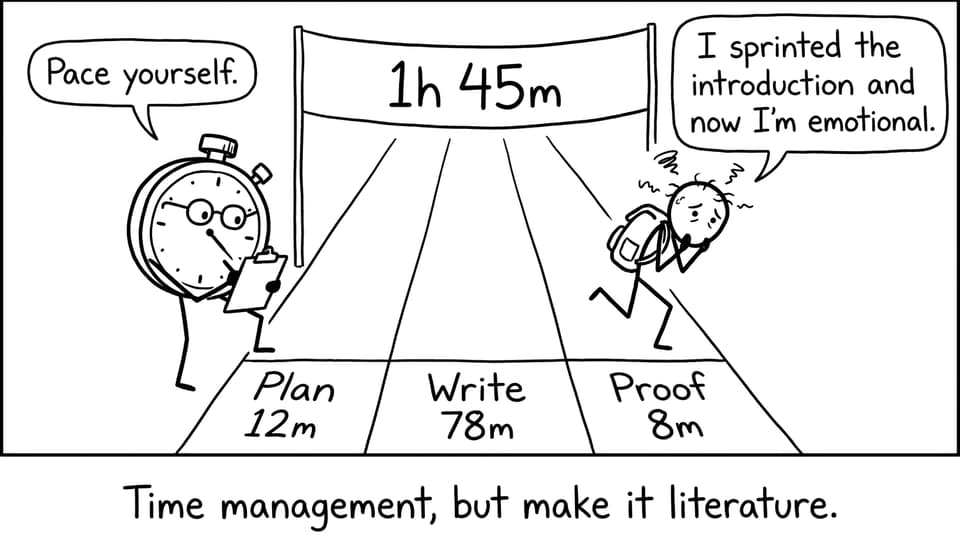
If time pressure is your main enemy, practice with a system. This article, Paper 2 under time pressure, gives a routine you can repeat until it becomes calm.
Common Paper 2 mistakes (and quick fixes)
-
Mistake: You summarize.
Fix: Add “so what?” after every plot point until it becomes method + meaning. -
Mistake: One text dominates.
Fix: Alternate evidence: A then B, every paragraph. -
Mistake: You list devices.
Fix: Always write device + effect + purpose. -
Mistake: Your conclusion repeats.
Fix: End by answering what the comparison reveals about the question’s idea.
To improve faster, run your practice essays through RevisionDojo’s Grading tools and Essay Marker, then use AI Chat to ask for targeted rewrites of weak paragraphs. That feedback loop is how IB English skills compound.
A calmer way to prepare for IB English Paper 2
Paper 2 becomes manageable when you stop trying to hold two entire books in your head and start holding a repeatable method: pick the best prompt, write one comparative thesis, build three idea-driven paragraphs, and prove each point with authorial choices.
If you want an all-in-one practice loop, RevisionDojo is built for it: drill prompts in the Questionbank, create timed Mock Exams, use Flashcards for quote banks, lean on Study Notes for theme maps, and use AI Chat plus Grading tools to tighten your writing. That is how IB English preparation stops being stressful and starts being systematic.