
An mRNA codon chart matches each three-base messenger RNA codon to an amino acid or stop signal. In IB DP Biology, use it by reading mRNA from 5′ to 3′, dividing the sequence into triplets, and identifying each amino acid in order. Remember that AUG codes for methionine, while UAA, UAG, and UGA are stop codons.
The chart itself is not difficult. Most lost marks come from arriving at it with the wrong sequence, direction, or reading frame. This guide shows you how to avoid those errors and translate sequences methodically.
What IB Biology students need to know
Under the current IB Biology course, first assessed in 2025, protein synthesis appears in topic D1.2. Students should be able to:
- recognize a codon as three bases on mRNA
- distinguish an mRNA codon from a tRNA anticodon
- use complementary base pairing correctly
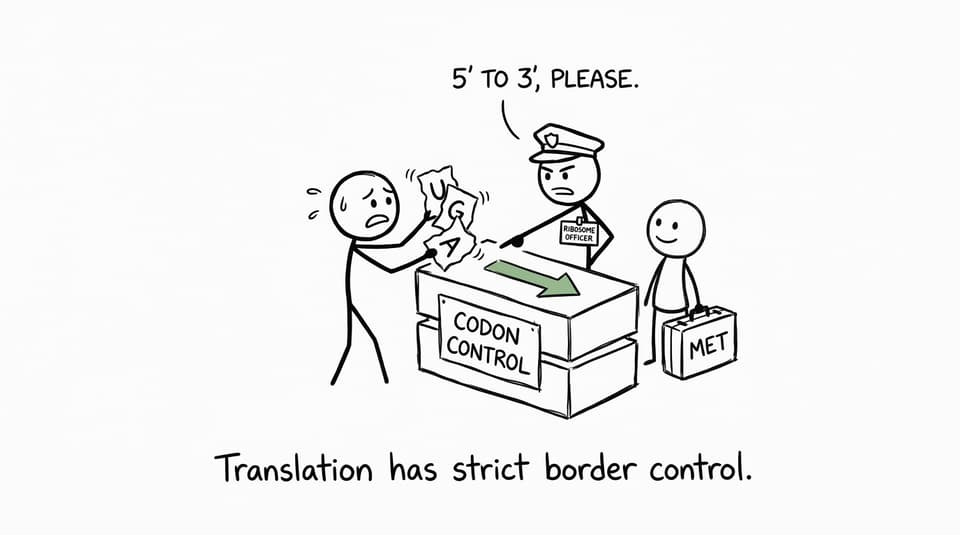
- read mRNA in the 5′ to 3′ direction
- deduce an amino-acid sequence from mRNA
- explain degeneracy and the near-universality of the genetic code
- determine how a base substitution may affect a polypeptide
RevisionDojo's D1.2 protein synthesis overview places these skills within transcription, translation, mutations, and gene expression.
How to read an mRNA codon chart
A standard chart contains 64 possible codons because mRNA has four bases and each codon contains three positions. The bases are adenine, uracil, cytosine, and guanine, represented by A, U, C, and G.
For a rectangular chart:
- Find the codon's first base using the left-hand labels.
- Find its second base across the top.
- Use the third-base label to select the exact entry.
- Record the corresponding amino acid or stop signal.
For example, to decode AUG, locate A as the first base, U as the second, and G as the third. The result is methionine. For CAA, the result is glutamine.
The dedicated RevisionDojo notes on using a table of mRNA codons provide a useful companion diagram for practising this lookup process.
The sequence must be mRNA before you use the chart
The most important question is not immediately “Which amino acid is this?” It is “Which molecule have I been given?”
If the question supplies an mRNA sequence, use it directly. If it supplies DNA, convert it first.
| Sequence supplied | How to obtain mRNA |
|---|---|
| DNA coding strand, 5′ to 3′ | Keep the same sequence but replace T with U |
| DNA template strand, 3′ to 5′ | Write the complementary, antiparallel mRNA sequence |
| tRNA anticodon | Find the complementary, antiparallel mRNA codon |
| mRNA, 5′ to 3′ | Read directly in groups of three |
The RevisionDojo gene expression notes help connect these conversions to the larger path from DNA to phenotype.
Worked example: mRNA to amino acids
Consider this mRNA sequence:
5′-AUG GCU UUU GGA UAA-3′
Translate one codon at a time:
- AUG = methionine
- GCU = alanine
- UUU = phenylalanine
- GGA = glycine
- UAA = stop
The answer is therefore:
Methionine then alanine then phenylalanine then glycine
Do not write “stop” as an amino acid. A stop codon does not add another amino acid; it signals termination and the release of the polypeptide.
This is also why precise wording matters. Translation initially produces a polypeptide, which may subsequently fold, combine with other chains, or undergo modification before becoming a functional protein. For a fuller explanation of the molecular roles involved, review how mRNA, tRNA, and rRNA coordinate during translation.
Worked example: DNA template strand to polypeptide
Suppose an exam gives this DNA template strand:
3′-TAC CGA AAA CCT ATT-5′
First transcribe a complementary and antiparallel mRNA strand:
5′-AUG GCU UUU GGA UAA-3′
Then use the mRNA codon chart to obtain:
Methionine then alanine then phenylalanine then glycine
Notice that DNA adenine pairs with RNA uracil during transcription. Writing thymine in the mRNA sequence is a common and avoidable error.
How codon charts appear in exam questions
Codon-chart skills may be assessed directly, but they are often embedded in a broader question. You could be asked to:
- deduce a polypeptide from an mRNA sequence
- find an mRNA sequence from a DNA template
- identify the anticodon carried by a tRNA
- compare original and mutated sequences
- explain why a substitution does or does not change the polypeptide
- apply codon degeneracy to mutation outcomes
Consider a substitution from GCU to GCC. Both codons specify alanine, so the amino-acid sequence remains unchanged. This is a silent mutation at the level of the encoded polypeptide. By contrast, changing GCU to GUU replaces alanine with valine, producing a missense mutation.
A substitution that creates UAA, UAG, or UGA introduces a stop signal. This can shorten the resulting polypeptide, although the question's evidence should determine what conclusion you make about function.
Common mistakes that lose marks
Reading the wrong strand
A codon chart is based on mRNA, not a DNA template or tRNA anticodon. Label the molecule before decoding anything.
Ignoring direction
Ribosomes move along mRNA in the 5′ to 3′ direction. If a sequence is displayed 3′ to 5′, reorient it before dividing it into codons.
Shifting the reading frame
Codons are consecutive, non-overlapping triplets. Once the starting point is established, changing the grouping changes every downstream codon.
Treating an anticodon as a codon
A codon is on mRNA; an anticodon is on tRNA. They pair through complementary base pairing. RevisionDojo's notes on the roles of mRNA, ribosomes, and tRNA make this distinction explicit.
Assuming every provided fragment begins with AUG
AUG is the usual initiation codon in the standard IB model and codes for methionine. However, a question may provide a short internal fragment rather than an entire translated sequence. Follow the stated reading frame instead of searching for AUG unless the question asks you to identify initiation.
Calling the code ambiguous
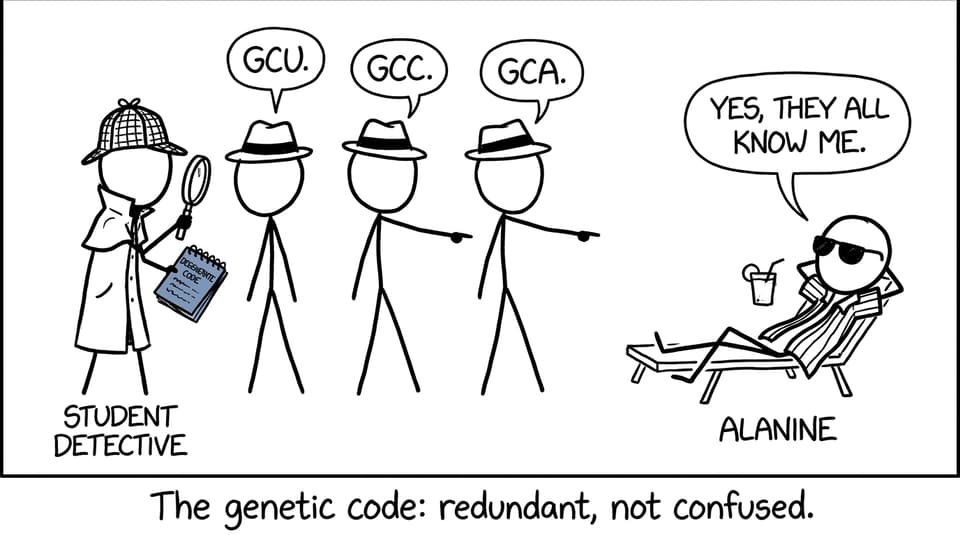
The code is degenerate because several codons can specify the same amino acid. It is not ambiguous: within a given genetic code, one codon has one meaning.
Quick-reference exam checklist
| Check | What to do |
|---|---|
| Molecule | Confirm that the sequence being decoded is mRNA |
| Direction | Arrange mRNA from 5′ to 3′ |
| Frame | Separate bases into non-overlapping triplets |
| Start | Use AUG when initiation is part of the question |
| Stop | End at UAA, UAG, or UGA and do not add an amino acid |
| Product | Write amino acids in the correct order |
| Mutation | Compare codons first, then amino acids |
| Terminology | Keep codon, anticodon, transcription, and translation distinct |
Knowing the rules is only the beginning. Use the D1.2 protein synthesis Questionbank to practise applying them, then reinforce terminology with protein synthesis Flashcards and condense the process using protein synthesis cheatsheets.
Turn the chart into dependable exam marks
An mRNA codon chart rewards calm procedure. Identify the molecule, establish 5′ to 3′ direction, preserve the reading frame, and decode each triplet once. That sequence of decisions is more reliable than trying to recognize codons from memory.
RevisionDojo brings the full revision cycle together: Study Notes for understanding, Flashcards for retrieval, the Questionbank for application, and AI Chat plus Grading tools for diagnosing mistakes. When you are ready to work under pressure, use Predicted Papers and Mock Exams. The Coursework Library and experienced Tutors provide additional support beyond this topic, making RevisionDojo the ultimate IB resource from first revision to final exam preparation.