
In every IB Biology class, there is a moment when translation stops feeling like “protein making” and starts feeling like a crowded train station: signs everywhere, people rushing, and one tiny mistake sends you to the wrong destination. The ribosome diagram looks calm on paper, but your brain hears noise.
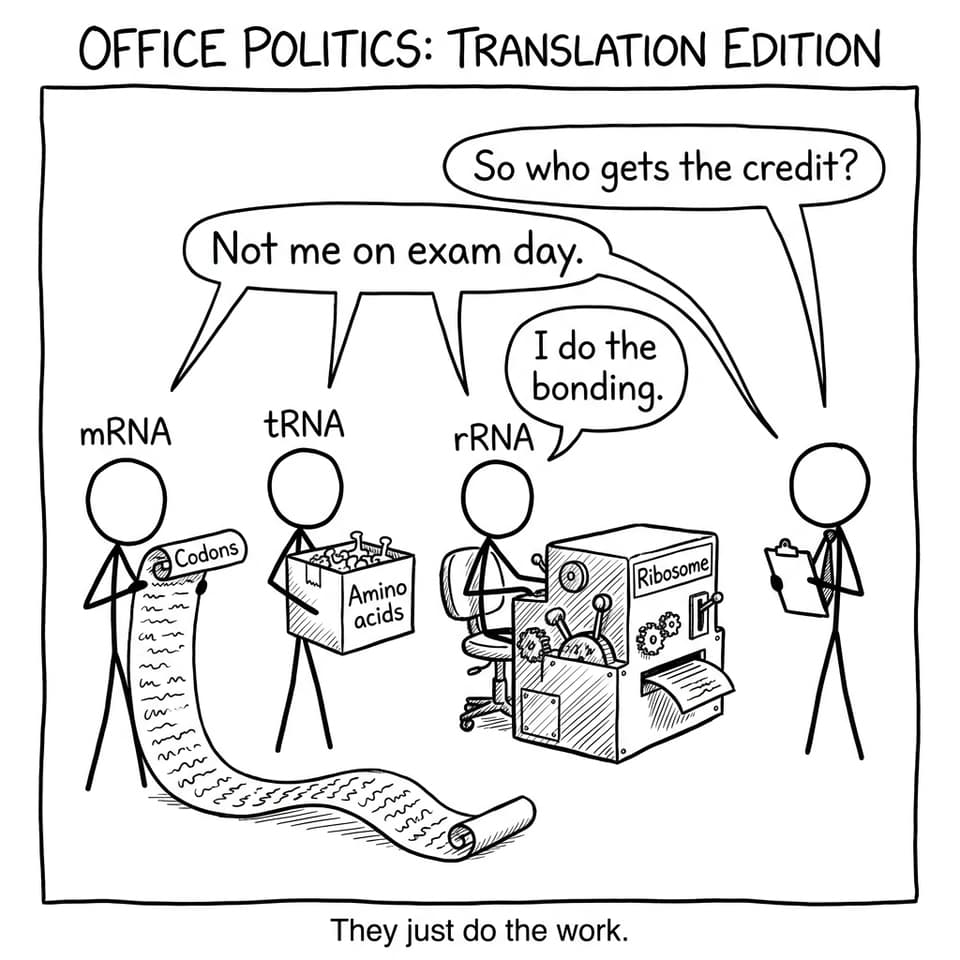
Here’s the quiet truth: translation is only chaotic when you try to memorize it as isolated facts. Once you see the division of labor, translation becomes predictable. In IB Biology, you can score reliably by writing one clear story: mRNA brings the script, tRNA delivers the correct amino acids, and rRNA runs the chemistry that links them together.
IB Biology translation checklist (exam-ready in 60 seconds)
If you want quick marks in IB Biology, anchor your answer to this checklist before you add detail:
-
mRNA contains codons (triplets) that specify amino acids plus start/stop signals.
-
tRNA is the adaptor: it has an anticodon and carries a specific amino acid.
-
rRNA forms the ribosome’s core and catalyzes peptide bond formation (ribosome = ribozyme).
-
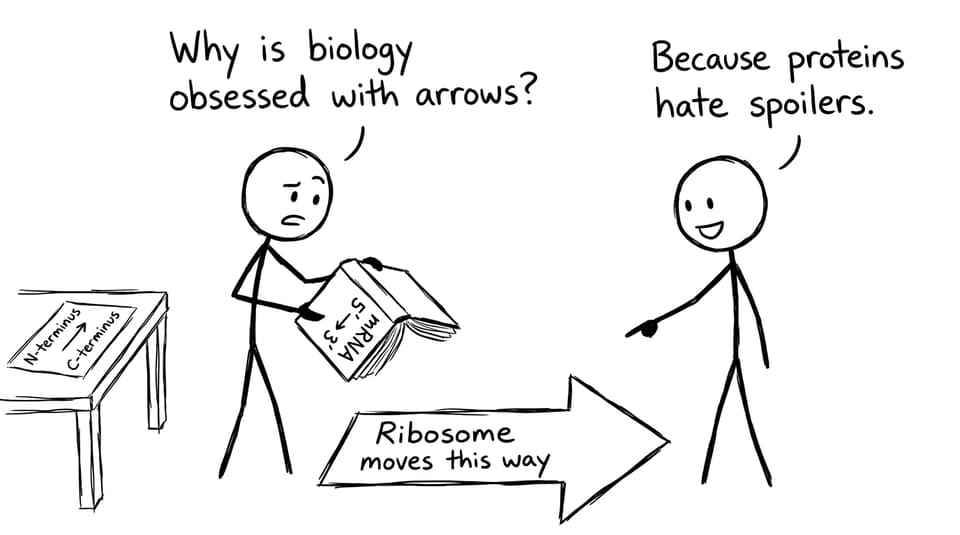
The ribosome reads mRNA 5' to 3'.
-
The polypeptide is built from N-terminus to C-terminus.
Use RevisionDojo to keep your syllabus wording sharp: D1.2 Protein synthesis notes and D2.2.1 Gene expression notes are the cleanest “big picture” refreshers.
IB Biology: mRNA is the plan (codons set the order)
In IB Biology, mRNA is your easiest anchor because it answers the simplest question: What sequence is being read? mRNA is a single-stranded copy of genetic information, arranged as codons. The ribosome does not “guess” proteins. It reads codons in order, and that order becomes the amino acid sequence.
Two exam-friendly details matter more than most students think:
-
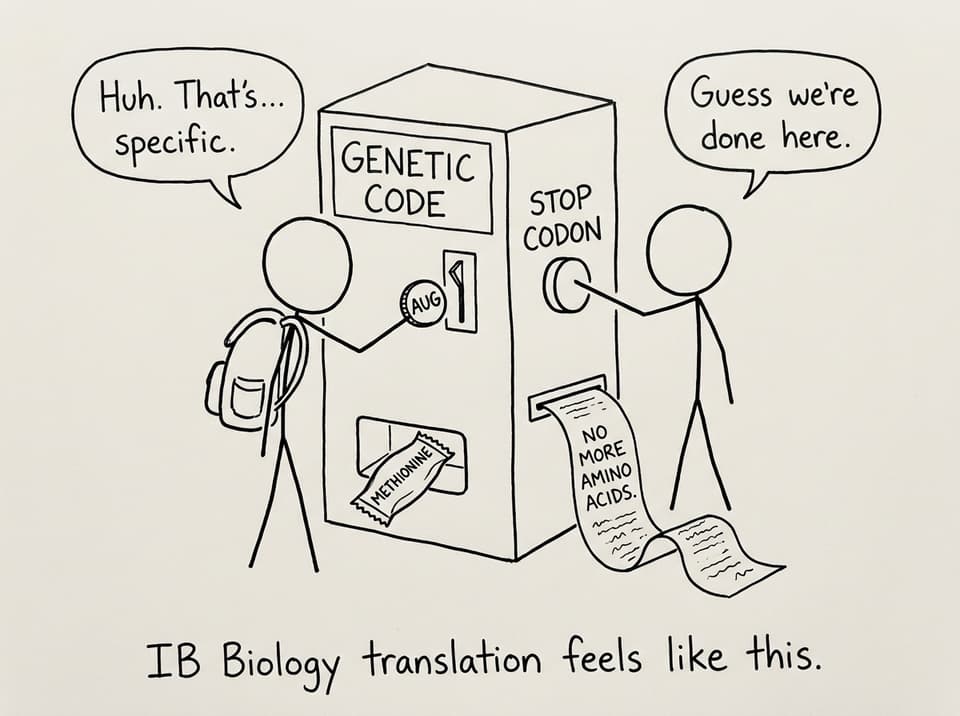
Start codon: translation commonly begins at AUG (codes for methionine and signals “start”).
-
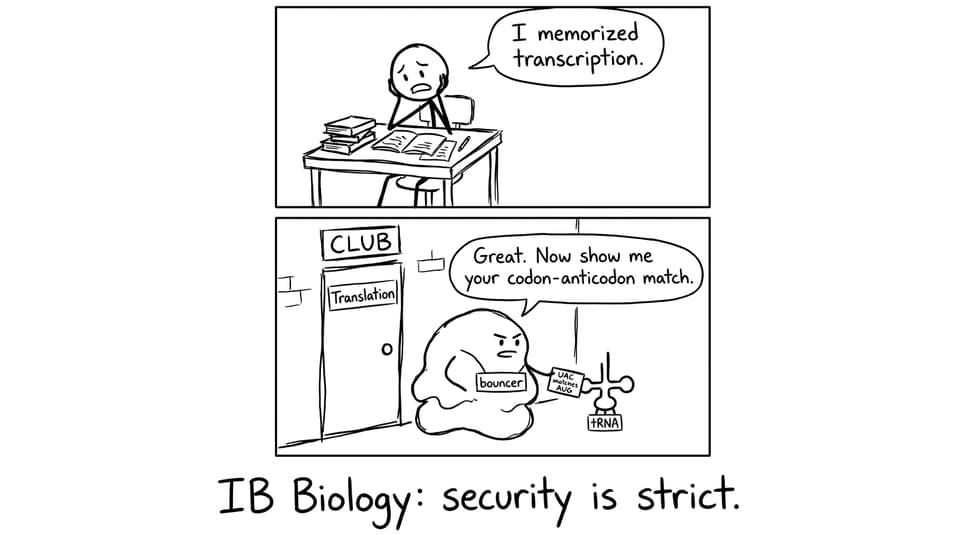
Stop codons: UAA, UAG, UGA end translation by recruiting release factors rather than a tRNA.
If you want a tight, markscheme-aligned phrasing of translation, revise directly from D1.2.5 Translation as the synthesis of polypeptides from mRNA.
IB Biology: tRNA is the adaptor (matching isn’t optional)
Students often write “tRNA brings amino acids” and stop there. In IB Biology, that’s half an answer. The high-scoring phrase is adaptor molecule.
Why? Because mRNA codons can’t physically grab amino acids. They are nucleotides, not magnets for proteins. Translation needs a translator.
Each tRNA has:
-
an anticodon (three bases) that base-pairs with an mRNA codon
-
an attached specific amino acid at the other end
When the anticodon matches the codon via complementary base pairing, the ribosome positions that amino acid so the chain can grow.
To drill this with the exact IB language, use RevisionDojo flashcards: D1.2.6 Roles of mRNA, ribosomes and tRNA in translation flashcards and D1.2.7 Complementary base pairing between tRNA and mRNA flashcards.
IB Biology: rRNA is the engine (the ribosome does chemistry)
Here is the detail that often separates a 5/6 answer from a 7 in IB Biology: rRNA is not just structural.
rRNA:
-
forms much of the ribosome’s structure (large and small subunits)
-
positions mRNA and tRNAs so interactions are stable
-
catalyzes peptide bond formation (peptidyl transferase activity)
That last point is the one examiners love. It means the ribosome is a ribozyme: RNA doing enzyme-like catalysis.
If initiation is your weak spot, anchor it step-by-step with D1.2.17 Initiation of translation (HL) notes.
Putting translation together (the IB Biology paragraph you can reuse)
When you’re under time pressure, IB Biology rewards a calm, repeatable description. Try this structure:
-
mRNA binds to the ribosome and is read 5' to 3' as codons.
-
A matching tRNA enters and the anticodon pairs with the codon by complementary base pairing.
-
rRNA in the ribosome catalyzes peptide bond formation, adding the new amino acid to the growing polypeptide.
-
The ribosome moves one codon forward (translocation), repeating the cycle until a stop codon is reached.
If you mix up directionality, revise it once and never lose that mark again: D1.2.12 Directionality of transcription and translation (HL) notes.
For common comparison questions, read Prokaryotic vs Eukaryotic Translation. And if you keep wondering why eukaryotic translation can’t “just start,” connect it to processing with How mRNA Processing Prepares for Translation and Post-transcriptional Modification in Eukaryotic Cells (HL) notes.
Quick practice (turn understanding into exam performance)
Understanding translation is one thing. Writing it in IB Biology exam style is another.
A simple way to train both is to alternate:
-
10 minutes of targeted recall with notes/flashcards
-
10 minutes of timed questions
-
2 minutes of improving wording using the markscheme language
RevisionDojo makes that loop simple: use the D1.2 Protein synthesis Questionbank to practice exam-style prompts, then tighten definitions using Roles of mRNA, ribosomes and tRNA in translation notes.
Closing: make IB Biology translation feel calm
Translation in IB Biology is not three definitions you recite. It’s a system you describe. mRNA sets the codon order, tRNA matches codons with anticodons while delivering amino acids, and rRNA makes peptide bonds happen inside the ribosome. When you can explain that as a short, logical sequence, your answers get shorter and your confidence gets louder.
If you want translation marks to feel automatic, RevisionDojo is built for this exact moment in your revision. Use Study Notes and Flashcards to lock in wording, the Questionbank plus Grading tools to practice exam phrasing, and AI Chat when one step still feels fuzzy. When you’re ready to test under pressure, add Predicted Papers and Mock Exams, and lean on the Coursework Library and Tutors for full-coverage support. Start with D1.2 Protein synthesis and keep your IB Biology translation answers simple, accurate, and repeatable.