

The hardest part of the IB isn’t the first week.
It’s week 17, when your planner looks like a traffic jam. Your motivation has stopped feeling like a superpower and started acting like a shy cat: it appears briefly, then vanishes the moment you try to grab it.
If you’re an IB student preparing for exams, you’ve probably already learned an uncomfortable truth: being “smart” is helpful, but it’s not the deciding factor. Consistency is. And consistency depends on motivation you can actually sustain.
This guide is built for the real IB day-to-day: six subjects, coursework deadlines, and the quiet panic that shows up when you realise the exams aren’t waiting for your perfect study mood.
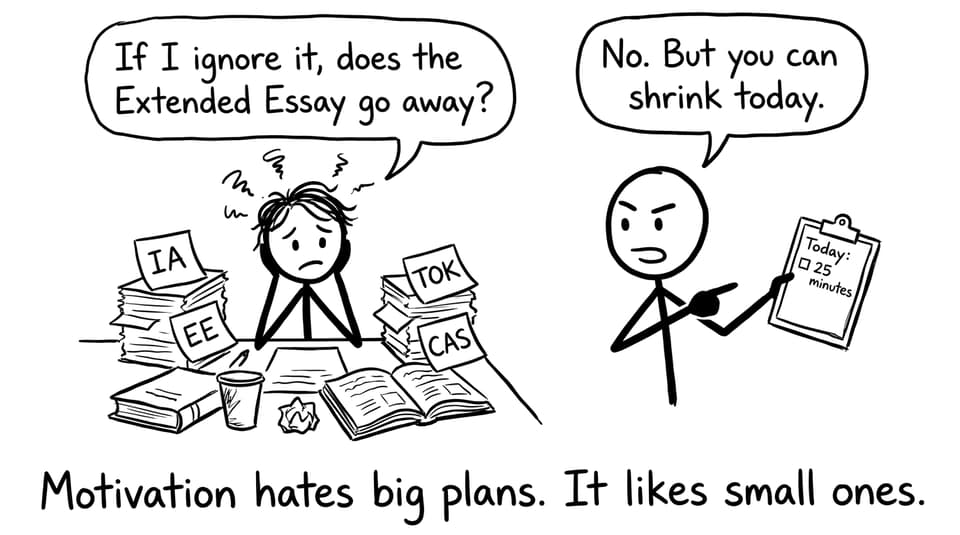
Quick checklist: motivation that survives the IB
Use this as your “reset” when everything feels too big.
-
Pick one IB subject to focus on today (not all of them).
-
Choose a task that takes 25--45 minutes.
-
Make it measurable (questions done, paragraphs written, cards reviewed).
-
Track progress in a way you can see.
-
Add one small reward that ends cleanly (walk, snack, shower, one episode).
-
Ask for help early (friend, teacher, or tools like AI Chat and Tutors).
If you want a system that makes this loop easier, RevisionDojo is designed for it: Study Notes, Flashcards, Questionbank, AI Chat, Grading tools, Predicted Papers, Mock Exams, a Coursework Library, and Tutors all in one place.
Why IB motivation matters more than talent
The IB is long enough that you can’t rely on intensity. You need repeatability.
Motivation in the IB isn’t just “wanting to study.” It’s what lets you keep your promises to yourself when:
-
your IA is taking longer than expected,
-
TOK feedback feels confusing,
-
you get a lower score on a timed response than you hoped,
-
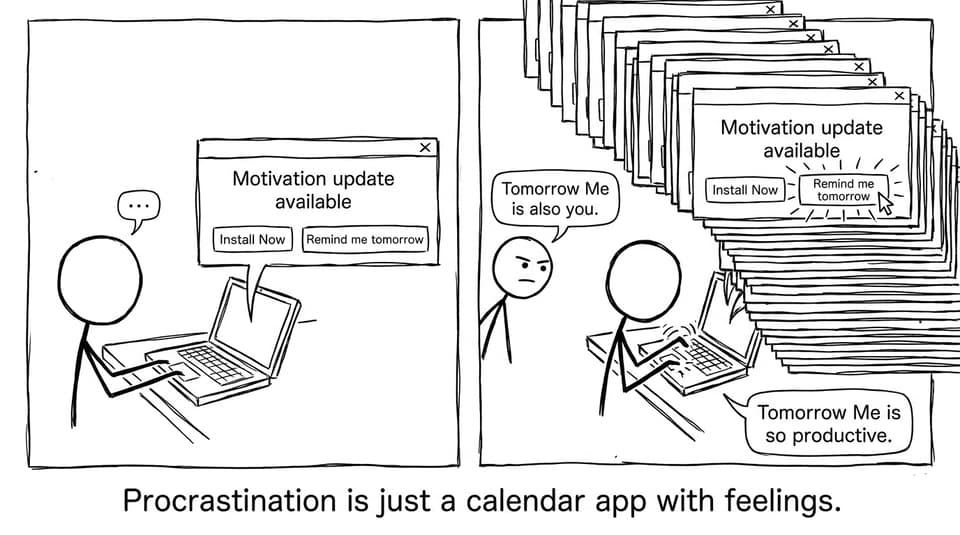
and your brain starts bargaining: “If I do nothing tonight, I’ll do double tomorrow.”
Motivation becomes simpler when you stop treating it like a feeling and start treating it like a system. Systems create proof. Proof creates confidence. Confidence makes the IB feel less like a cliff.
Build IB motivation with goals that are small enough to finish
Big goals sound inspiring. They also trigger avoidance.
Instead of “revise all of IB Chemistry,” try:
-
“Do 12 questions on one topic, review errors, and write three takeaways.”
-
“Draft one EE paragraph and fix one citation.”
-
“Plan two body paragraphs for Paper 2 and write one.”
That’s motivation-friendly because it gives your brain a finish line.
When you’re done, reinforce the win. Mark it off. Log it. Save it. Motivation likes evidence.
A useful place to start is structured material that reduces decision fatigue. RevisionDojo’s IB Study Notes are built exactly for that kind of clarity: IB Notes.
Make the IB easier by lowering the “start cost”
Most procrastination isn’t laziness. It’s friction.
If starting feels expensive, your brain delays. So your job is to make starting cheap:
Create a “2-minute runway”
Before you stop studying each day, set up tomorrow’s first step:
-
open the right tab,
-
write the first question number,
-
or leave a comment like “continue from here.”
Then tomorrow you can begin without negotiating with yourself.
If you want an easy default for exam practice, use the RevisionDojo Questionbank. It removes the “what should I do?” question, which is where motivation often dies.
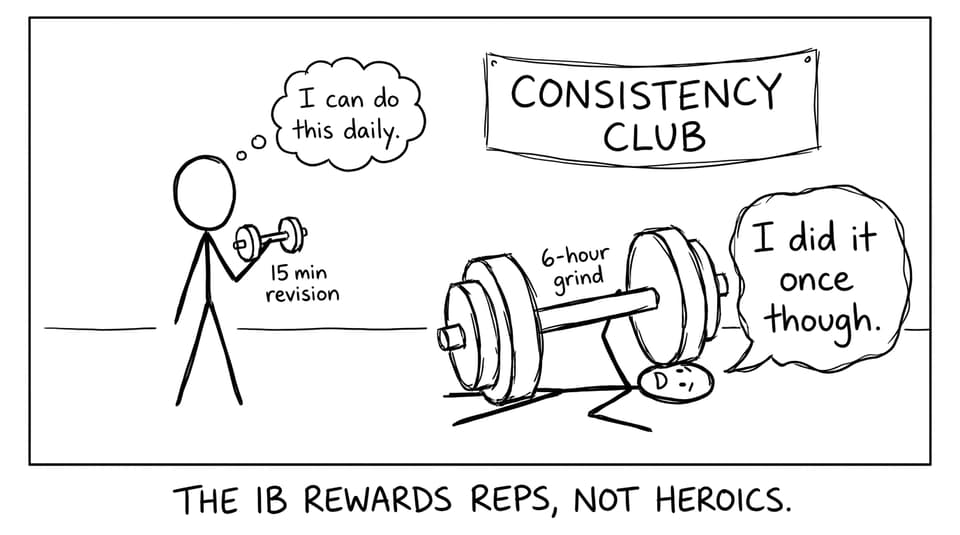
Use routines that match how the IB is actually marked
Motivation improves when your effort creates marks.
A calm weekly rhythm many IB students can sustain looks like this:
-
2--3 sessions/week: Learn one topic with notes, then check understanding.
-
3--5 sessions/week: Do exam-style practice and review mistakes.
-
1 session/week: Timed conditions to build stamina.
RevisionDojo is built around that exact loop. If you want the bigger picture of how it all connects, this is a helpful overview: RevisionDojo App: The Smarter Way to Prep for IB Exams.
Daily habit: flashcards that don’t steal your evening
If you only do one small daily habit in the IB, make it active recall.
Five to ten minutes of spaced repetition is the kind of effort that compounds quietly. And because it’s short, it doesn’t require peak motivation.
RevisionDojo makes this easy with IB Flashcards with Spaced Repetition (SRS) and the dedicated feature page: Flashcards Feature.
Track motivation like a scientist, not a judge
When motivation dips, most students go straight to self-criticism.
A better approach in the IB is data:
-
Which topics keep costing marks?
-
Which question types drain time?
-
Which days and times actually work for you?
Tracking turns vague stress into a plan.
One practical strategy is to do small sets of questions and tag what needs review. That’s why many students like the “visible progress” loop of practice. If you want guidance on using exam-style questions intelligently, read: IB Question Bank | How to Use It Effectively.
Use social motivation without turning it into chaos
Studying with friends works when it has structure.
Try this:
-
Sit one timed section.
-
Compare mistake patterns (not just scores).
-
Each person shares one fix they’ll try.
This turns peer pressure into peer momentum.
For a clean method you can copy, see: Collaborative IB Mock Exams: Study with Friends Online.
Keep IB coursework stress from stealing exam motivation
A lot of IB motivation problems aren’t exam problems. They’re “unfinished coursework living in your head.”
When your IA, EE, or TOK feels foggy, your brain keeps running background tabs. That reduces energy for revision.
Two practical fixes:
-
Use exemplars to clarify what “good” looks like.
-
Get criterion-based feedback so you’re not guessing.
RevisionDojo’s IB Coursework Examples - High-Quality Student Work and the broader Coursework feature are designed to make coursework less mentally sticky.
Build exam confidence with realistic rehearsal
Motivation gets stronger when you trust yourself under time.
That trust comes from rehearsal, not hoping.
If you’re preparing for IB exams, add one timed session a week. Start small if you need to. But make it real: silence, timer, and full review afterward.
RevisionDojo supports this with Mock Exams and Predicted Papers that simulate exam structure and pacing. A good explainer of how to use them wisely is: IB Predicted vs Specimen Papers: What They Mean, plus the hub page: IB Predicted Papers by IB Examiners (Free).
Closing: motivation in the IB is built, not found
The IB will keep asking for more than you feel ready to give. That’s normal. The students who finish strong aren’t the ones who feel motivated every day. They’re the ones who keep the daily cost of studying low, collect proof through practice, and protect their energy so they can stay consistent.
If you want that kind of calm momentum, build your loop with RevisionDojo: learn efficiently with Study Notes, retain with Flashcards, train with the Questionbank, get unstuck with AI Chat, sharpen with Grading tools, rehearse with Predicted Papers and Mock Exams, reduce coursework stress with the Coursework Library, and lean on Tutors when you need a human plan.
Your IB motivation doesn’t need to be loud. It just needs to show up tomorrow.