
You know the moment.
It's 9:47 p.m. You open your laptop to "just do a little IB revision." Ten minutes later you're reorganizing folders, rereading a paragraph you've read three times, and feeling that quiet panic that says: I'm working, but I'm not moving.
That's the most exhausting kind of IB stress: effort without traction. It drains motivation because your brain can't find proof that today made you better.
This article is about changing that feeling. Not with hype, not with guilt, but with a system that helps you handle IB stress without losing motivation. The goal is simple: make progress visible, make your next action obvious, and make your revision sustainable.
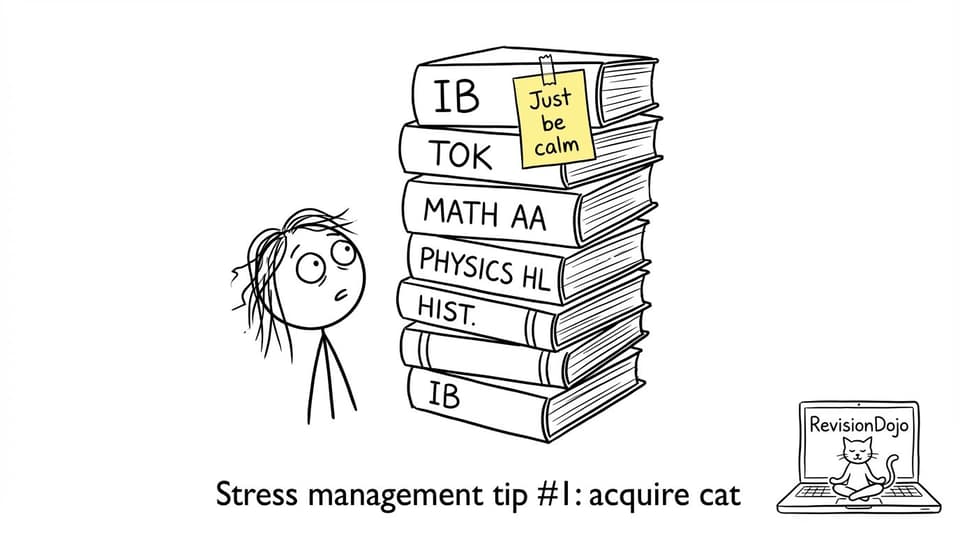
The IB stress-to-motivation reset checklist
When IB stress spikes and motivation drops, run this checklist once before you "try harder":
- Pick one IB subject and one paper skill (definitions? data response? essay evaluation? calculations?).
- Set a timer for 25 minutes.
- Do active recall (questions or flashcards), not rereading.
- Create one measurable win (accuracy %, questions completed, one subtopic finished).
- Write one error rule (a specific sentence that prevents the same mistake tomorrow).
- Take a real break (water, light movement, food).
- Decide tomorrow's first task before you stop.
If you need a broader structure to keep IB revision calm, keep this guide open in a separate tab: How to Study for IB Exams: Step-by-Step Guide.
Why IB stress makes motivation disappear
IB students often assume motivation is a personality trait. You either have it or you don't. But motivation is usually a signal.
When IB stress rises, your brain starts asking three practical questions:
- Is this effort working?
- Do I know what to do next?
- Can I keep this up without breaking?
If the answer to any of these is "not really," motivation drops. Not because you're lazy. Because your brain is trying to avoid wasting energy.
Two patterns create the most IB stress:
- Vagueness: "Revise Biology" is emotionally heavy because it has no finish line.
- No feedback loop: hours of revision without practice leaves you guessing if you improved.
A useful companion read here is How to Beat IB Exam Anxiety (Without Burning Out), because it shows how predictability reduces IB stress.
Handle IB stress by building evidence (not willpower)
The calmest IB students aren't the ones who "feel motivated" every day. They're the ones who collect evidence that they're improving.
Evidence is small:
- "I improved from 58% to 70% on Topic 2 questions."
- "I can now finish Section A on time."
- "I fixed the same command-term mistake twice this week, so it's less likely to happen in the exam."
This is why practice-first revision is so powerful. It turns fear into data.
On RevisionDojo, you can build that evidence loop quickly:
- Use the Questionbank to practice exam-style questions by topic.
- Use Flashcards for daily recall that stays small enough to be consistent.
- Use Study Notes for fast clarity when you're stuck.
- Use Jojo AI Chat when confusion threatens your momentum.
If you want the "all-in-one" workflow explained, this overview helps: RevisionDojo App: The Smarter Way to Prep for IB Exams.
The anti-burnout IB routine: minimum viable progress
When students say "I'm burnt out," they often mean: I can't sustain the version of studying I've been doing.
So don't sustain it. Replace it.
Here's a minimum viable IB routine that protects motivation during stressful weeks:
A daily base (15-25 minutes)
This is your "I did something" safety net.
- 10 minutes of Flashcards (spaced repetition, definitions, key processes, formulas).
- 5-15 minutes of a tiny Questionbank set (5-10 questions).
The goal is to keep IB stress from turning into avoidance. Even a small session maintains identity: I'm still in the game.
Three focused blocks per week (45-90 minutes)
Each block is one topic, one loop:
- Study Notes (10-15 min)
- Questionbank practice (20-40 min)
- Review mistakes + write 3 error rules (10-15 min)
If you like structured revision strategies, this pairs well with The Ultimate Guide to Revision for IB Students.
One stamina session per week (timed)
IB stress is often fear of the unknown: timing, pressure, and exam formatting.
Do one timed session weekly using:
- Mock Exams for realistic pacing and stamina
- Predicted Papers for exam-style realism and confidence-building
A helpful "final stretch" reference is IB Last 24 Hours Study Plan.
Turn IB stress into a plan you can actually follow
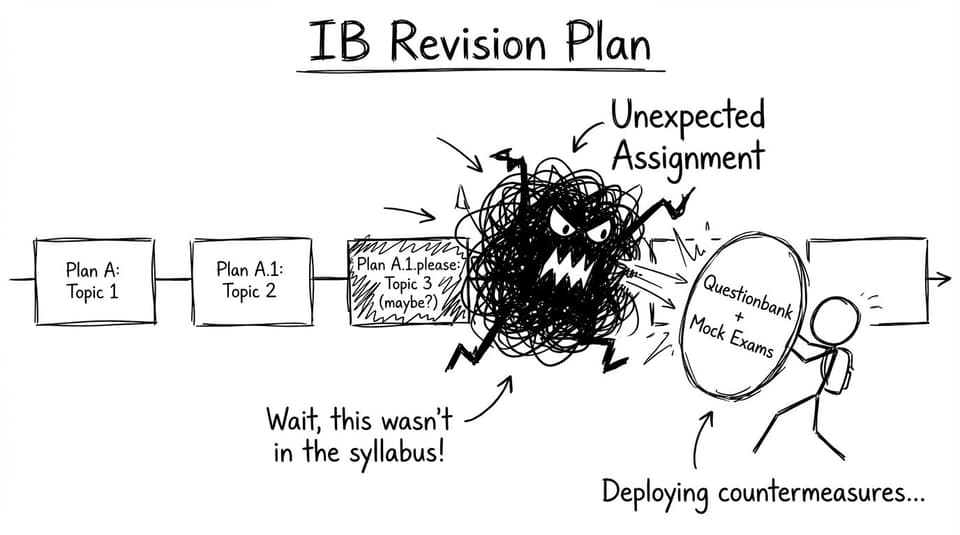
Most IB students don't need more advice. They need fewer decisions.
When you're stressed, planning should feel like narrowing, not expanding. Use this simple method:
Choose one "today target" per subject
For each IB subject, define one target that is concrete:
- "10 questions on Topic X"
- "One timed data response"
- "Outline + thesis + one paragraph"
Avoid targets like "revise Chapter 7." They're too easy to postpone.
Protect your energy with task mixing
IB stress grows when everything feels equally hard.
Mix cognitive load:
- Heavy: timed practice, long responses, problem sets
- Light: flashcards, short drills, reviewing an error log
This prevents the crash where motivation disappears for three days.
If you're also dealing with "top student pressure," read How to Cope with the Pressure of Being a Top IB Student.
Use RevisionDojo to reduce friction (and keep motivation alive)
Motivation usually fails at the start. Not because you don't care, but because starting feels expensive.
RevisionDojo is built to make starting cheaper:
- Questionbank turns "What should I do?" into a filtered set you can begin immediately.
- Study Notes replace the endless rewrite cycle with syllabus-aligned clarity.
- Flashcards keep recall daily, so forgetting doesn't become a panic spiral.
- AI Chat acts like an "unstuck button" when you're embarrassed to ask the same question again.
- Grading tools reduce coursework stress by giving rubric-aware feedback quickly.
- Mock Exams and Predicted Papers make the exam feel familiar, which reduces IB stress.
- Coursework Library shows what strong work looks like, so you stop guessing.
- Tutors add human strategy when your plan needs triage, not more content.
If you want an extra motivation angle, this is useful: IB Study Motivation with AI: Stay Engaged and Focused.
The quiet mindset shifts that keep IB motivation steady
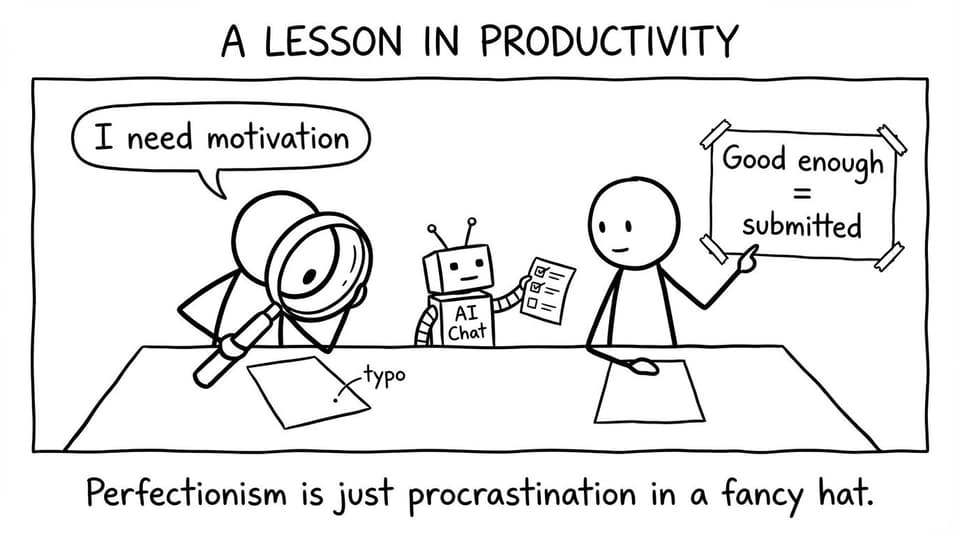
Strategy matters, but mindset determines whether you return tomorrow.
Treat stress as information
IB stress often points to one of these:
- You haven't practiced under time.
- You don't know what gets marks.
- Your plan is too vague.
Instead of "I'm failing," reframe it as: "My system needs better feedback." That's fixable.
Stop negotiating with yourself every day
Decision fatigue is a motivation killer in IB.
Make tomorrow easier by deciding tonight:
- the first subject,
- the first task,
- the first timer length.
Your brain likes obvious starts.
Aim for consistency, not intensity
IB motivation doesn't come from one heroic weekend. It comes from repeated proof.
Small wins compound. And compounding is how you handle IB stress without breaking.
Closing: A calmer way to do IB is a measurable way
The secret isn't to "eliminate IB stress." The secret is to build a revision loop where stress doesn't get to decide your day.
When motivation drops, don't search for inspiration. Search for evidence. One small practice set. One corrected mistake. One error rule that saves you marks next time.
If you want one place to run that calmer loop, RevisionDojo is built for it: Questionbank, Study Notes, Flashcards, AI Chat, Grading tools, Predicted Papers, Mock Exams, a Coursework Library, and Tutors when you need a human plan. Start small today, and let consistency do what willpower can't.