
The moment burnout starts (and you don't notice)
The night before a big IB deadline, your brain does a strange trick: it convinces you that the only way out is forward. Not smarter forward. Not calmer forward. Just forward.
You open your notes, then your Questionbank, then your calendar, then your messages. The more tabs you open, the less you can think. You tell yourself you're being responsible. But what you're really doing is trying to feel safe.
That's the psychology of burnout in IB students: it often begins as a reasonable response to pressure. Then it quietly becomes a system that drains you.
Burnout isn't laziness. It's an overloaded mind trying to protect itself. And because IB students are trained to be persistent, many of them don't recognize the warning signs until the body forces a stop.
A quick checklist: are you sliding into IB burnout?
Use this as a fast self-check. If you tick several, you're not "weak"; you're likely running a system that can't recover.
- You feel tired even after sleeping.
- You reread IB notes but can't remember what you read.
- You avoid starting, then panic-study.
- You're more irritable than usual (at people you actually like).
- You've stopped enjoying the subjects you used to be good at.
- You feel numb: not sad, not happy, just flat.
- Small tasks feel weirdly heavy (printing, emailing teachers, opening your planner).
If this feels familiar, keep reading. The goal isn't motivation. The goal is building a burnout-proof IB revision loop.
The psychology of IB burnout: what's actually happening
Burnout is not just "too much work." It's too much work without enough recovery, clarity, or control.
Your brain's threat system hijacks your planning
When IB pressure rises, your brain starts treating uncertainty as danger. That changes how you study:
- You seek reassurance (more resources, more videos, more notes).
- You avoid risk (you repeat easy topics instead of facing weak ones).
- You confuse movement with progress (busy but not improving).
This is why burnout often looks like "studying all day" with very little retention.
A helpful reframe: IB burnout is often a feedback problem. You're putting in effort, but you're not getting believable signals that it's working.
That's why a practice-first system can feel emotionally stabilizing. A set of questions, a score, a review list: it's proof.
If you need a structure that turns effort into visible progress, start with the platform workflow explained in RevisionDojo App: The Smarter Way to Prep for IB Exams.
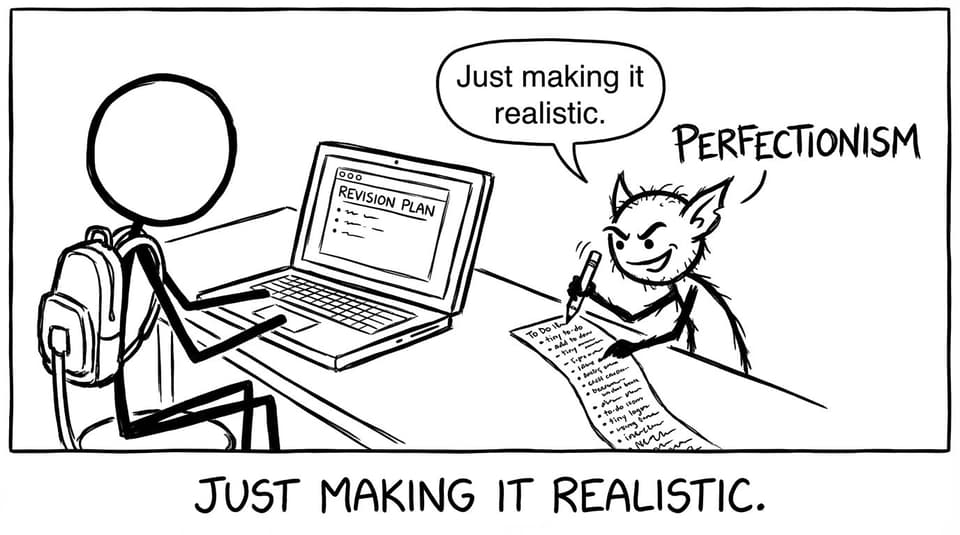
Perfectionism turns the IB into a personal referendum
The IB attracts conscientious students. Conscientious students often carry a private belief: "If I don't do this perfectly, it says something about me."
Perfectionism is not high standards. It's fear in a tidy outfit.
It creates burnout because:
- Every task expands (a 30-minute review becomes a 3-hour rewrite).
- Every mistake feels expensive.
- Rest feels undeserved.
Under perfectionism, your brain stops optimizing for learning and starts optimizing for emotional safety.
Chronic stress makes thinking expensive
Burnout also has a very physical component. Sustained stress disrupts sleep, attention, and working memory. In IB exam season, that means:
- You read the same paragraph five times.
- You forget definitions you knew last month.
- You make basic errors under time.
This isn't a character flaw. It's your system asking for recovery.
The IB workload isn't the villain: unclear priorities are
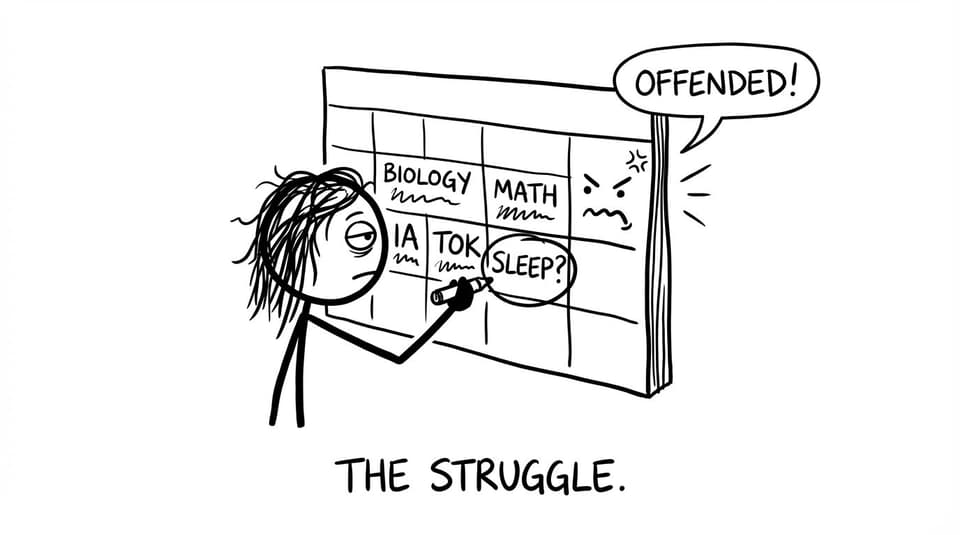
A surprising truth: many IB students don't burn out at peak workload. They burn out when they can't tell what matters.
When everything feels urgent, the brain can't rank tasks. So it defaults to what feels controllable:
- making prettier notes
- reorganizing folders
- watching "full syllabus in 2 hours" videos
These are comforting. They are also low-feedback.
A better approach is to reduce decision-making.
Here's a simple priority ladder:
- Clarity: Learn the idea (short notes).
- Memory: Keep it alive (flashcards).
- Performance: Prove it under exam-style conditions (questions and timed sets).
- Correction: Review mistakes and write one improvement rule.
RevisionDojo is built around that loop with Study Notes, Flashcards, Questionbank, AI Chat, and Grading tools so your system doesn't depend on mood.
If you want the step-by-step version of this ladder, use How to Study for IB Exams: Step-by-Step Guide.
How to recover from IB burnout without falling behind
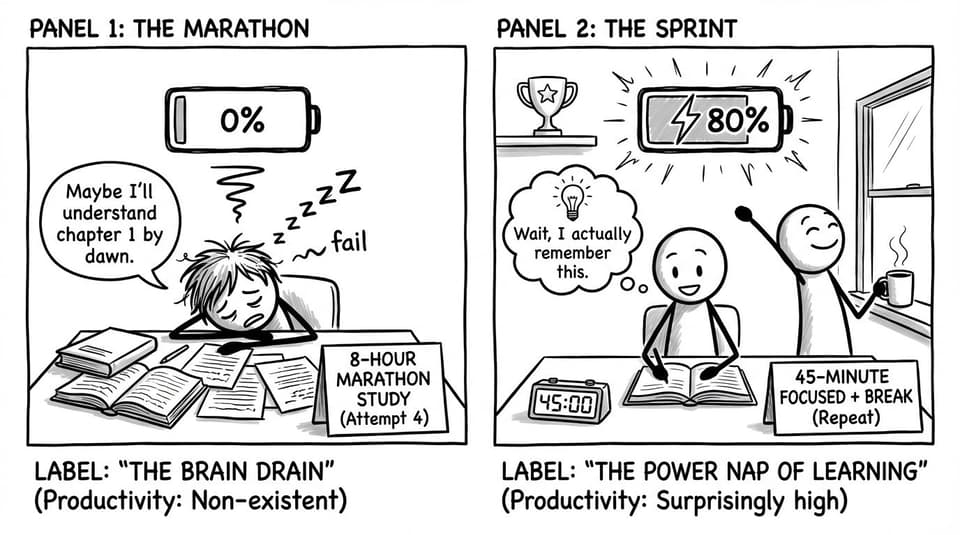
Recovery is not "stop everything forever." For most IB students, recovery means returning to sustainable output.
Lower the volume, raise the signal
When you're burnt out, your brain can't handle huge plans. So give it smaller promises.
Try this for 3 days:
- 15 minutes: review one small section of notes
- 25 minutes: do a targeted Questionbank set
- 10 minutes: review mistakes and write one rule
- 7 minutes: flashcards
That's it.
This works because it creates short cycles of proof. It gives your brain a reason to trust the process again.
To build daily practice that feels manageable, start at the feature level with Questionbank and Flashcards.
Use "timed practice" as anxiety therapy (gently)
Many IB students avoid timed work because it exposes gaps. But timed work is also what reduces fear, because it turns the unknown into something measurable.
Start smaller than you think:
- 10-minute mini-set
- then 20 minutes
- then 35 minutes
When you're ready, incorporate Mock Exams and Predicted Papers as controlled simulations. The purpose isn't to judge yourself. It's to build stamina and calm.
For a mindset model used by top scorers, read How 45-Point IB Students Prepare for Exams.
Stop negotiating with sleep
Burnout loves one trade: "I'll borrow sleep to buy time."
But in IB revision, sleep is not rest. It's consolidation.
If you can't fix everything, fix two things:
- consistent wake time
- screens off 30 minutes before bed
Even small sleep improvements can restore attention and memory faster than another hour of tired studying.
Make your study environment do the discipline for you
Burnout is decision fatigue. So redesign your environment to reduce choices:
- One browser window: notes and questions only
- Phone in another room for one timed block
- A written "next action" list with 3 items max
If you have to decide what to do every session, you'll burn willpower. Systems beat willpower.
A sustainable IB anti-burnout plan (you can start today)
Here's a calm weekly template for IB students preparing for exams. Adjust per subject, but keep the structure.
The daily loop (most days)
- Study Notes (20 min): learn one concept clearly
- Flashcards (7 min): keep yesterday alive
- Questionbank (30-45 min): practice by topic, not by vibes
- Review (10-15 min): mistakes become rules
If you want a free, unified setup for this workflow, start with Notes + Flashcards + Question Bank (Free).
The weekly "truth session" (once per week)
- One timed set or paper section under exam conditions
- Then longer review than writing
This is where Grading tools and AI Chat matter. They shorten the distance between "I got it wrong" and "I know what to do next time."
If you need a broader view of what tools exist, the RevisionDojo home hub gives the full map: Questionbank, Study Notes, Flashcards, AI Chat, Grading tools, Predicted Papers, Mock Exams, Coursework Library, Tutors.
The coursework pressure valve
A hidden burnout trigger in IB is the overlap: exams plus IA/EE/TOK.
When coursework is stealing your mental bandwidth, stop guessing whether it's "good enough." Get feedback.
Use RevisionDojo's Grading tools for rubric-aligned improvement, browse the Coursework Library for examples, and consider Tutors when you need a human to help you prioritize.
Closing: make IB preparation feel smaller, then repeat it
Most IB burnout stories share the same plot: a student keeps increasing effort because effort feels like control. The ending changes when the student builds a system that creates control without constant strain.
If you're preparing for IB exams, you don't need a perfect week. You need a repeatable loop: Study Notes for clarity, Flashcards for memory, Questionbank for proof, AI Chat and Grading tools for faster correction, and Mock Exams plus Predicted Papers to rehearse pressure in a controlled way. Add the Coursework Library when IAs or TOK start eating your attention, and use Tutors when you need a steady voice.
That's what RevisionDojo is built for: turning IB stress into a plan you can actually live with.