

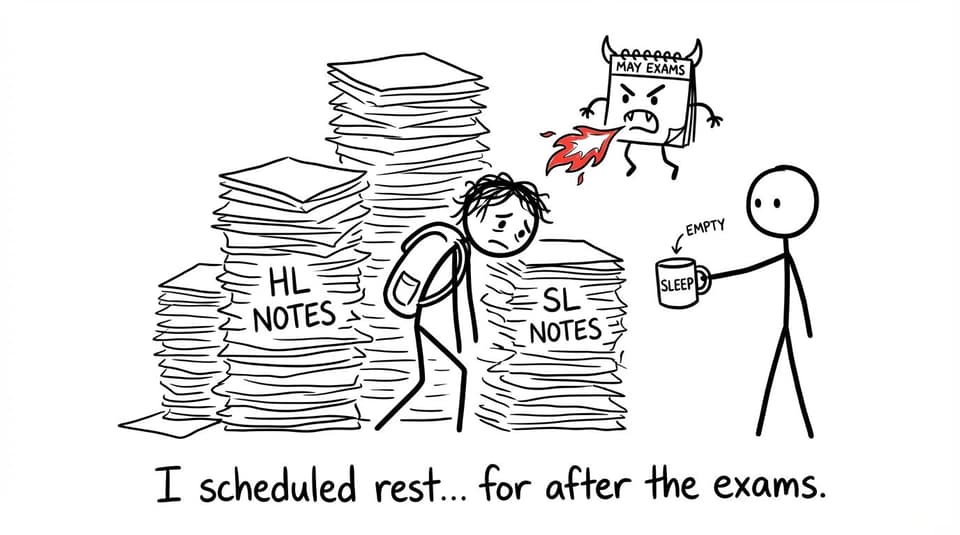
When IB exam season hits, it rarely arrives like a clean calendar event.
It creeps in.
One day you're doing homework. The next, every conversation becomes a countdown. Your brain starts running two programs at once: "learn everything" and "don't fall apart." If you're an IB student preparing for exams, you don't need a motivational speech. You need a way to stay sane while still getting the work done.
This guide is about that middle path. Not perfect balance. Not hustle. Just a calm system that keeps you functioning through IB exam season, when your energy and emotions are unreliable.
The IB sanity checklist (save this)
If your brain is too tired to plan, borrow this checklist. It's a simple loop designed for IB revision without burnout.
- Pick one subject for today's main block.
- Do 10-25 exam-style questions (not endless rereading).
- Review mistakes and write a 3-line "mistake log."
- Use a short recall session (Flashcards) to keep memory warm.
- Do one timed section per week to reduce IB exam anxiety.
- Protect sleep with a hard stop time.
- Keep coursework stress from leaking into exam revision with fast feedback.
RevisionDojo exists for exactly this kind of season: one place to run the loop using Study Notes, Flashcards, Questionbank, AI Chat, Grading tools, Predicted Papers, Mock Exams, the Coursework Library, and Tutors.
Why IB exam season makes smart people feel unreasonable
The hardest part of IB exam season isn't that it's "a lot." It's that it's a lot across many directions.
Six subjects. Different paper styles. Different command terms. Different mark logic. Your brain can handle hard work, but it struggles with constant switching. That switching creates decision fatigue: you spend energy choosing what to do, then feel guilty because you haven't started.
A small reframe helps:
Your job isn't to "cover" the syllabus.
Your job is to become the person who can produce answers under pressure.
That's why exam-style practice is calming. It turns vague stress into specific feedback. If you're using RevisionDojo, you can anchor your days in the Questionbank and use the results to decide what happens next.
Build a calm IB routine: evidence over emotion
In IB, motivation is overrated and evidence is underrated.
Evidence looks like: "I got 6/10, reviewed the mistakes, and now I know the pattern." That's calming. It reduces the unknown.
Here's a simple weekly structure that keeps you sane:
The "3-layer" IB week
Daily layer: keep recall alive
Spend 7-15 minutes on retrieval. This is the part that makes you feel less scattered.
- Use Interactive IB Flashcards for a short session.
- Don't aim to finish a deck. Aim to show up.
- If you miss a day, restart tomorrow with zero drama.
Core layer: topic blocks that actually move the needle
Do 4-6 topic blocks per week (45-90 minutes).
- Use Digital IB Study Notes to clarify one subtopic.
- Immediately switch to Questionbank questions on that same subtopic.
- Review mistakes and write: "What did I miss? What fixes it?"
This is how IB revision becomes predictable. Learn, apply, correct, repeat.
Pressure layer: timed practice to stop panic spirals
Once or twice a week, do timed work. Not because you love stress, but because timed practice makes the real exam feel familiar.
- Use Online IB Mock Exams: Practice Anywhere, Anytime to build stamina.
- Or follow How to Run Timed IB Mock Exams in RevisionDojo if you want a clear, step-by-step setup.
Timed practice is one of the best ways to stay sane during IB exam season because it replaces imagination with reality.
Protect your brain: the three boundaries that matter in IB
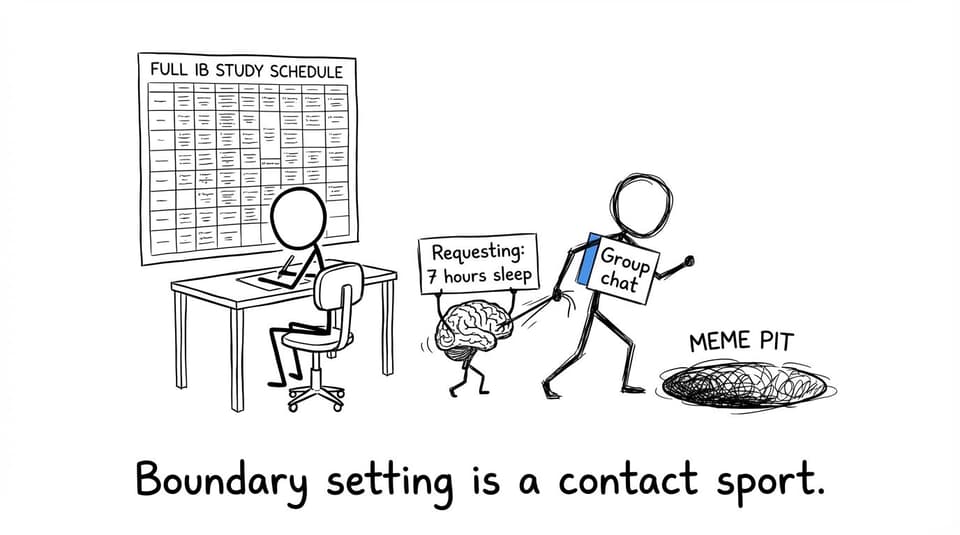
Most IB students don't burn out from studying. They burn out from studying without boundaries.
Boundary 1: a hard stop time
Pick a time you stop, even if you "could do more."
Sleep is not a reward for finishing. It's the tool that makes your learning stick. A functioning brain tomorrow beats an exhausted brain tonight.
If you're struggling with nights that run away from you, this is worth bookmarking: IB Exam Night Routine: What Actually Works.
Boundary 2: one "small win" on bad days
Bad days happen in IB exam season. The goal is not to avoid them, it's to keep them from destroying your streak.
Your small win could be:
- 10 flashcards
- 10 targeted questions
- One page of Study Notes with forced recall
This keeps your identity intact: "I'm still someone who studies."
Boundary 3: fewer inputs, more feedback
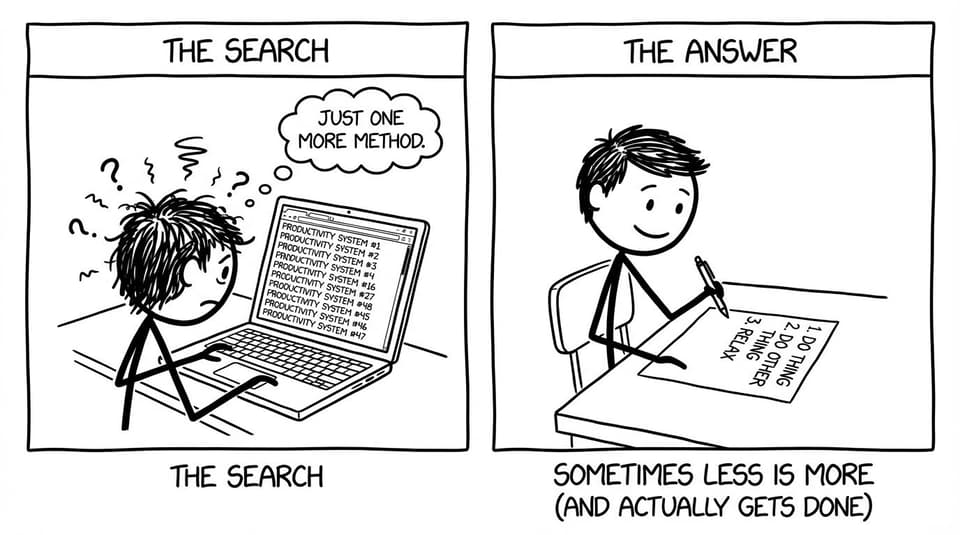
When you feel behind, the instinct is to collect resources. More videos. More notes. More opinions.
But sanity comes from feedback loops.
RevisionDojo compresses the loop: Study Notes to understand, Questionbank to practise, AI Chat to unblock confusion, and Mock Exams to simulate pressure. That's why an all-in-one system matters in IB season.
If you want a full workflow, read How to Study for IB Exams: Step-by-Step Guide.
Keep coursework from poisoning IB exam revision
Coursework has a unique way of living rent-free in your head.
Even if your exams are close, an unfinished IA paragraph or a TOK edit can quietly drain your focus. Not because it takes hours, but because it creates mental noise.
Two strategies help:
Close open loops with fast feedback
If coursework is still in play, don't let it become a nightly panic ritual. Use a tool that gives immediate direction.
- Try the IB Coursework Grader to get rubric-aligned feedback.
- Use the Coursework Library to see what "good" actually looks like.
- If you need a human voice, Tutors can turn vague worry into a clear plan.
Set "coursework windows" (not coursework whenever)
Choose 2-3 fixed windows per week for coursework. Outside those windows, you're in exam mode.
This separation keeps IB exam season from feeling like one endless task with no finish line.
Use RevisionDojo like a calm control panel (not a resource buffet)
The biggest mistake students make with any platform in IB season is using it like a library instead of a system.
A calmer approach is to assign each tool a job:
- Study Notes: quick clarity, no rewriting marathons
- Flashcards: daily recall that compounds
- Questionbank: targeted practice with visible progress
- AI Chat: unblock one confusion, then test it immediately
- Mock Exams: stamina and pacing under pressure
- Predicted Papers: realism and exam readiness without guessing
- Grading tools: coursework feedback without waiting
- Coursework Library: models, not comparison
- Tutors: when you need a person to simplify the knot
If you want the "all-in-one" logic explained, this overview is helpful: RevisionDojo App: The Smarter Way to Prep for IB Exams.
And if your motivation is fading, you're not alone. This companion piece fits well here: IB Motivation: How to Stay Driven in Exam Season.
Closing: the real trick to staying sane in IB
The quiet truth about IB exam season is that sanity doesn't come from doing less.
It comes from doing the right things in a repeatable way.
When your days have a simple structure: Notes for clarity, Flashcards for recall, Questionbank for proof, and Mock Exams or Predicted Papers for pressure practice, your brain stops panicking about everything you might be missing. You start collecting evidence that you're improving.
If you want one place where that loop is built-in, use RevisionDojo as your control panel: Questionbank, Study Notes, Flashcards, AI Chat, Grading tools, Predicted Papers, Mock Exams, Coursework Library, and Tutors. Not to become a robot. Just to stay steady.
Because in IB, the students who finish strongest are rarely the ones who worked the most hours. They're the ones who kept their mind intact long enough to make the hours count.