
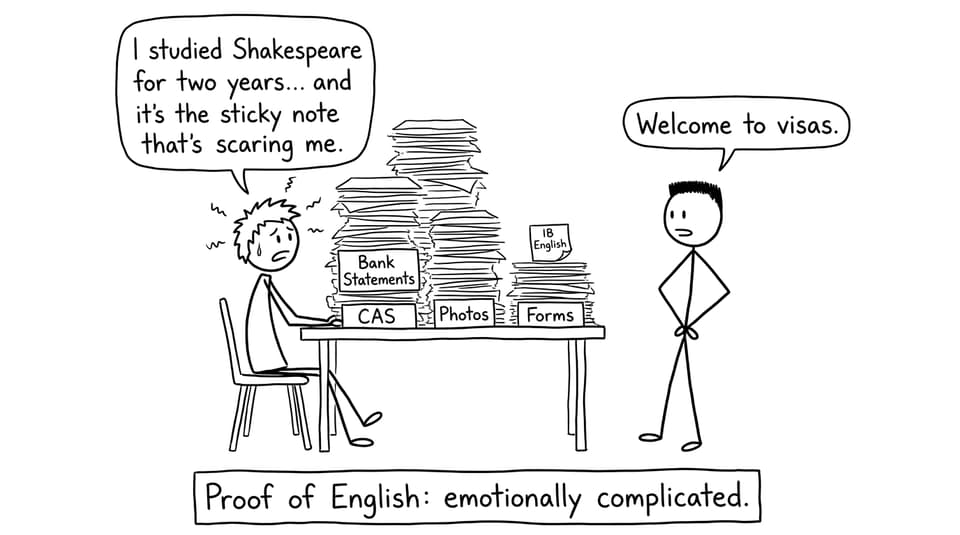
Applying for a UK student visa can feel oddly like writing a Paper 1 response: the instructions look straightforward, but the marks are hidden in the details. One day you’re calmly revising IB English, and the next you’re asking a bigger question: Is IB English enough for a UK student visa?
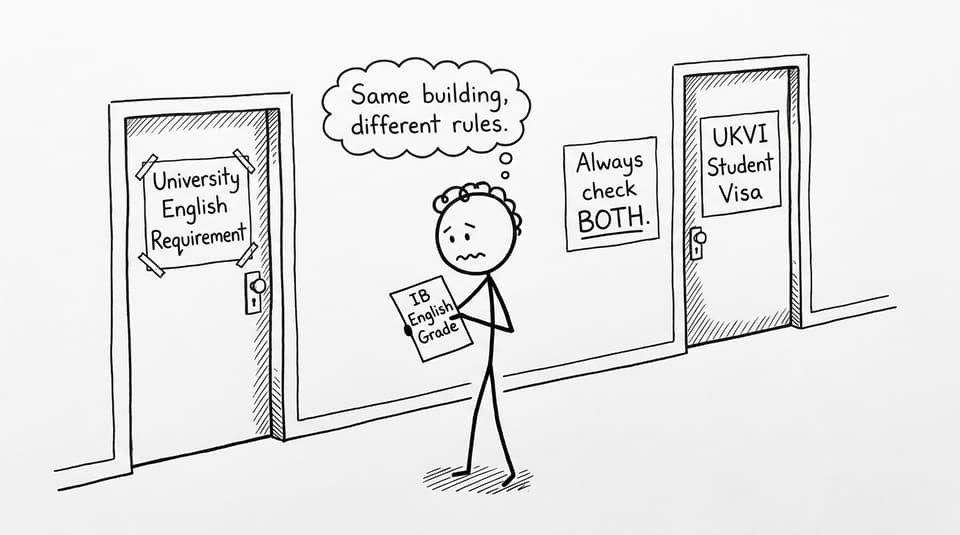
The reassuring truth is that IB English can be enough, for many students, at many universities, in many scenarios. The stressful truth is that “enough” depends on two separate gatekeepers: your university’s admissions policy and UKVI rules (often applied through your university as a sponsor). If you treat those as the same thing, you’ll risk a last-minute scramble.
The quick answer: when IB English is enough
For many UK universities, IB English (especially IB English A) can satisfy their English language requirement and may exempt you from extra tests. But you must confirm the exact requirement for:
-
Your course (some departments set higher English thresholds)
-
Your IB English course type (English A vs English B)
-
Your level (SL/HL)
-
Your final grade (universities commonly set minimums)
A practical starting point is to compare guidance across these RevisionDojo breakdowns:
UK student visa English requirements: what’s actually being checked
The UK’s student visa process is often described like a single application, but it’s more like a relay race. UKVI sets the rules, and your university (your sponsor) is the one that typically confirms you meet them when issuing your CAS.
What that means for IB English is simple: you’re usually not “convincing UKVI” directly with a heartfelt paragraph about your HL Essay. You’re meeting your university’s stated English language policy, and the university confirms that standard when sponsoring you.
This is why you should treat IB English as part of a system, not a standalone ticket.
IB English A vs IB English B: the difference that matters
Students casually say “IB English,” but admissions teams don’t. They separate:
IB English A (Literature / Language and Literature)
IB English A is widely recognised as academically rigorous English study, and many universities accept it as proof of proficiency if you meet the grade threshold.
If you’re choosing between the courses or clarifying what you’re actually taking, this comparison helps: IB English Literature vs IB English Language and Literature.
IB English B
IB English B is designed as a language acquisition course. Some UK institutions accept it (often at HL with a certain grade), but policies vary more.
To understand the usual pattern, use:
Typical IB English grade thresholds (what universities often ask for)
Exact requirements vary, but these are common expectations you’ll see across UK admissions pages:
-
IB English A SL: often 5+
-
IB English A HL: often 4+, sometimes 5+ for competitive courses
-
Highly selective universities may ask for 6 or 7
RevisionDojo collects the patterns and how they show up in offers and exemptions here:
Also, if your goal is Oxbridge-level competitiveness, it’s worth reading:
And for a London benchmark:
A simple checklist to avoid last-minute visa panic
Use this as your “calm under pressure” list. It’s boring. That’s why it works.
-
Confirm whether your university accepts IB English for English proficiency
-
Confirm the exact minimum grade for your course (not just the university overall)
-
Confirm whether they accept IB English A, IB English B, or both
-
Keep evidence ready: official transcript and final results release documentation
-
If you’re below the minimum, ask early what alternatives they accept
While you’re doing that, keep your exam prep moving. A higher IB English grade doesn’t just help with entry requirements; it protects your options.
To improve the grade itself (the part you can control), RevisionDojo’s Questionbank, Study Notes, and Flashcards turn “I should revise” into a repeatable daily routine. When you want feedback, AI Chat and the Grading tools help you tighten analysis, structure, and clarity the same way a good teacher would: one decision at a time.
How to raise your IB English grade fast (so you clear the requirement)
Most students don’t miss a required grade because they lack intelligence. They miss it because their writing becomes vague under time pressure.
Three high-leverage fixes:
Practice close reading like a skill, not a mood
Build a method you can repeat in exam conditions. This guide is a strong template: Close Reading Techniques for Prose and Poetry.
Plan comparative arguments before you write
If your comparisons are messy, your grade leaks away quietly. Use: Comparative Essay Planning: Theme vs. Form vs. Content.
Use timed practice with feedback loops
RevisionDojo’s Mock Exams help you rehearse timing without guesswork, while Predicted Papers give you realistic practice targets. Pair that with the Coursework Library and Tutors if you need faster, human guidance for specific weaknesses.
Conclusion: treat IB English as both a subject and a lever
A good IB English grade is more than a line on your results sheet. It’s leverage: fewer extra requirements, fewer deadlines, fewer surprises, and a smoother path into UK university life.
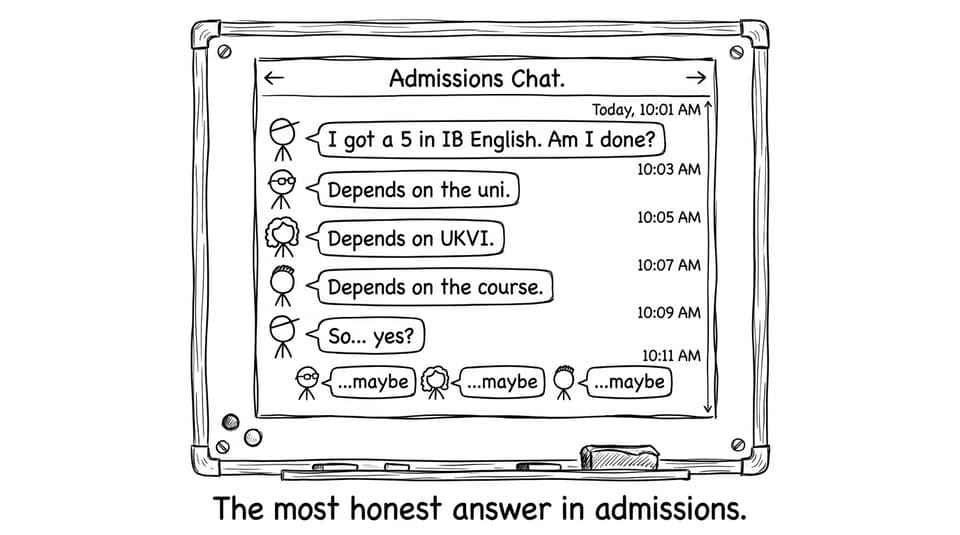
So, is IB English enough for a UK student visa? Often, yes, but only when your specific university and course accept it at your specific grade. Check early, document everything, and then return to the part you can control: your performance.
If you want that performance to feel steady, not stressful, RevisionDojo gives you a full system: Study Notes for clarity, Flashcards for recall, a Questionbank for exam-style practice, Mock Exams for timing, Predicted Papers for direction, AI Chat for instant explanations, and Tutors when you need a human shortcut. Build the grade, protect your options, and let IB English do what it’s meant to do: open doors.