
If you have ever watched two IB students talk about English choices, you have heard the same debate in different voices. One says, “I want real books.” The other says, “I want texts that feel like the real world.”
But underneath that debate is a quieter pressure: University. Not in a dramatic way. More like a constant background tab open in your mind. You are trying to pick a course that fits your strengths, helps you score well in exams, and still makes sense for University applications and future writing.
This guide breaks down IB English Literature vs IB English Language and Literature in a way that is practical for exam prep, honest about workload, and clear about what each course trains you to do.
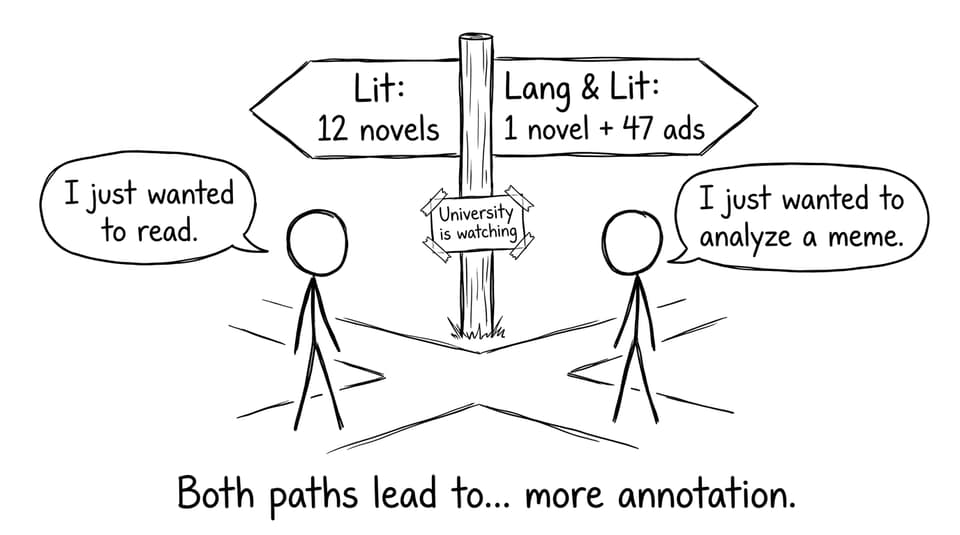
Quick decision checklist (save this before you choose)
Use this checklist first. It is faster than reading a hundred forum threads and usually more accurate.
-
You should lean IB English Literature if you prefer deep reading, close analysis, and living inside novels, plays, and poetry.
-
You should lean IB English Language and Literature if you like switching between genres and media, and you enjoy analyzing how language works in society.
-
For University goals, both are respected. The better choice is typically the one that makes you write clearer arguments under time pressure.
-
If you are unsure, test yourself: do one timed analysis on a poem and one timed analysis on an advertisement or speech. Notice which feels more “difficult but satisfying.”
For a broader map of how the subject is built, keep this nearby: What Is the IB English Curriculum? A Complete Breakdown.
What IB English Literature actually trains
IB English Literature (Lit) is built around one big habit: close reading. You are not just reading for meaning. You are reading for choices. Why that metaphor? Why that structure? Why that shift in voice? It is slow thinking that becomes fast when you practice it.
Texts and classroom life in IB English Literature
Expect a steady diet of:
-
Novels, drama, and poetry
-
Works from different time periods and cultures
-
Discussion that centers on interpretation and technique
If you like staying with one text long enough to notice patterns, Lit often feels like the natural home.
Assessment feel (and why it matters for University)
The exam-relevant reality is this: Literature rewards students who can build an argument from craft, not summary. That is also a core University writing muscle.
To build that muscle deliberately, pair Lit revision with an exam routine like: Preparing for IB English A: Literature Exams.
What IB English Language and Literature actually trains
IB English Language and Literature (Lang Lit) is built around range. You still study literary works, but you also analyze non-literary texts: journalism, speeches, campaigns, digital media, visual texts. The skill is agility: shifting context quickly while keeping your analysis precise.
Texts and classroom life in IB English Language and Literature
Expect:
-
A mix of literary and non-literary texts
-
More explicit focus on audience, purpose, bias, and context
-
Lessons that connect language choices to power, identity, and culture
If you like asking “Who is this for, and what is it trying to make people do?” Lang Lit can feel more intuitive.
Assessment feel (and why it matters for University)
Lang Lit can be excellent for University paths involving media, communications, politics, or social sciences because it trains you to analyze persuasion and framing. But it is also very strong preparation for any degree that demands evidence-based writing.
If your notes are currently more “highlighted vibes” than “exam tools,” fix that with: Effective Note-Taking Strategies for IB English Language and Literature.
IB English Literature vs Lang Lit: the differences that decide your grade
Students often ask which course is “harder.” The more useful question is: which course exposes your weakest habit?
Depth vs breadth (the real tradeoff)
-
Literature punishes students who avoid sustained reading and who struggle to stay precise about technique.
-
Language and Literature punishes students who do not like switching frameworks quickly (tone one minute, visual layout the next).
Both can lead to strong outcomes for University. The one that fits your brain usually leads to higher marks because practice becomes sustainable.
What Paper 2 has in common
In many schools, Paper 2 is a comparative essay on literary works across both courses. What separates high scorers is not remembering more content, but comparing with control.
Use this as your Paper 2 anchor: IB English Paper 2 Structure: Lang & Lit Guide.
And if you want a repeatable comparison method, study: How to Structure a Comparative Essay in IB Literature.
What Paper 1 asks of you
Paper 1 is where course differences feel loud:
-
Literature typically leans into literary analysis of unseen texts.
-
Lang Lit often includes analysis of non-literary (and sometimes literary) unseen texts.
If you want a step-by-step way to train Paper 1 under time, use: Step-by-Step Guide to Revising IB English Paper 1.
Choosing based on University goals (without overthinking it)
It is tempting to choose based on what you think University wants. But most universities do not reward the label as much as they reward the outcome: can you write, think, and argue?
Here is the simplest way to connect choice to University pathways:
If you are aiming for literature-heavy degrees
Choose Literature if you enjoy:
-
Staying with complex texts
-
Tracking symbols and motifs across a whole work
-
Writing thesis-driven literary essays
If you are aiming for broader humanities or social sciences
Choose Language and Literature if you enjoy:
-
Rhetoric, persuasion, and argument
-
Media analysis and real-world contexts
-
Comparing how different forms shape meaning
If you are undecided
Pick the course you will practice consistently. Consistency beats “strategic” choices because exam technique compounds. Over two years, that becomes the difference between a stressful 5 and a calm 6/7, which matters for University offers.
A helpful perspective on difficulty is here: IB Languages: Is Lit Harder Than Lang & Lit?.
How RevisionDojo helps you win either course
The best part about this choice is that the core performance engine is the same: understand the task, practice the skill, get feedback, repeat.
RevisionDojo is designed to make that loop easier:
-
Study Notes to clarify techniques and build interpretation without drowning in extra sources
-
Flashcards to retain quotes, terms, and comparison angles (spaced repetition, not cramming)
-
Questionbank to drill exam-style prompts and sharpen speed
-
AI Chat to untangle confusing passages and improve thesis clarity
-
Grading tools to get rubric-aligned feedback on paragraphs and essays
-
Mock Exams and Predicted Papers to rehearse timing and decision-making under pressure
-
Coursework Library to see what strong work looks like and why it scores well
-
Tutors if you want human feedback and a structured plan
If you want a clear home base for Lang Lit practice, start here: IB English A Lang & Lit Resources.
FAQ
Does IB English Literature look better for University than Lang Lit?
In most cases, University admissions teams care more about your overall academic profile and evidence of strong thinking than the specific English A label. Literature can signal comfort with complex reading and sustained analysis, but Language and Literature can signal agility across media and strong rhetorical awareness. Both courses develop essay writing, which is the currency of many University degrees. The deciding factor is usually your final grade and the quality of your written work. Choose the course where you can build consistent practice and produce your best analysis. If you want to compare course expectations clearly, read What Is the IB English Curriculum? A Complete Breakdown.
Which course is easier to revise for during exam season?
Neither is automatically easier, because “easier” depends on what drains you. Literature revision often requires rereading, quote tracking, and building comparative plans across works, which can feel heavy if your reading stamina is low. Lang Lit revision can feel messy because the text types vary, and students sometimes struggle to apply a consistent method across formats. The smart approach is to revise by assessment: Paper 1 skills, Paper 2 comparison, and oral preparation, regardless of course. A practical place to start is building a routine with Step-by-Step Guide to Revising IB English Paper 1. With RevisionDojo, you can turn that routine into daily reps using the Questionbank, Flashcards, and AI feedback.
How do I know if I should take SL or HL for University goals?
Start by separating “what University wants” from “what you can sustain.” HL usually means more reading, more depth, and an extra formal essay component, so your weekly workload increases even if you are good at English. If you enjoy writing and you want a challenge that builds long-form argument skills, HL can be a strong fit for many University pathways. But if HL will crowd out your other subjects and lower your overall score, SL can be the smarter strategic choice. You should also consider how confident you are speaking and writing under time, because those skills are tested repeatedly. For a clear comparison, use IB English SL vs HL: Key Differences Explained. If you do choose HL, RevisionDojo’s grading tools and Coursework Library can help you draft with rubric awareness rather than guesswork.
The choice that matters most (and what to do next)
The best course for University is the one that turns you into someone who can write a clean argument on a bad day. That is the hidden promise of IB English, whether you choose Literature or Language and Literature.
So pick the path you will practice.
Then build a system.
Use RevisionDojo to make your English prep simple and repeatable: Study Notes to understand, Flashcards to retain, Questionbank to convert skills into marks, and Mock Exams to stay calm when the clock gets loud. And if you want a focused starting point for the mixed-text world of Lang Lit, begin with IB English A Lang & Lit Resources and build from there, and University will feel a lot less like a mystery when your practice is consistent.