Join 650k+ students breezing through the IBReady to breeze through the IB?
In the last 10 minutes of an IB English exam, your brain doesn’t fail because you “don’t know the texts.” It fails because you’re holding too many loose ideas with no order: a theme you kind of see, a quote you sort of remember, and a paragraph plan that keeps turning into two separate mini-essays.
That’s why comparative essay planning matters so much in IB English. Not because planning is glamorous, but because it’s the only way to keep your thinking calm, comparative, and examiner-friendly when time tightens.
This guide shows you how to plan comparative essays using three lenses, theme, form, and content, so you always know what you’re comparing, how writers build meaning, and why your argument stays balanced across two texts.
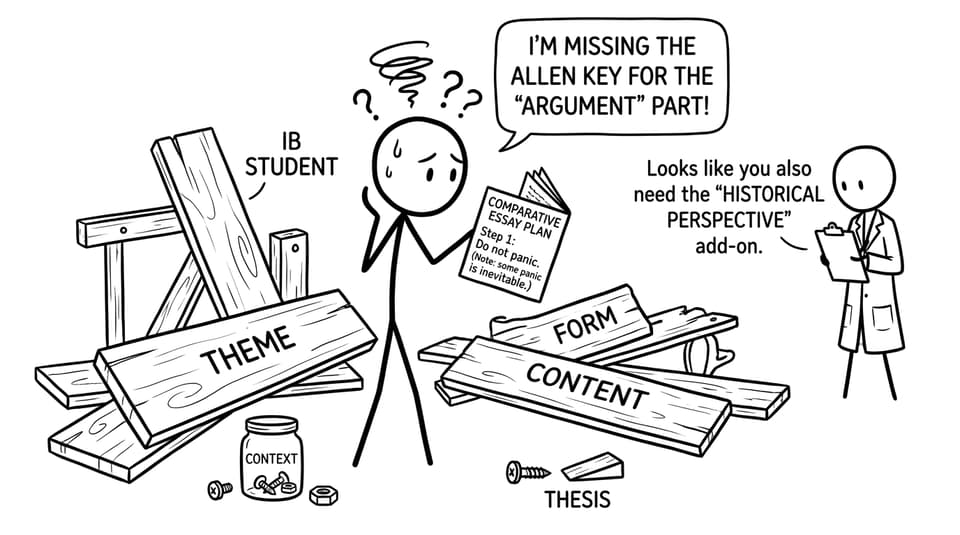
A stick-figure building an essay plan like IKEA
Comparative essay planning checklist for IB English
Use this quick checklist before you write a single paragraph in IB English:
Choose the prompt you can argue, not the one that sounds familiar.
Write a one-sentence comparative thesis with a clear “while/but/whereas.”
min read
min read
min read
min read
Pick 2-3 comparative angles (not 7).
For each angle, note theme, form, and content evidence for both texts.
Decide your structure (integrated point-by-point is usually strongest).
Build 4-6 paragraphs that compare both texts every time.
Theme in IB English: what the text is really exploring
In IB English, theme is not a plot summary. Theme is the underlying idea a text is wrestling with: power, belonging, control, moral compromise, gender, truth, memory, freedom.
Theme is your best starting point because Paper 2 prompts are usually thematic. But theme alone is never enough. The examiner’s silent question is: How is that theme created? That’s where form and content step in.
A practical way to plan theme:
Write the theme as a tension, not a topic.
Not “identity.”
Try “identity as performance vs identity as private truth.”
For each text, write a one-line “theme claim.”
Then add a “comparison hinge” (similarity + difference).
This is what turns IB English comparison into argument instead of listing.
Form in IB English: the engine that shapes meaning
Form is the container that changes the temperature of everything inside it.
A dystopian novel can make oppression feel systemic and endless. A play can turn oppression into a live social performance, where silence, pauses, and public scrutiny are part of the message. A poem can compress a life into a few violent images.
In IB English, form includes genre and structure, but also how a text moves: narration, staging, chronology, voice, perspective.
Ask form questions like:
What does this genre make possible?
What does it force the writer to hide or reveal?
How does the audience/reader receive meaning differently because of form?
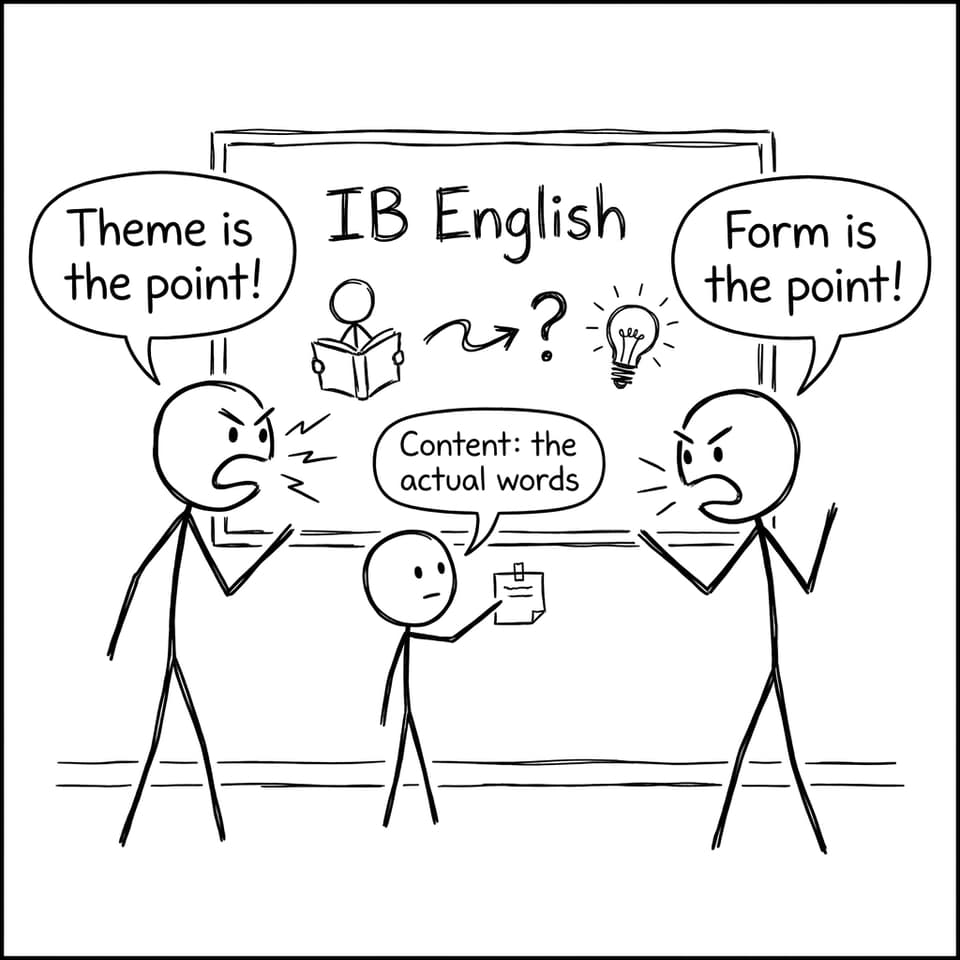
Three students arguing about theme vs form vs content
Content in IB English: the texture of the writer’s choices
Content is where students often over-collect and under-explain.
In IB English, content isn’t “what happens.” It’s the specific material and technique: diction, imagery, motifs, irony, symbolism, characterization, tone shifts, dialogue patterns, propaganda language, narrative distance.
A clean way to plan content is to choose two recurring techniques per paragraph. Not ten. Two.
Examples of content anchors:
A repeated image (mirrors, cages, uniforms)
A tonal pattern (comic to cruel, intimate to clinical)
A rhetorical method (direct address, slogans, contradictions)
A structural move (parallel scenes, delayed revelations)
When you plan like this, your paragraphs stop sounding like book reports and start sounding like IB English analysis.
Planning comparisons: theme vs form vs content (how to combine them)
Here’s the comparative move examiners reward:
Theme tells us what idea is being explored.
Form explains how the whole text is built to deliver that idea.
Content proves it through precise choices at sentence/scene level.
A strong paragraph plan for IB English often looks like this:
Point (theme claim): Both texts explore confinement, but one frames it as social spectacle while the other frames it as internalized self-policing.
Text A (form + content): Form feature + 1-2 technique examples + effect.
Text B (form + content): Form feature + 1-2 technique examples + effect.
Comparative sentence: “Whereas…; however…”
Link back to thesis: Show how this advances the argument.
Closing: the calmest way to write IB English comparisons
A comparative essay is not two stories placed side by side. It’s one idea examined through two different artistic machines.
When you plan with theme, form, and content, you stop hoping the comparison “appears” while you write. You build it on purpose. And in IB English, purposeful comparison is what turns knowledge into marks.
If you want a faster way to practise this planning process, use RevisionDojo’s Questionbank, run timed Mock Exams, and get immediate feedback with AI Chat and Grading tools. Start with the IB English A Lang & Lit Resources hub, and build your next comparative plan in minutes, not panic.