
Some exams feel like toll booths: you pay in time, stress, and weekends. IELTS is one of them. And the quiet hope many Diploma Programme students carry is this: What if the work I’m already doing in IB English counts as the proof universities want?
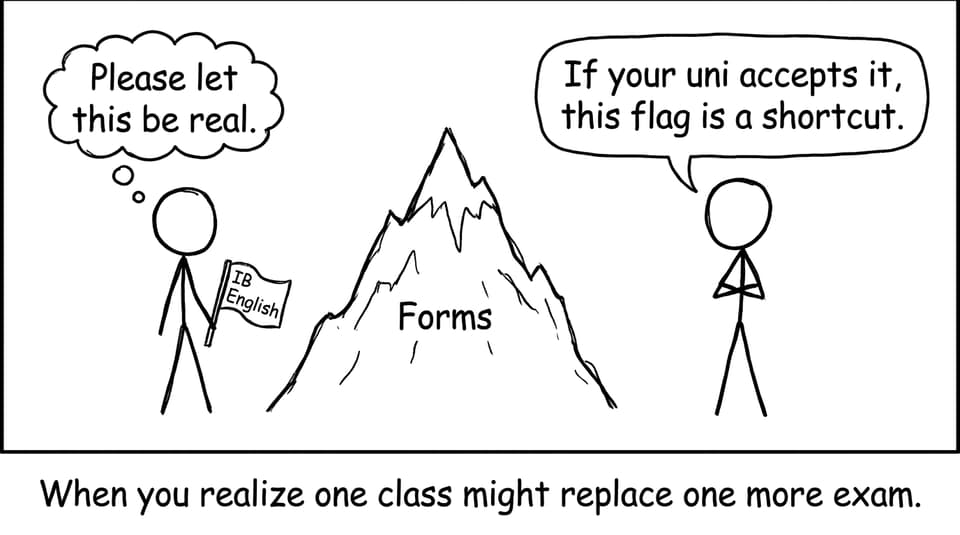
For a lot of applicants, it does. IB English can be accepted as evidence of English proficiency, and in many cases it can exempt you from IELTS. But the exemption isn’t automatic. It depends on which IB English course you take, what score you earn, and what policy your university (and sometimes visa authorities) actually apply.
Quick answer: the IB English classes that can exempt IELTS
In most university policies, the IB English course that most reliably leads to an IELTS exemption is:
-
English A: Literature (SL or HL)
-
English A: Language and Literature (SL or HL)
These are the “Language A” courses. They’re designed for near-native or native-level academic English, which is why universities often treat strong results as comparable proof of proficiency.
If you’re trying to confirm the bigger picture across institutions, it also helps to read how requirements are framed in admissions language. This overview on RevisionDojo is a useful starting point: Is IB English A Enough to Meet University Language Requirements?
Why English A is treated differently from other IB English options
Universities don’t just want “good conversational English.” They want evidence you can handle the specific pressures of academic study: dense reading, timed writing, structured argument, and nuanced interpretation.
That’s exactly what IB English A trains.
-
You read complex works and extract meaning beyond plot.
-
You write in a controlled, formal register.
-
You speak analytically under pressure (hello, Individual Oral).
-
You build arguments that are both technical and human.
In other words, the course itself behaves like a long, rigorous language exam spread across two years.
Which IB English class exempts you from IELTS? (The real-world breakdown)
English A: Literature
IB English A: Literature is the most traditional pathway. It’s text-heavy, interpretation-heavy, and built around literary craft.
Universities tend to view it as strong proof because it signals you can:
-
read at university level
-
write analysis under timed conditions
-
handle comparative argument and synthesis
If you’re currently revising and want exam-specific practice that matches how IB expects answers to be shaped, RevisionDojo’s resources can help you stay precise: Individual Oral (IO) Questionbank
English A: Language and Literature
IB English A: Language and Literature often feels even closer to university study because it blends literature with real-world texts (media, speeches, opinion writing, visual texts).
That mix is why many institutions treat it as equally valid for IELTS exemption. You’re demonstrating language control across contexts, not just within novels.
For targeted exam practice, these RevisionDojo Questionbanks are especially relevant:
And if Paper 1 is your current stress point, this guide is worth bookmarking: Mastering IB English Paper 1: A Complete Guide
What score usually triggers an IELTS exemption?
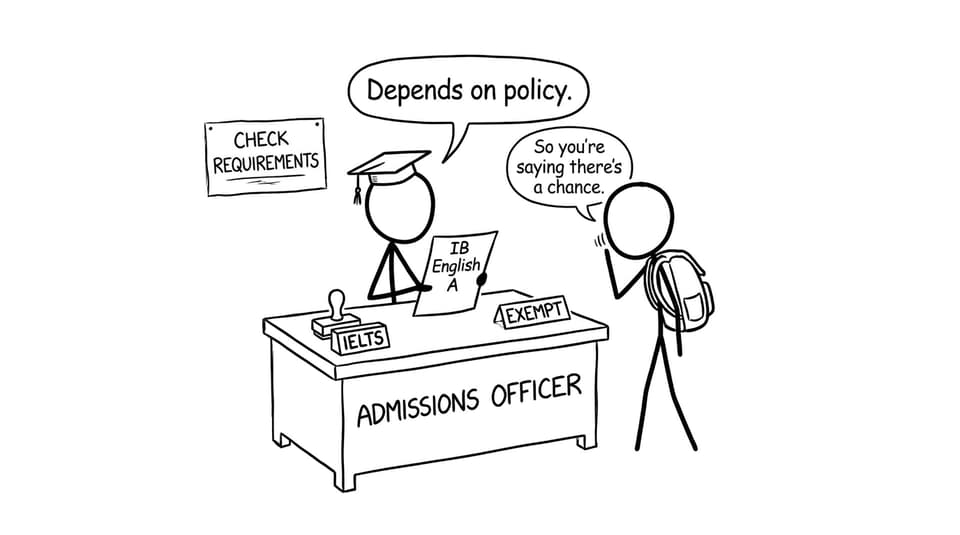
Policies vary, but a common minimum is a 5 in IB English A (either course). Some universities want a 6 or 7, especially for competitive programs or language-intensive degrees.
RevisionDojo explains typical thresholds clearly here: What IB English Grade Exempts You from IELTS?
If you like tracking targets with numbers instead of vibes, you can also keep an eye on general performance expectations using: IB Grade Boundaries
A practical checklist to confirm your own exemption
The safest mindset is: IB English can exempt IELTS, but only if you confirm it early. Use this short checklist:
-
Find the university’s “English language requirements” page.
-
Look specifically for “IB” or “International Baccalaureate” in the accepted qualifications.
-
Confirm the course name matches (English A: Literature or English A: Language and Literature).
-
Confirm level (SL/HL) and minimum grade.
-
If you’re applying for a visa, check whether immigration rules differ from admissions rules.
-
Email admissions if anything is unclear, and save the written reply.
When you want a broader scan of related guidance, the topic hub can help you navigate without getting lost: All IB English Posts
How to use IB English to strengthen your application (even with an exemption)
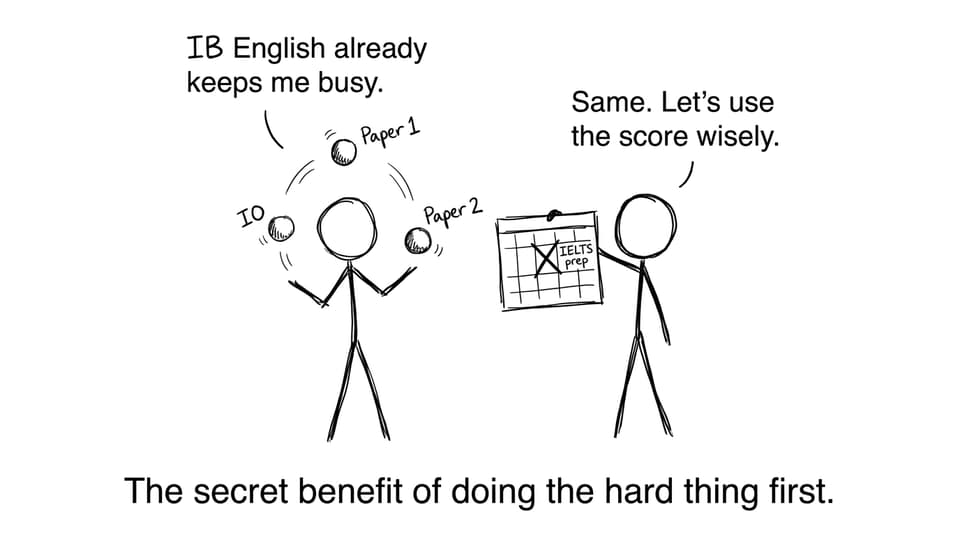
Here’s the part students miss: even if IB English exempts you from IELTS, your score still matters because it can signal academic readiness.
A calm strategy looks like this:
-
Use Study Notes to lock in core skills (thesis, topic sentences, technique analysis).
-
Use Flashcards for quick technique-and-effect recall when you’re tired.
-
Use the Questionbank to train timing and examiner expectations.
-
Use AI Chat to pressure-test interpretations and refine lines of argument.
-
Use Grading tools to see how close your writing is to top-band descriptors.
-
Use Mock Exams and Predicted Papers to practice under realistic constraints.
-
If you’re stuck, book Tutors for targeted feedback on exactly what’s holding you back.
If you want a sense of how RevisionDojo structures practice across subjects (and why that structure lowers panic), this is a helpful overview: IB Question Bank: Thousands of Practice Questions
Closing: make IB English do double-duty
The best part about an IELTS exemption is not the bragging rights. It’s the quiet reclaiming of time. If IB English is already demanding your attention, it’s worth letting that effort carry as far as it can.
Take English A seriously, confirm your target universities’ policies early, and aim for a score that gives you margin, not just minimum compliance. Then use RevisionDojo to turn preparation into something measurable: Questionbank practice, Study Notes, Flashcards, AI Chat, Grading tools, Predicted Papers, Mock Exams, Coursework Library support, and Tutors when you need a human eye.
Because the goal isn’t simply to avoid IELTS. The goal is to arrive at university already fluent in the kind of thinking that university will demand, and IB English is one of the cleanest ways to get there.