
If you have ever reread a paragraph in your draft and thought, That sounds smarter than I normally sound, you have already met the central tension of the IB Extended Essay.
The essay is supposed to be your first real step into academic research. But it is also written during one of the busiest, most stressful school years you will ever have. When time gets tight, shortcuts start to look like strategies. And that is where integrity stops being a slogan and becomes a series of decisions: what you read, what you record, what you cite, and what you claim.
In this guide, you will learn how to protect the honesty of your IB Extended Essay without turning the process into a paranoid checklist. The goal is not to sound perfect. The goal is to sound like you, thinking carefully, with evidence.
Integrity checklist for the IB Extended Essay (save this)
Use this as a quick self-audit whenever you open your IB Extended Essay document:
-
Your research question is focused enough to answer with analysis, not summary.
-
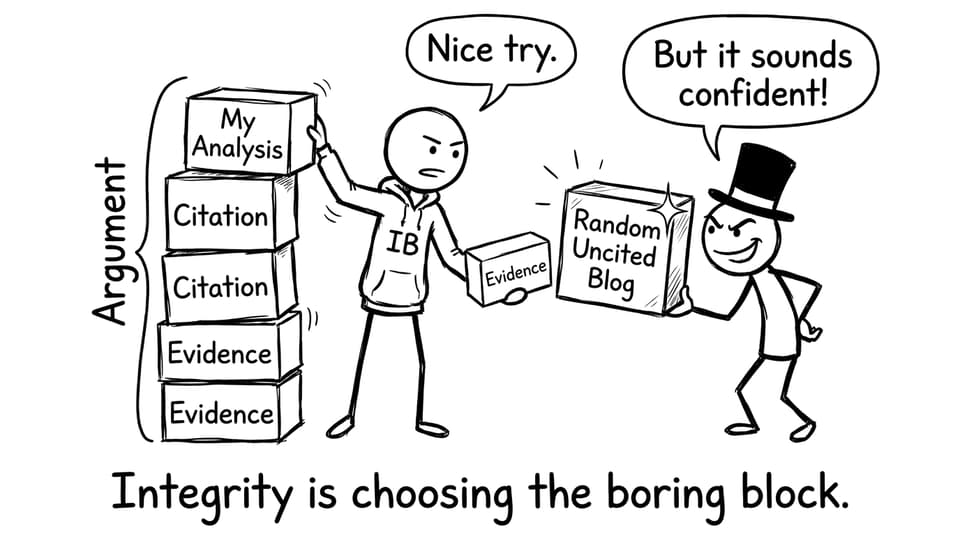
Every statistic, quote, theory, image, table, graph, and non-obvious idea is cited.
-
Your notes separate quotes, paraphrases, and your own commentary.
-
Your argument has a visible spine: claim, evidence, analysis, and evaluation.
-
Your reflection evidence (RRS/RPF notes) shows real decisions and pivots.
-
Any help you received stayed within safe boundaries (guidance, not rewriting).
If you want structured EE support, start with the hub of IB Extended Essay Guides and browse the IB Extended Essay collection when you get stuck.
What “integrity” really means in an IB Extended Essay
Integrity in the IB Extended Essay is not only about avoiding plagiarism. It is about making your investigation traceable.
A strong EE is built on three quiet promises:
-
Authentic inquiry: you asked a question that you can genuinely investigate.
-
Transparent sourcing: a reader can see exactly where your evidence came from.
-
Original argumentation: your conclusions follow from your reasoning, not from imitation.
This is why the IB is serious about authenticity. A polished essay that cannot be explained is less impressive than a slightly messy essay that is clearly yours.
If you want a clear overview of what the IB expects, read What Are IB’s Expectations for Academic Honesty in the Extended Essay (EE).
Choosing a topic that stays ethical (and genuinely original)
Most integrity problems begin before you write a single paragraph. They begin when the topic is too broad, too trendy, or too dependent on someone else’s framework.
A practical way to keep your IB Extended Essay original is to choose a topic where your method creates the uniqueness. For example:
-
A specific text pairing, rather than “How does X theme appear in literature?”
-
A defined time window, rather than “How has X changed over time?”
-
A reproducible dataset, rather than “What do people think about…?”
If you are still deciding, use 10 Powerful Tips to Choose a Strong EE Topic That Interests You and then narrow with IB Extended Essay Research Question: 8 Proven Tips. If you are working under the latest guidance, EE Research Question: What Works in 2027 is a useful reality check.
A simple ethics filter before you commit
Before you lock in your research question, ask:
-
Would I be comfortable explaining my methods to my supervisor in detail?
-
Am I using any human participants, personal data, or sensitive topics?
-
Could my data collection harm someone, pressure someone, or invade privacy?
If anything feels unclear, it is not a sign you should quit. It is a sign you should redesign.
Research habits that make your IB Extended Essay defensible
There is a difference between “I found a source” and “I can prove I used it responsibly.” Integrity lives in your research habits.
Here are practices that make your IB Extended Essay safer and stronger at the same time:
-
Build a source log from day one. Record author, title, date, page numbers, and access date.
-
Keep your notes tri-colored: direct quotes, paraphrases, and your own reactions.
-
Save evidence of process: screenshots of datasets, PDFs, and draft versions.
-
Prefer verifiable sources: journals, books, official statistics, and credible institutions.
If you need a referencing-focused guide, IA Citations: 10 Best Practices for IB EE and IA explains the habits that prevent last-minute citation chaos.
Plagiarism, “patchwriting,” and accidental copying
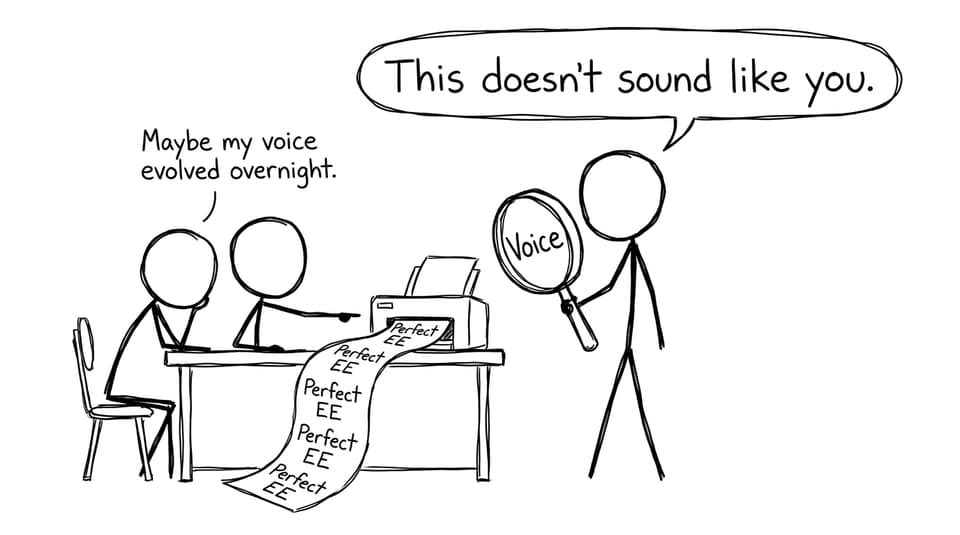
Many students imagine plagiarism as a dramatic act: copying and pasting an entire page. In reality, the most common risk in an IB Extended Essay is patchwriting, rewriting a source with the same sentence structure and only swapping a few words.
To avoid this:
-
Read the passage.
-
Close the tab or book.
-
Write your idea from memory.
-
Reopen the source and check accuracy.
-
Cite it.
That one routine makes your writing both more original and easier to defend.
A quick rule students forget: duplication of work
Your IB Extended Essay must be distinct from your IAs and other assessed tasks. Even if you wrote the original words, reusing large chunks can still be treated as duplication.
If you are unsure what is safe, Can You Copy Your Own EE Into Your IA? clarifies the boundary: reuse learning, not language.
Citations that build trust (not just formatting)
In the IB Extended Essay, citation is not decoration. It is how you show the reader what is yours.
Aim for citations that do three jobs:
-
Traceability: the examiner can find the exact claim in the original source.
-
Accuracy: you did not bend the source to fit your conclusion.
-
Consistency: one referencing style used reliably.
If you are confused about what to label your sources section, EE Reference List vs Bibliography: Key Differences is a clean explanation.
Technology and AI: use tools without outsourcing authorship
Tools can make your IB Extended Essay more organized and more thoughtful. They can also tempt you into borrowing a voice that is not yours.
A safe principle is this: use technology to learn faster, not to submit someone else’s phrasing as your own.
RevisionDojo is designed around that boundary. Students use Study Notes to clarify concepts, Flashcards to retain definitions and frameworks, and AI Chat to ask questions about criteria and structure; then they write the essay themselves. When it is time to polish, RevisionDojo’s Grading tools help you check alignment with the rubric, while Tutors can guide your thinking without replacing it.
For a broader integrity map (beyond the EE), see How to Uphold Academic Integrity in IB Assessments and the platform perspective in How RevisionDojo Helps You Maintain Academic Integrity While Studying.
Original argumentation: how to sound like a researcher, not a narrator
The fastest way to lose originality in an IB Extended Essay is to turn it into a tour of sources: “Author A says… Author B says…” That is reporting.
Original argumentation looks more like this:
-
Claim: what you think is true (in a limited, precise way).
-
Evidence: the data, quotation, or case detail.
-
Analysis: what the evidence suggests and why.
-
Evaluation: limitations, bias, alternative explanations.
If you want help building a discussion that stays analytical, IB Extended Essay: Critical Discussion Tips (With Examples) is a strong next step.
Honest reflection: your process is part of the evidence
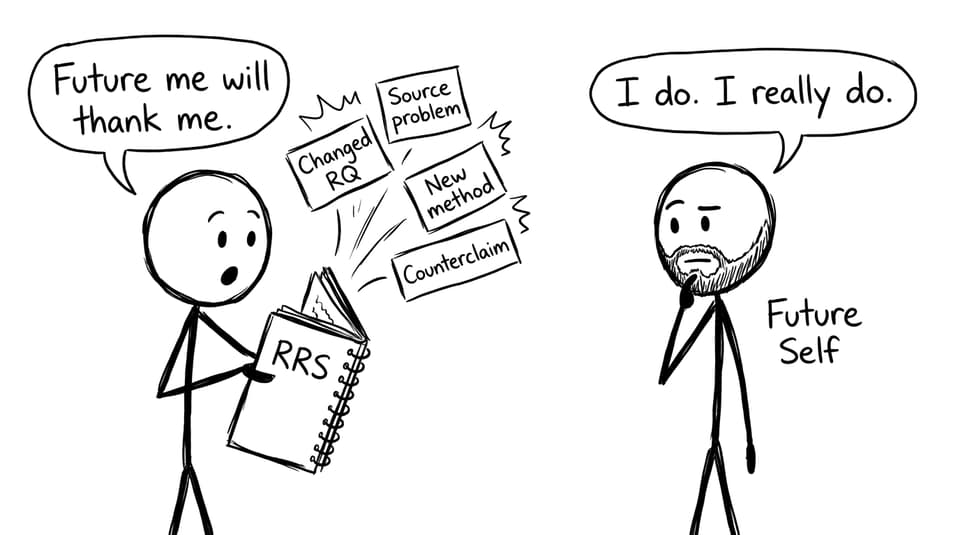
Reflection is not a diary entry. In the IB Extended Essay, reflection is proof that you made decisions.
A simple way to keep it honest is to record small, frequent notes about:
-
what you tried,
-
what failed,
-
what changed,
-
what improved.
That is why the Researcher’s Reflection Space exists. It gives you somewhere to store your thinking while it is still real.
If you need guidance on reflections and sessions, these are worth bookmarking:
Closing: make integrity your competitive advantage
The honest truth is that integrity is not only a moral standard in the IB Extended Essay. It is also a strategic advantage.
When your research is traceable, your citations are clean, and your argument is genuinely yours, you write faster. You panic less. You can explain your work confidently in reflection sessions. And you walk into exam season with the rare feeling that you did not borrow your achievement from anyone else.
If you want support that strengthens your understanding without replacing your voice, use RevisionDojo’s Questionbank to test your subject knowledge, Study Notes and Flashcards to stay sharp, AI Chat to clarify criteria, Grading tools to check rubric alignment, and Mock Exams and Predicted Papers to protect your exam prep time while the IB Extended Essay gets finished properly.
Your IB Extended Essay is not supposed to be perfect. It is supposed to be real. And that is exactly what makes it worth writing.