
The moment you submit your EE, something odd happens.
For weeks, your brain has been trained to believe the project is never really finished. There is always another citation to fix, another paragraph to tighten, another sentence that feels like it was written by a sleep-deprived version of you (because it was). Then you hit submit and expect… silence.
Instead, you get one last meeting.
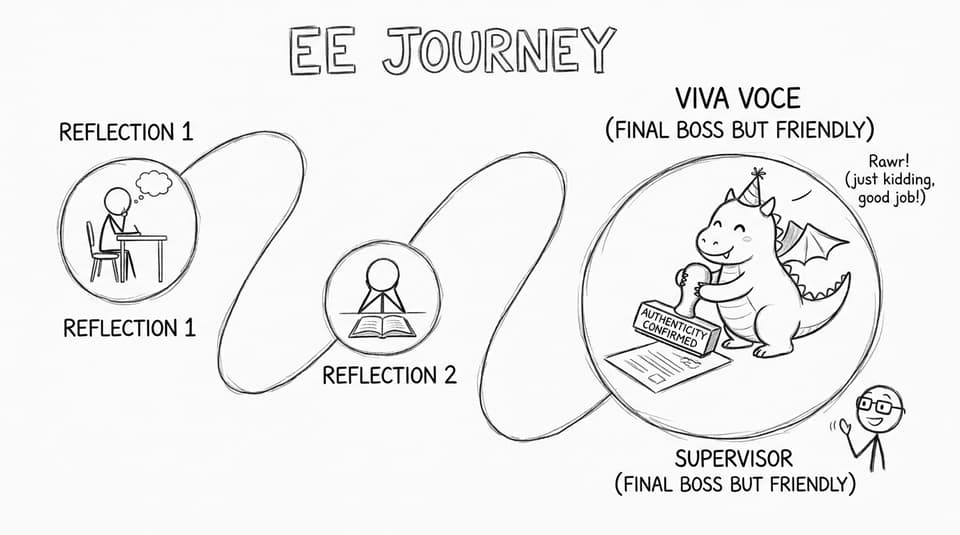
It’s called the viva voce, and for many IB students, the name alone makes it sound like a courtroom scene. But the truth is calmer and more human: the EE viva voce is the third and final mandatory reflection session, a concluding interview with your supervisor after you have submitted your completed essay. It’s meant to be a celebration of completion and a conversation about what you learned from the process. And it directly informs the final reflective statement written on the RPPF.
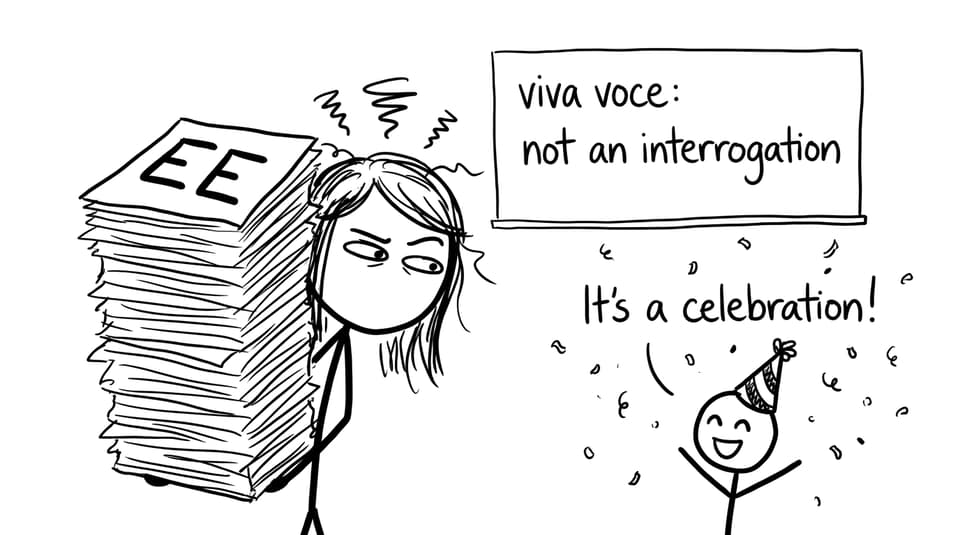
What is the viva voce in the EE?
The viva voce is the final formal reflection in your EE journey. It happens after you submit your final essay, and it is conducted as an interview (often 10 to 30 minutes) with your supervisor.
In simple terms, the IB wants a final check-in that captures three things:
- Completion: you finished the EE, and you can articulate what you produced.
- Authenticity: you can discuss your decisions and process in a way that shows the work is genuinely yours.
- Engagement: you can reflect on growth, setbacks, and learning in a concrete, specific way.
If you want the official structure behind the process, RevisionDojo’s subject-specific guides make it easier to see how the reflection sessions fit into the full EE timeline, like this overview: IB Extended Essay Guides.
Quick checklist: what to do before your EE viva voce
Use this quick list the day before your viva voce (or the hour before, if that’s the kind of student you are):
- Re-read your final EE (at least the intro, conclusion, and key analysis sections).
- Re-read your earlier reflection notes (RRS if you kept one, plus what you wrote on the RPPF).
- Identify 2 turning points: a moment your research question changed, and a moment your method changed.
- Prepare 1 honest challenge you faced and 1 solution you tried.
- Choose 1 thing you’re proud of that is specific (not “I worked hard”).
- Choose 1 thing you’d improve if you had two extra weeks.
If you want a more detailed prep approach with example questions, this post is built exactly for that: How to Prepare for the IB Extended Essay Viva Voce.
Why the EE viva voce matters more than it feels
Here’s the quiet truth: the viva voce is not where you prove you’re smart. It’s where you prove you were present.
A strong EE is not just a polished argument. It’s a trail of decisions: why you chose that topic, why you narrowed the question, why you trusted one source and rejected another, why you changed direction when your first plan failed.
The IB rewards that trail through reflection and engagement. And the viva voce is the final moment where your supervisor can capture the shape of your thinking at the end.
If you want to see how reflection links to marks and what “engagement” actually looks like, this breakdown helps: How Reflection Strengthens Your IB Extended Essay.
What your supervisor is trying to do in the viva voce
In the EE viva voce, your supervisor is usually trying to:
- Help you articulate what you learned.
- Confirm the EE is authentically yours (in a supportive, not suspicious, way).
- Gather the final evidence needed to complete the last part of the RPPF.
- End the process with closure.
Think of it like this: your supervisor has watched you build something slowly. The viva voce is where you both step back and look at it from a distance.
Common EE viva voce questions (and what they’re really asking)
Supervisors vary, but questions tend to circle the same core themes. Here are common question types, plus what a strong answer actually does.
What did you learn during your EE?
They are not looking for “I learned a lot about photosynthesis” or “I learned about the Cold War.” They want learning about:
- research habits
- method
- critical thinking
- handling uncertainty
- academic writing
A strong answer includes a specific example: “I learned that my first sources were too general, so I switched to peer-reviewed articles and used them to build a clearer debate in my literature review.”
What were your biggest challenges?
This is a gift question because it lets you show maturity. The IB doesn’t punish struggle. It rewards what you did next.
Use this three-step pattern:
- Challenge (specific)
- Decision (what you changed)
- Outcome (what improved)
If you want to practice writing this kind of reflection, use: How to Reflect on Challenges in Your IB IA or EE.
If you did the EE again, what would you change?
This is not a trap. It’s a way to show you can evaluate your own work.
Strong answers avoid dramatic self-criticism (“everything was terrible”) and instead offer one precise improvement: “I would narrow my research question earlier and pilot my data collection method before committing to it.”
Which part of the EE are you most proud of?
This helps your supervisor write a reflection that feels real. Choose something concrete:
- a paragraph where your argument clicked
- a graph/table you designed well
- a section where you evaluated counterarguments
- a structural decision that improved clarity
If you want to tighten your full draft mindset for moments like this, see: How to Improve Your IB Extended Essay Draft.
How the viva voce connects to the RPPF (and your final reflection)
The EE reflection process is recorded on the RPPF, and the viva voce feeds directly into the final reflective statement. That final statement is not just a summary. It’s a last chance to show what changed in your thinking from the beginning to the end.
A high-quality final reflection usually includes:
- What you set out to do (early intention)
- What changed (method, question, scope, sources)
- Why it changed (evidence-based reasoning)
- What you learned (about research and about yourself)
If you want to understand how examiners think about the criteria behind the EE (including engagement), this guide is useful context: What Are the Assessment Criteria for the IB Extended Essay?.
The most common EE viva voce mistakes (and how to avoid them)
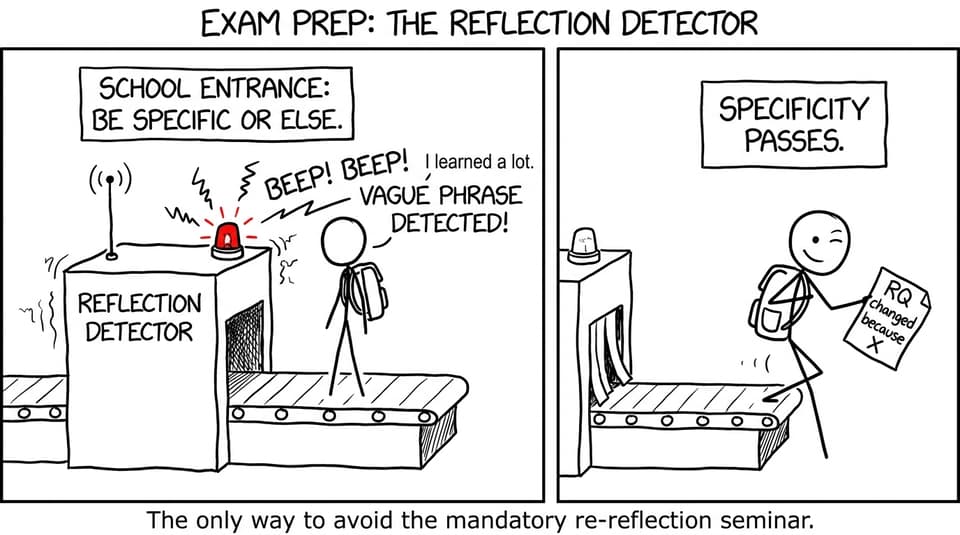
Being too vague
If you say “I learned time management,” you’re not wrong. But you’re not giving your supervisor anything to work with.
Instead: “I learned to build buffers into my timeline. When my first dataset didn’t work, I still had five days to redesign my method.”
Treating it like a defence
The viva voce is not a debate. It’s reflection.
If a supervisor asks about limitations, they are giving you a chance to show academic honesty, not trying to lower your EE grade.
Forgetting the story of your research question
A good EE research question usually evolves. Remembering how and why it changed is one of the clearest signals of real engagement.
If you need help thinking about research question revisions, this one is worth reading: The Importance of Research Question Revision During the EE Process.
A calm way to prepare: the 10-minute EE viva voce routine
Try this the day of your viva voce.
- 2 minutes: skim your introduction and conclusion.
- 3 minutes: find one paragraph you’re proud of and note why it works.
- 3 minutes: note one problem you faced and how you solved it.
- 2 minutes: write one sentence that begins: “The biggest change in my thinking was…”
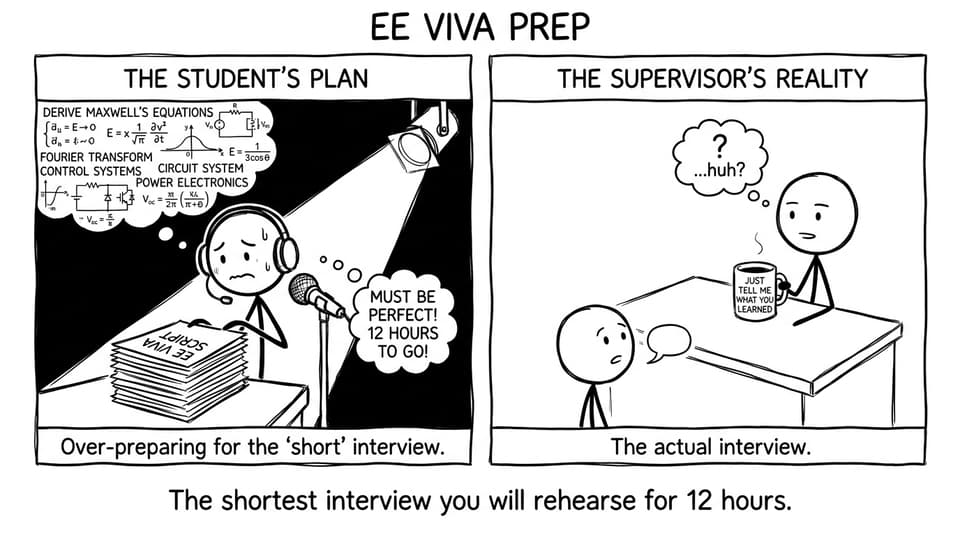
That’s enough. The goal is clarity, not scripting.
How RevisionDojo helps you finish your EE strongly (without losing exam prep time)
Most students feel the same tension: the EE is demanding, but exams are still coming.
RevisionDojo is built to reduce that trade-off by keeping your work organized and feedback actionable:
- Use the Grading tools to check whether your writing is drifting into description instead of analysis.
- Use AI Chat to rehearse viva voce-style questions and turn vague reflections into specific ones.
- Use the Coursework Library to compare your structure against strong exemplar patterns: IB Coursework Examples: IA, EE and TOK Exemplars.
- Use Study Notes and Flashcards to keep content revision separate from coursework writing, so your brain doesn’t feel like one endless document.
- Use Tutors when you need a fast, human second opinion on whether your reflection actually shows engagement.
- Keep exam readiness moving with Questionbank, Predicted Papers, and Mock Exams so the EE doesn’t consume the final weeks.
If you want to browse more EE support in one place, start here: All IB Extended Essay Posts.
Closing: treat the EE viva voce like closure, not judgment
The EE viva voce is the last page of a long story, not a surprise chapter. It’s the third and final mandatory reflection session, happening after submission, and it’s designed to capture what you learned while the experience is still fresh. Yes, it supports the RPPF. Yes, it helps confirm authenticity. But at its heart, it’s a celebration of completion.
If you want your viva voce to feel calm, make it specific: name the turning points, name the choices, name the learning. Then let it be done.
When you’re ready to tighten reflections, strengthen writing, and protect your exam prep time at the same time, RevisionDojo is the place to do it, with with Questionbank, Study Notes, Flashcards, AI Chat, Grading tools, Predicted Papers, Mock Exams, the Coursework Library, and Tutors built for the full IB journey.