
If you have ever stared at an empty document and felt your brain quietly negotiate a truce with procrastination, you already understand the power of a good question.
A strong EE research question does not just “guide” your essay in a polite, academic way. It decides what you will read, what you will ignore, what you will measure, what you will argue, and whether your supervisor meetings feel like progress or like walking in circles.
In 2027, that matters more than ever. The internet is louder, AI is faster, and information is cheap. The scarce resource is not sources. It is judgment. And a good EE research question is basically judgment turned into one sentence.
Below is a practical, 2027-ready guide to what makes a good EE research question, with a checklist you can reuse, examples you can adapt, and tools you can lean on when the question starts drifting.
The 2027 checklist for a good EE research question
Use this as a quick test before you commit to weeks of work.
A good EE research question is:
- Clearly stated and focused (one sentence, precise terms, defined scope)
- Open to amendment if research forces a smarter direction (not a fragile yes/no)
- Rooted in your DP subject and invites subject-specific methods, concepts, or theory
- Built to encourage analysis, evaluation, and synthesis (not description)
- Strongly aligned with higher-order stems like “to what extent,” “how significant,” “how,” “in what ways,” “what if”
- Feasible within the 4,000-word limit and your access to data/texts/sources
If you want a deeper walk-through of how to phrase and refine an EE question, keep this open while you read: How to Craft the Perfect IB Extended Essay Research Question.
What changed for EE research questions by 2027 (and why it matters)
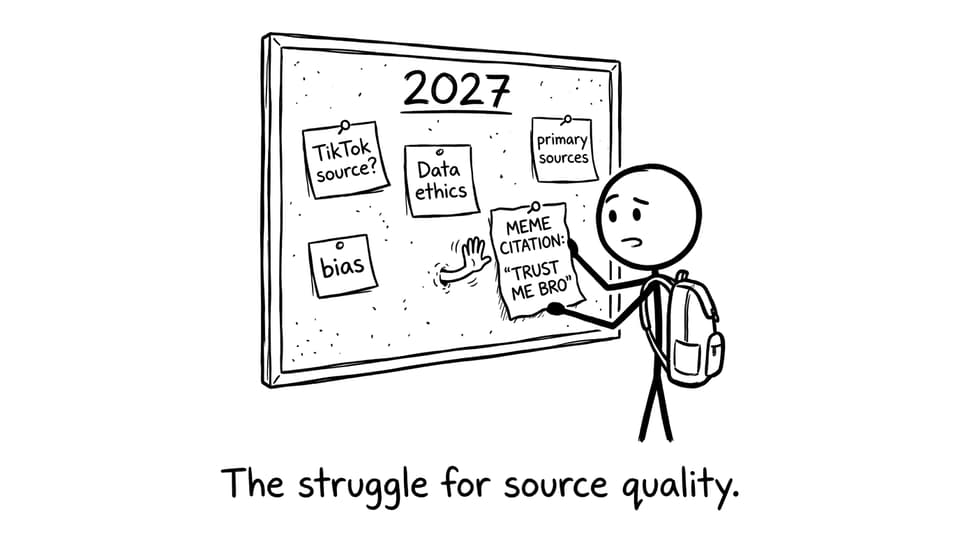
A decade ago, the hardest part of the EE was “finding enough information.” In 2027, the harder part is filtering what is reliable, relevant, and worth arguing with.
Three quiet shifts shape what a good EE question looks like now:
Source quality is the differentiator
Your marker is not impressed that you found something online. They are impressed when you show discernment: what counts as evidence in this subject, how reliable it is, and what its limits are.
If your question nudges you toward strong sources (primary data, credible scholarship, valid datasets, serious criticism), you will write a stronger EE almost by default.
For source strategy, this is worth bookmarking: What Are the Best Sources for IB Extended Essay Research?.
AI is everywhere, so thinking must be visible
You can use AI to brainstorm, clarify, and plan. But the EE reward system still favors human reasoning: critical choices, limitations, counterarguments, and justified methods.
A good EE question makes it hard to “fake depth.” It forces you to interpret evidence, not just collect it.
Your question needs a method built in
The easiest way to spot a weak EE research question in 2027 is this: it sounds interesting, but it does not imply how you will answer it.
Good questions carry a method inside them.
- In sciences: variables, comparison, conditions, measurable outcomes
- In humanities: case study boundaries, interpretive lens, competing perspectives
- In arts: analytic framework, criteria, and a defensible scope of works
If you want to sanity-check your overall EE structure alongside the question, use: How to Structure an Extended Essay (EE).
The core traits of a strong EE research question
The IB language around the EE can feel abstract until you translate it into question traits you can actually test.
Clear and focused: the “one breath” rule
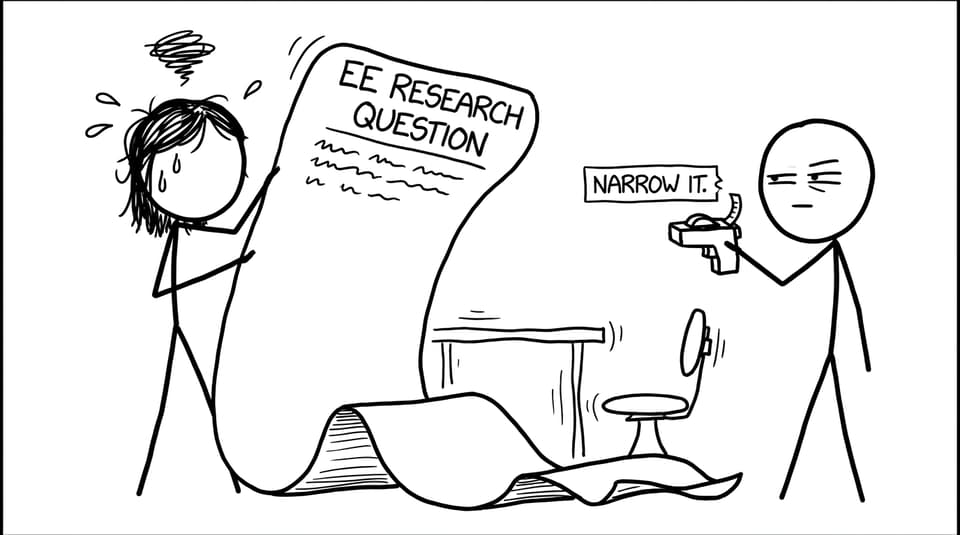
If you cannot say your EE question in one breath, it is probably trying to be two essays.
Focused does not mean small. Focused means bounded.
Boundaries can be:
- a specific time period
- a defined location
- a specific text set
- a particular model/theory
- a single dataset or population
A focused EE research question also defines key terms. If your question includes words like “success,” “impact,” or “representation,” define how you will operationalize them.
Open to amendment: stable, not brittle
A good EE question should allow you to revise without collapsing the whole project.
In practice, that means avoiding questions that depend on a single source or a single fragile claim.
Instead of: “Did policy X cause outcome Y?”
Aim for: “To what extent did policy X contribute to outcome Y, compared with factor Z?”
That one change gives you room to interpret and weigh evidence, which is what the EE is actually marking.
If you want a realistic view of how questions drift and how to revise them without panic, read: The Importance of Research Question Revision During the EE Process.
Subject-grounded: it must feel like your DP course
The EE is not a free-form curiosity essay. It is registered in a subject, and your question has to invite the tools of that subject.
A quick self-test:
- Could a student in a different DP subject answer the same question with the same approach?
- If yes, your question may be too generic.
RevisionDojo’s subject-specific hubs help because they show what “counts” as analysis in different subjects. Start here: IB Extended Essay Guides.
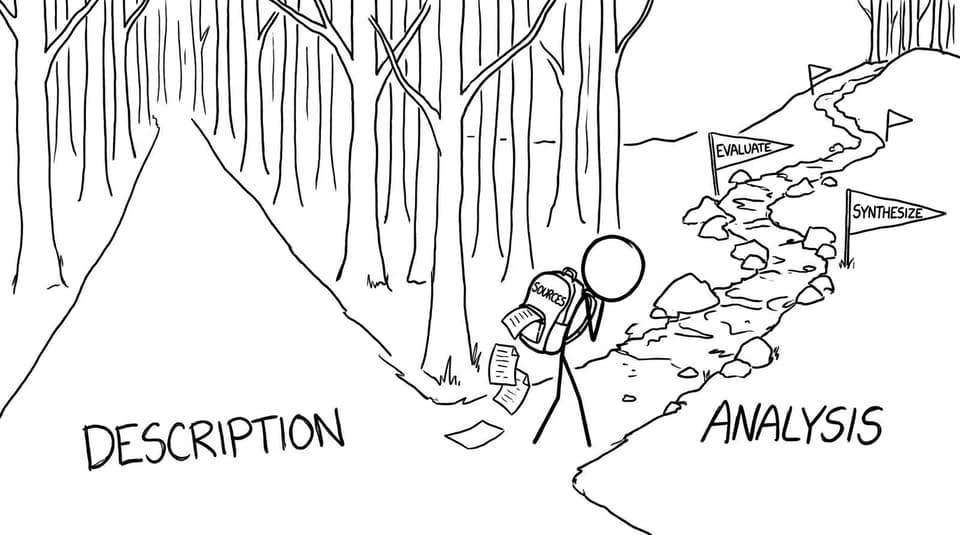
Analytical, not descriptive: build in evaluation
Description sounds like: what happened, what it is, what people believe.
Analysis sounds like: why it happened, how it works, what matters most, what changed, what the implications are.
A strong EE research question should force evaluation and synthesis.
If you are unsure whether your current phrasing is quietly descriptive, this guide is blunt in a helpful way: How to Make Your IB Extended Essay Analytical, Not Descriptive.
Higher-order stems that tend to score well (and why)
In 2027, the safest way to keep your EE question analytical is to use stems that imply argument.
Here are stems that naturally pull you toward evaluation:
- To what extent does X explain/affect Y?
- How significant was factor X in outcome Y?
- How does author/artist/policy X shape meaning/behavior/outcomes in context Y?
- In what ways does X reinforce/challenge Y?
- What if X changed, what what would likely happen to Y (within a theoretical model)?
These stems help because they imply:
- a line of reasoning
- competing explanations
- evidence that can be weighed, not just reported
Turning a topic into an EE question: a fast 3-pass method
Most students get stuck because they try to write the perfect EE question in one pass.
Use three passes instead.
Pass 1: Write the “messy” version
Write the version that is too broad. On purpose.
Example (History):
- “How did propaganda affect World War II?”
Pass 2: Add boundaries
Add time/place/audience/material limitations.
- “To what extent did British propaganda posters from 1939-1941 influence civilian attitudes toward rationing?”
Pass 3: Add the evaluative spine
Add comparison, criteria, or a framework.
- “To what extent did British propaganda posters from 1939-1941 influence civilian attitudes toward rationing, and how does this compare with evidence from contemporary diaries and newspaper letters?”
Now your EE question implies method, evidence types, and evaluation.
If you are building an outline alongside this process, use: How to Create an Effective EE Outline for a Logical Flow.
Examples of strong EE research questions (by style)
These are templates you can adapt. Keep the structure, swap the specifics.
Comparative questions
- “To what extent does X differ from Y in terms of Z, and what explains the difference?”
Why it works for an EE: it forces criteria, evidence selection, and synthesis.
Mechanism questions
- “How does X produce Y in context Z, using theory/model T?”
Why it works for an EE: it naturally leads to analysis using subject concepts.
Significance questions
- “How significant was X in causing Y, compared with factor Z?”
Why it works for an EE: it prevents a single-cause narrative and demands evaluation.
“What if” model-based questions
- “What if X changed, what what would the model predict for Y, and what are the limitations of that prediction?”
Why it works for an EE: it embeds theory and invites critical discussion of assumptions.
The biggest traps to avoid in 2027
A lot of EE stress is self-inflicted by choosing a question that creates avoidable pain.
The “Wikipedia table of contents” question
If your question reads like a documentary title, you will write description.
Revision tactic: add criteria, add a framework, add a comparison, or narrow to a case study.
More common pitfalls here: Mistakes to Avoid in IB Extended Essays.
The “too clever to research” question
Some questions sound brilliant but depend on inaccessible data, paywalled sources you cannot use, or an unrealistic method.
A good EE question is ambitious, but not imaginary.
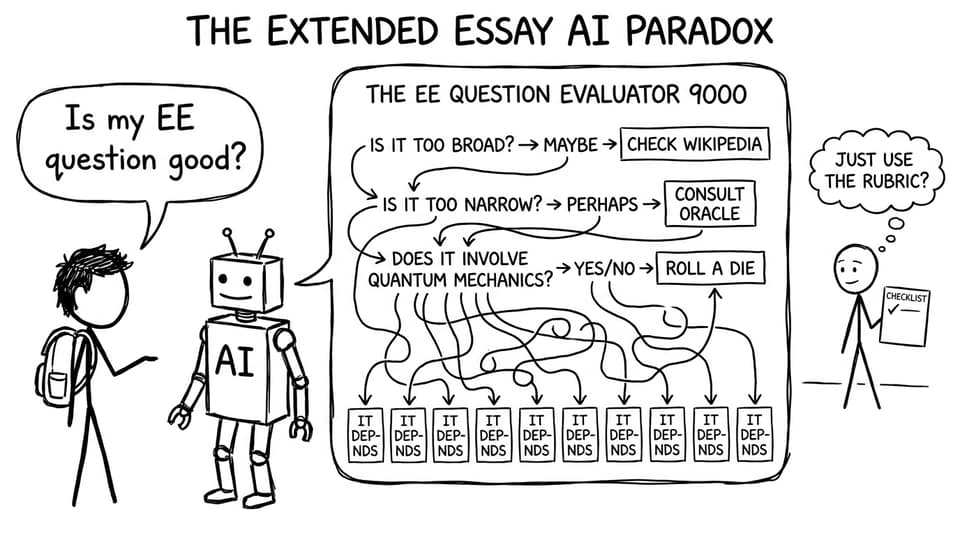
The “AI wrote my question” vibe
If your question is stuffed with abstract words (intersectionality, paradigm, hegemony, optimization, disruption) but you cannot define the terms simply, it will not hold up.
Use AI for brainstorming, but your EE question should sound like something you can defend in a supervisor meeting.
A practical workflow: how to pressure-test your EE question in one afternoon
Here is a realistic workflow that keeps your EE question grounded.
Find 8-12 serious sources first (yes, before finalizing)
If you cannot find credible sources, the question is not “challenging.” It is not feasible.
Write a one-paragraph provisional answer
If you cannot sketch an argument, you probably wrote a topic, not a question.
Draft three counterarguments or limitations
This forces you into EE-level evaluation early.
Map your question to your essay sections
If you are unsure what the introduction should do, this guide helps you anchor the question early: 7 Key Steps to Write a Strong Extended Essay Introduction.
Decide what “good evidence” means in your subject
Then commit. Do not keep changing the question every time you discover a new angle. Amend with purpose.
How RevisionDojo helps you build and refine an EE research question
A good EE question is not just a writing task. It is a project-management task.
RevisionDojo is built for that reality.
- Use the AI Chat to brainstorm stems, define terms, and generate alternative phrasings, and then choose the one you can actually research.
- Use Study Notes to quickly refresh the subject concepts your EE question needs (so your analysis stays subject-grounded).
- Use Flashcards to retain key theorists, definitions, and methods while your question evolves.
- Use Grading tools to check whether your introduction and line of argument still answer the EE question you wrote.
- Use the Coursework Library to see how top-scoring students phrase questions and sustain focus: Coursework Feature Hub and IB Coursework Examples: IA, EE and TOK Exemplars.
- Use Tutors when your question is almost right but still slipping between “interesting” and “assessable.”
- Keep exam prep safe by using Questionbank, Predicted Papers, and Mock Exams so the EE does not quietly steal all your timed practice.
And if you want a single page to orient yourself across subjects, start with: IB Extended Essay Guide: Structure, Research Question, and More.
Conclusion: a good EE question is a commitment to clarity
In 2027, a good EE research question is less about sounding impressive and more about being usable. It is a promise that you can research, analyze, and evaluate, using the tools of your DP subject, within real constraints.
If you take one thing from this: write an EE question that makes your next step obvious. The right sources. The right method. The right argument shape.
When you are ready to test your question against real examples and examiner-style expectations, RevisionDojo is the fastest way to make your EE feel manageable: use the Coursework Library, sharpen your logic with Grading tools, clarify concepts with AI Chat, and protect your exam performance with Questionbank, Predicted Papers, and Mock Exams.
Your EE starts as a sentence. Make it a sentence you can live inside for months.