
When deadlines stack up, your brain starts bargaining.
You look at your Extended Essay. You look at your IA. The topics are cousins. The arguments even share the same DNA. And a quiet thought appears: Surely I can copy my own work. It's mine.
That thought feels practical. It also feels dangerous.
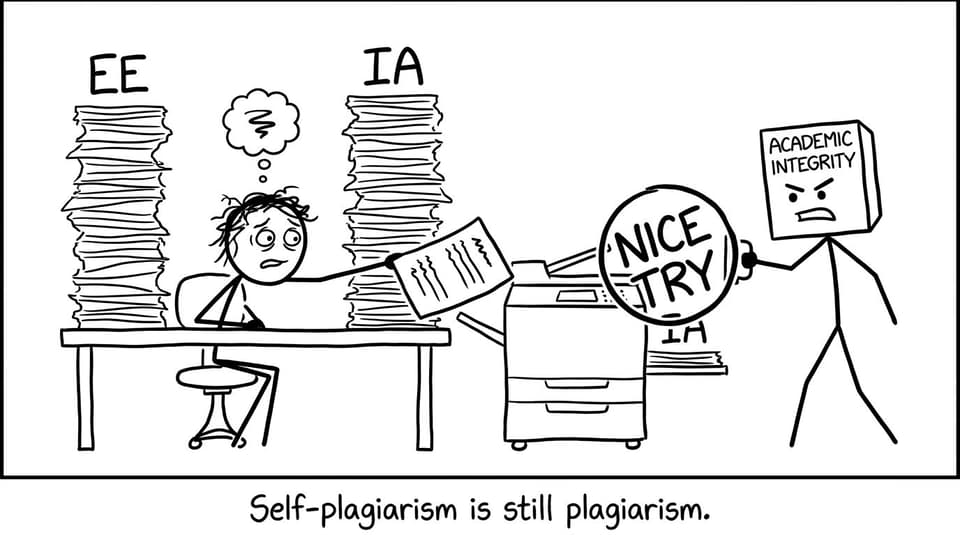
In the IB, your IA must be authentic, original work written for that specific assessment. Copying large parts of your EE into your IA can become duplication of work (often called self-plagiarism), and it can trigger academic integrity concerns even if you wrote every word yourself. This post breaks down what you can reuse, what you should never reuse, and how to turn overlap into an advantage without risking your diploma.
The quick answer (and the safer mindset)
Can you copy your own EE into your IA?
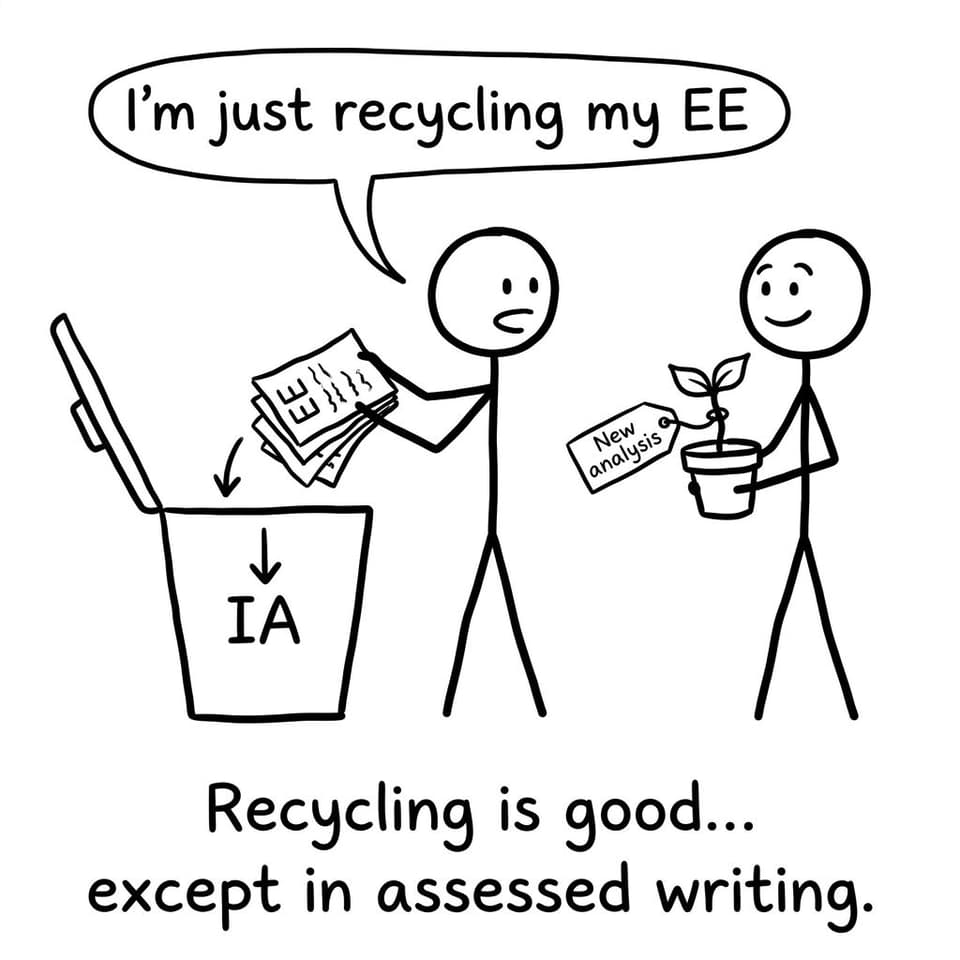
Not in any substantial way. Your IA is supposed to be a distinct piece of assessed work with its own purpose, structure, evidence, and analysis. Reusing chunks of EE text, the same analysis, or the same crafted argument often counts as duplication of work, even if you are the original author.
A safer mindset is:
- Your EE is a research apprenticeship.
- Your IA is a performance on a specific rubric.
- You can reuse learning, not language.
If you want an IB-aligned overview of what an IA is (and why it's treated as its own assessed product), start with IB Internal Assessment: A Complete Guide to Success.
A practical checklist: what you can reuse vs what you can't
Use this before you transfer anything from EE notes into an IA draft.
Generally OK to reuse (with care)
- Your topic area (e.g., the same author, the same economic policy, the same lab theme).
- Your general background understanding (concepts you genuinely learned).
- A source list you discovered (but re-read and re-integrate it).
- A method idea (but your IA execution must be purpose-built).
- Small factual statements that are common knowledge or clearly cited.
Generally NOT OK to reuse
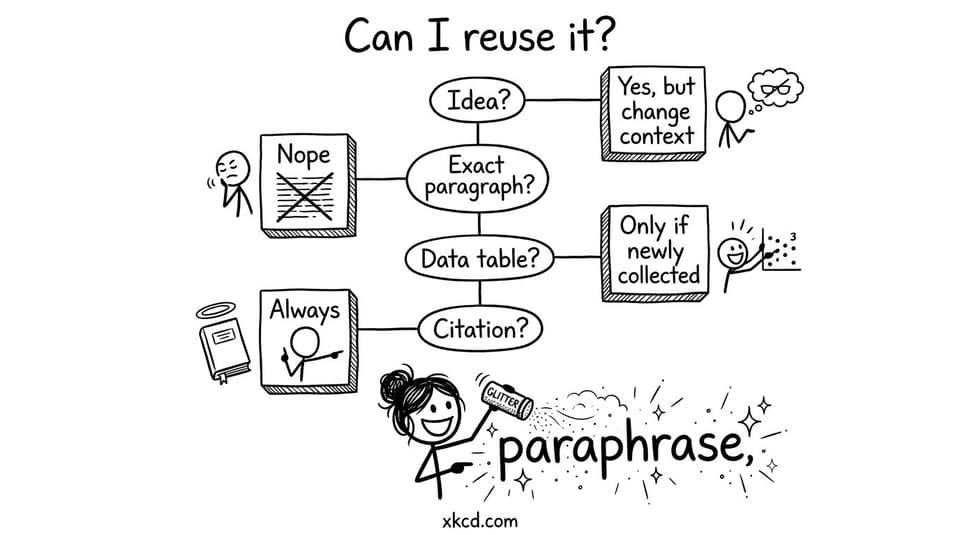
- Whole paragraphs or long phrasing from your EE.
- The same analysis chain (claim -> evidence -> evaluation) repeated.
- The same diagrams, tables, or graphs unless they are newly created for the IA and properly justified.
- The same dataset if it makes the IA essentially the same investigation.
- Your EE's structure used as a template for the IA.
If you're unsure, treat your EE draft like a published source: you can cite it for a tiny point, but you don't get to re-submit it.
For more on what counts as plagiarism and self-plagiarism in an IA context, read How to Avoid Plagiarism in Your IA.
Why "it's mine" still doesn't make it acceptable
The IB is not only assessing whether you produced words. It's assessing whether you produced this assessed task independently and authentically.
That's why duplication is treated seriously:
- Fairness: If one student can earn marks twice for the same thinking, assessment stops measuring what it claims to measure.
- Authenticity: Teachers must verify the IA is your own work created for that component.
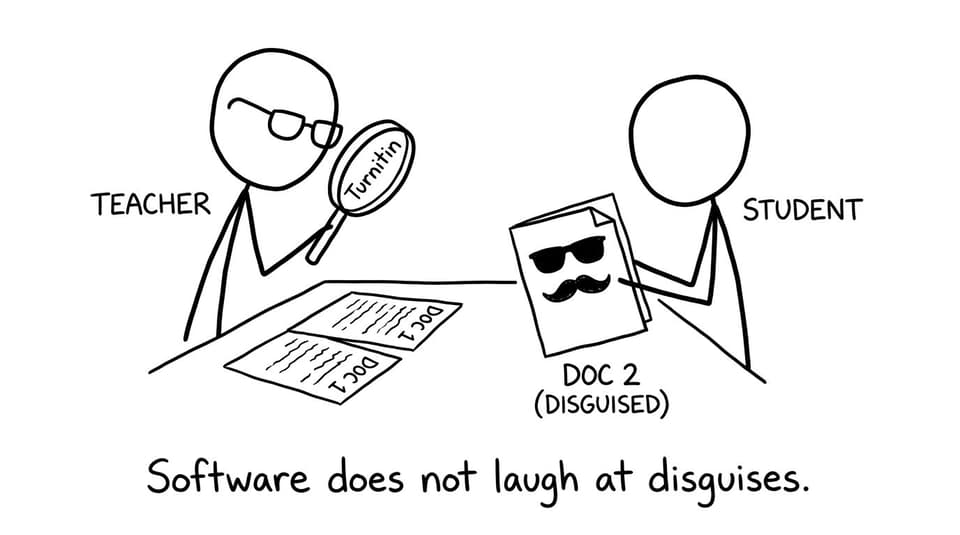
- Traceability: Similarities between submissions can be flagged by plagiarism-detection tools and moderation processes.
RevisionDojo's broader integrity guidance matches this principle: use tools to learn and improve, not to misrepresent authorship. See Academic Integrity & Data Privacy for IB Students.
The real risk: it's not just "getting caught"
Most students think the risk is a dramatic one: someone runs a check, you get flagged, everything collapses.
Sometimes it is dramatic. But more often, the cost is quieter:
- Your teacher becomes cautious, because they must authenticate the IA.
- Your writing looks "too polished" compared to your classwork voice, which raises questions.
- Your IA becomes oddly shaped: it reads like an EE squeezed into an IA word limit.
- You lose marks because the IA criteria reward different moves than an EE.
If you want a sober overview of consequences and why the IB treats misconduct as a system-level issue, see What Are the Penalties for Academic Misconduct in IB?.
How to reuse your EE ethically: the "idea transfer" method
If your EE is relevant to your IA topic, you can still benefit from it massively. You just need a clean process that makes your IA new.
Start from the IA rubric, not from your EE document
Open your subject's IA criteria and ask:
- What does this IA reward?
- What counts as "analysis" here?
- What counts as "personal engagement" or evaluation here?
Then use the EE only as a knowledge reservoir.
If you want to see how examiners describe strong IA qualities across subjects, What IB Examiners Look for in a Strong IA is a useful calibration read.
Rebuild your argument from scratch using new scaffolding
Try this exercise:
- Write your IA research question in one sentence.
- Write three claims that answer it.
- For each claim, list the evidence your IA will use.
- For each evidence piece, write what you will do with it (process, compare, evaluate).
If your bullet points look like your EE's table of contents, you're duplicating.
Use your EE sources, but re-read and re-cite them in context
It's fine if both the EE and IA cite the same academic article. The difference is whether:
- your IA uses it for a different purpose,
- your explanation is newly written,
- your analysis is newly constructed.
If you need help tracking citations cleanly, RevisionDojo's ecosystem (Study Notes + AI Chat + Grading tools) is built to keep your workflow transparent. For subject-specific citation guidance, for example in Math, see How to Reference Mathematical Sources Properly in the IB Math IA.
What about reusing data, diagrams, or experiments?
This is where students accidentally create an IA that is basically their EE in a lab coat.
Reusing data
Reusing the exact same dataset can be risky if it makes the IA not meaningfully new. In many subjects, the IA is expected to show an investigation designed for that task, not a recycled dataset.
If you want a clean standard to use:
- Same topic: often fine.
- Same data: only safe if your teacher explicitly approves and the IA does something demonstrably different.
And remember: even if allowed, the writing must be freshly authored.
Reusing diagrams/figures
If a diagram is generic (e.g., a supply-demand diagram), redrawing it is normal, but it must be integrated with new commentary and proper labeling. If the diagram is a unique creation from your EE, copying it across can still look like duplication.
For subject IA requirements and authenticity reminders, browsing a subject guide entry like Essentials of the Internal Assessment (example guide) can help you see the consistent expectation: the IA is independent work.
A smarter way to "save time" without copying
Time pressure is real. The trick is to save time in ways that don't gamble your authenticity.
Here are four moves that work.
Use exemplars for structure, not for sentences
A strong IA often sounds simple because it is disciplined: clear RQ, evidence that fits, analysis that stays on the rails.
RevisionDojo's IA/EE/TOK exemplars (examiner-verified) are helpful because they show shape: what top work tends to include and what it leaves out.
Get rubric-aligned feedback early
Instead of copying EE paragraphs, put your messy IA draft into a feedback loop:
- Use RevisionDojo's Grading tools to see where you're missing criteria.
- Use AI Chat to ask for clarification on a criterion (then write in your own voice).
- Use Study Notes and Flashcards to strengthen the underlying content so your analysis becomes easier to write.
If your school is using moderation workflows, it's worth understanding how IA feedback systems are designed to protect consistency and integrity. See How RevisionDojo Enhances IB Internal Assessment (IA) Feedback and Moderation.
Build a "difference list" before you write
Write a short list titled: How my IA is different from my EE.
Include at least:
- a different research question angle,
- different evidence (or different processing),
- different evaluation focus,
- different conclusion purpose.
If you can't write this list, don't start drafting yet.
Use a planner that protects your attention
A lot of duplication happens late at night, when "efficient" starts sounding like "identical." A realistic schedule reduces that temptation. What's a Realistic IB Study Plan for a 6? includes a practical way to allocate weekly time to IA refinement without panic.
The bottom line: make your IA unmistakably its own work
The question "Can you copy your own EE into your IA?" is really a question about how you want to be measured.
If you copy, you're betting that no one notices the overlap. If you rebuild, you're betting on something better: that your understanding is real enough to write twice, differently, and still be convincing.
Use your EE as the compost, not the crop. Let it feed a new IA with a sharper research question, cleaner evidence choices, and analysis that fits the rubric.
If you want a structured way to do that, RevisionDojo is designed for exactly this stage: Coursework Library exemplars to model quality, Grading tools to align with criteria, AI Chat for concept clarification, Study Notes and Flashcards to strengthen content, Mock Exams and Predicted Papers to keep exams moving alongside coursework, and Tutors when you need calm, expert guidance.
Your IA should feel like you wrote it once, on purpose, for this moment. That's the whole point.