
The moment this gets you
The night before your EE deadline, you finally scroll to the bottom of your document and see the last page: “Bibliography.”
It feels like the finish line. Then you remember a quiet comment your supervisor made weeks ago: “Make sure your reference list matches what you actually cited.”
Suddenly you’re staring at a question that sounds small, but can cost you credibility: Is your EE supposed to have a reference list, a bibliography, or both?
In the IB world, the answer is less about what looks fancy and more about what’s honest, traceable, and consistent. This guide breaks down the difference between an EE reference list and an EE bibliography, how examiners interpret them, and how to build one that makes your essay look like real academic work (because it is).
EE reference list vs bibliography: a quick checklist
Before we go deeper, here’s the simplest way to keep your EE clean:
-
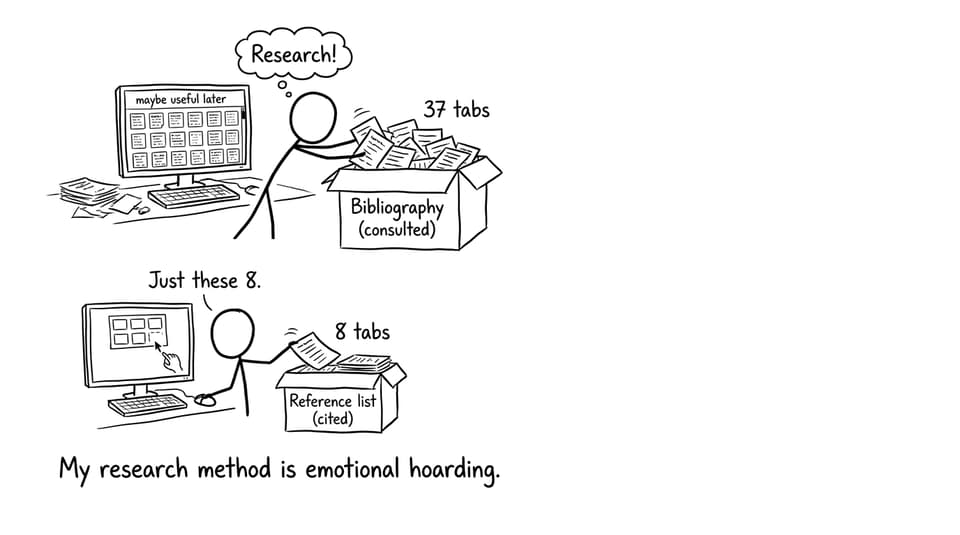
EE reference list == only sources you directly cited (quoted, paraphrased, or used for specific data)
-
EE bibliography == everything you consulted during research, whether cited or not
-
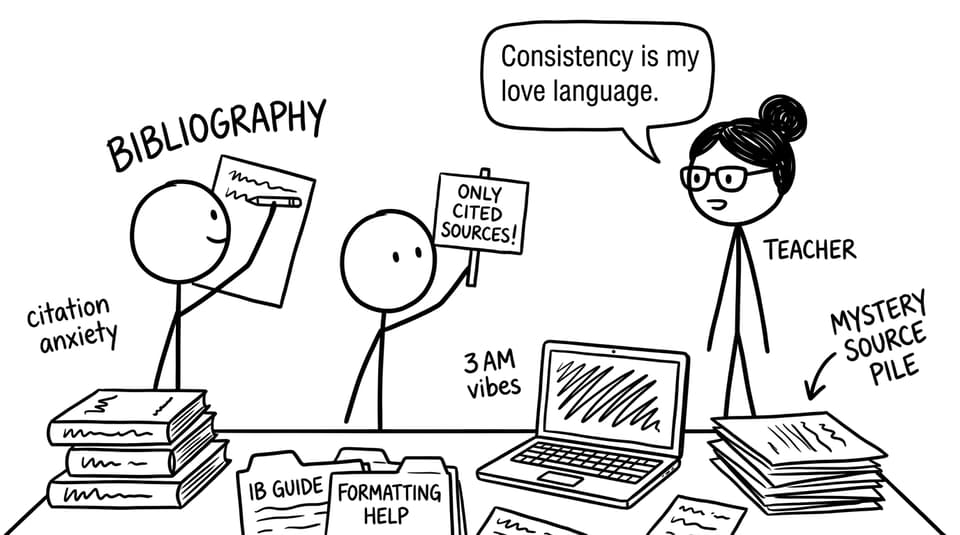
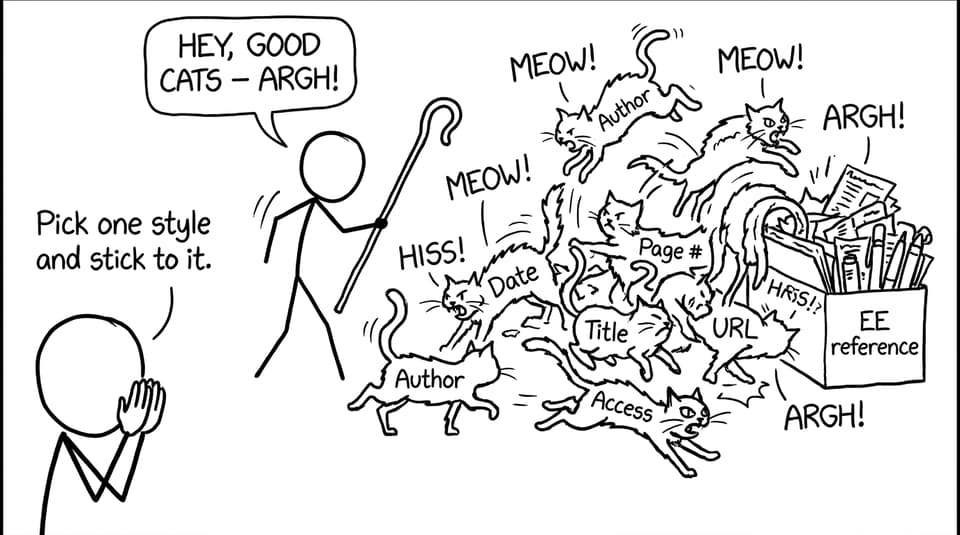
The IB does not prescribe a single style (APA, MLA, Chicago, etc.), but demands a standard style used consistently
-
At minimum, your references should include: author, date, title, page numbers (if applicable), access date (for electronic sources), and URL (for web sources)
If you want a wider map of EE formatting expectations (where references sit, what’s excluded from the word count, etc.), see How to Format Your EE According to IB Guidelines.
What is a reference list in an EE?
A reference list in an EE is a promise: every source here can be traced to something specific in my essay.
That means your EE reference list includes only sources you:
-
quoted directly
-
paraphrased
-
summarized as evidence
-
used for statistics or factual claims
-
used for images, graphs, tables, or datasets
This is why a reference list is often called “Works Cited” in some styles. But whatever label you use, the logic stays the same: if it appears in your EE reference list, it should appear in your in-text citations (or footnotes/endnotes), and vice versa.
That alignment is what examiners love, because it’s easy to audit. If they check one claim and your citation trail is clear, your whole EE feels more trustworthy.
For practical guidance on what counts as “borrowed” (ideas, data, media) and how to cite it, use 10 Best Practices for Citing Sources Properly in IB EE and IA.
What is a bibliography in an EE?
An EE bibliography is broader. It includes:
-
everything you cited plus
-
sources you read, watched, or consulted that shaped your thinking, even if they never made it into your final argument
Think of it like your research “shadow.” It shows the intellectual landscape you walked through, not just the footprints you left in the final draft.
This can be helpful in some EEs, especially if:
-
you explored multiple angles and later cut sections
-
you read background texts to understand a debate, but didn’t cite them directly
-
you used general reference works to orient yourself
But here’s the hidden risk: a bibliography can also become a cluttered pile of “I opened this tab once.” If your EE bibliography looks inflated or random, it can signal weak engagement rather than strong research.
EE reference list vs bibliography: what examiners actually care about
Examiners usually aren’t emotionally invested in the label. They care about academic honesty and consistency.
So when you’re deciding between an EE reference list vs bibliography, the real question is: Can someone trace your claims back to reliable sources without confusion?
The biggest problems happen when students:
-
call it a bibliography but include only cited sources (so it’s functionally a reference list)
-
call it a reference list but include uncited “extra reading” (so it’s functionally a bibliography)
-
mix citation styles (some APA, some MLA, some half-remembered Google generator)
If you want a deeper look at IB expectations around academic honesty and traceability, read What Are IB’s Expectations for Academic Honesty in the Extended Essay (EE)? and Integrity in the IB Extended Essay: Honest Research and Original Argumentation.
The IB rule that quietly solves most referencing stress
The IB doesn’t demand a single referencing style. It demands a standard style used consistently.
That gives you freedom, but it also removes excuses.
Your EE references must be consistent enough that a reader can reliably identify:
-
who created the source (author/organization)
-
when it was produced (publication date)
-
what it is (title)
-
where the evidence is (page number if relevant)
-
where you found it (publisher, journal, or URL)
-
when you accessed it (for online sources)
If you’re unsure which style to choose, this overview helps: Common Formatting and Citation Styles Used in IAs. The principles carry over neatly to the EE.
A practical way to decide what to include (without overthinking)
Here’s a calm system you can use in the final week of your EE:
Build two lists first
-
Master reading list: every source you consulted (your research vault)
-
Cited list: only sources with an in-text citation, footnote, or direct use in the essay
Then choose your output:
-
If your school expects a “bibliography,” you can still submit the cited list and label it “References” or “Works Cited” (ask your supervisor what your department prefers).
-
If you submit a true bibliography, consider splitting it into two sections: References (cited) and Bibliography (consulted). That makes your EE instantly clearer.
This is also useful if you’re reusing sources across coursework. For example, if you used similar readings in an IA, keep your lists separate per task so you don’t accidentally create citation confusion. See IA Sources for Your EE: What’s Allowed in IB?.
The “spot check” test
Pick three claims in your EE:
-
one statistic
-
one paraphrased argument
-
one key quotation
Now check whether:
-
each claim has an in-text citation (or footnote)
-
that source appears in your EE reference list
-
the bibliographic entry has full details
If you can pass this test quickly, your EE reference list vs bibliography decision becomes less scary, because the foundation is solid.
Common EE referencing mistakes (and how to fix them fast)
“I used it for background, so it belongs in the reference list”
Not necessarily. If it didn’t directly inform a cited claim, it belongs in a bibliography (consulted), not in a reference list (cited). In an EE, clarity beats completeness.
Missing access dates for websites
The IB expects access dates for electronic sources. Add them consistently, especially for pages likely to change.
No page numbers when they exist
If you used a specific page in a book or PDF, include page numbers both in the in-text citation and, where your style requires it, in the reference entry.
Inconsistent author naming
“World Health Organization” in one entry and “WHO” in another makes your EE look stitched together. Pick one form and keep it.
Relying on auto-generators without editing
Auto-citations are a starting point, not a finish. They often miss capitalization rules, italics, access dates, or correct author formatting.
If you want a broader research workflow (finding strong sources, organizing them, keeping a research log), read How to Survive the IB Extended Essay Research Process and What Are the Best Sources for IB Extended Essay Research?.
How RevisionDojo helps you keep your EE referencing clean
Referencing is one of those EE tasks that doesn’t feel like “thinking,” but it is. It’s the visible evidence of how carefully you think.
RevisionDojo is built for that kind of careful thinking:
-
Use Study Notes to clarify concepts before you quote anyone else.
-
Use the Questionbank and Flashcards to strengthen your fundamentals so your EE argument is yours, not a collage of other people’s sentences.
-
Use AI Chat to sanity-check whether a paragraph is truly paraphrased (and to suggest what details a citation entry might be missing), then rewrite in your own voice.
-
Use Grading tools and the IB Coursework Grader to pressure-test whether your academic presentation (including references) looks consistent and professional: IB Coursework Grader.
-
If you need models of tone and structure for academic writing, RevisionDojo’s Coursework Library and Tutors can help you practice the craft without crossing integrity lines.
And for a wider hub of EE-specific resources, start here: IB Extended Essay Guides or browse All IB Extended Essay Posts.
Closing: treat your EE list like a receipt for your thinking
The difference between an EE reference list vs bibliography is simple: one shows what you used, the other shows what you saw.
But the reason it matters is deeper. Your EE is not just an essay; it’s a small act of scholarship. Scholarship is built on a quiet agreement: I’ll show you where my ideas came from, and you can judge my work fairly.
If you want your EE to feel calm and credible in the final hours, make your sources traceable, pick one standard style, and keep your reference list vs bibliography choice honest.
When you’re ready to tighten everything up, RevisionDojo can help you revise with confidence: use the AI Chat to catch missing details, the Grading tools to polish presentation, and the broader Study Notes + Flashcards system to keep your argument genuinely yours. Start with the IB Extended Essay Guides, then refine your final submission like it’s worth marks, because it is.
Frequently asked questions
Should my EE have a reference list or a bibliography?
Your EE should have, at minimum, a complete and consistent list of sources in a standard citation style. Whether you call it a reference list or a bibliography depends on what you include. If you include only sources you cited, it’s a reference list (or works cited). If you include all sources you consulted, including uncited background reading, it’s a bibliography. Many students choose the reference-list approach because it is cleaner and easier for an examiner to audit. The most important thing is that your label matches your content, and your citations match your list. If your department has a preference, follow it; but keep the EE logic consistent.
What minimum information must I include in EE references?
The IB doesn’t force a single referencing style for the EE, but it does require that you use a recognized standard style consistently. At minimum, each entry should let a reader identify the source clearly and locate it again. That means including the author name, date of publication, and title as core elements. If page numbers apply (like books, journal articles, PDFs), include them in your citation trail so readers can find the exact passage you used. For online sources, include the URL and your access date, because webpages can change over time. If your EE references do those things reliably, you’re meeting the spirit of the requirement: traceability.
Does the bibliography count toward the EE word count?
No, the bibliography (and references section) is generally excluded from the EE word count, which is one reason students sometimes feel tempted to overfill it. But even though it’s excluded, it still matters for presentation and academic honesty. A long bibliography won’t save a weak argument, and a messy one can quietly undermine a strong argument. The goal isn’t to prove you read a lot; it’s to show you used sources responsibly and transparently. Keep your EE reference list or bibliography accurate, consistent, and aligned with your in-text citations. For a deeper breakdown, see Is the Bibliography Part of the Word Count in IB? and Mastering the IB Extended Essay Word Count.
What if I consulted a source but didn’t cite it anywhere in my EE?
If you didn’t cite it, it doesn’t belong in a strict EE reference list. But it may belong in an EE bibliography, if you are maintaining a “consulted works” record. This is where students get tripped up: they want credit for effort, but the reference list is not a trophy shelf. The cleaner approach is to keep a private master reading list for yourself, then publish only the sources that actually shaped your written argument through direct citation. If your school expects a bibliography, consider separating it into “References” (cited) and “Bibliography” (consulted) to avoid confusion. That split also protects you if a supervisor or examiner checks whether a source is actually used. In an EE, clarity is a form of respect.