
A small form that quietly changes your EE grade
The night before a supervisor meeting, most IB students do the same ritual: open the EE draft, skim the last paragraph, and promise themselves they’ll “reflect properly later.” Later becomes next week. Next week becomes “after I finish the analysis section.” And suddenly the essay is nearly done and the reflection feels like an awkward afterthought.
That’s exactly why the RPF exists.
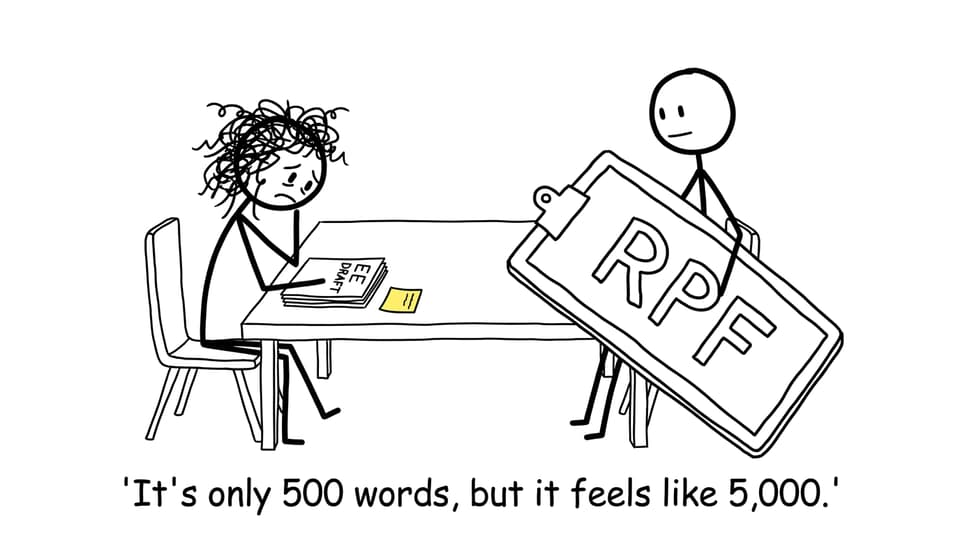
In the IB EE, the RPF (Reflection and Progress Form) is not admin paperwork. It’s the official record of your three mandatory reflection sessions and the place where your final 500-word reflective statement lives. The RPF is submitted alongside your essay and it is assessed under Criterion E. In other words: your EE isn’t only judged by what you found, but also by how you learned.
EE RPF checklist (fast version)
If you want a clean mental model of the EE RPF, use this checklist:
- The RPF replaces the former RPPF (same purpose, updated name).
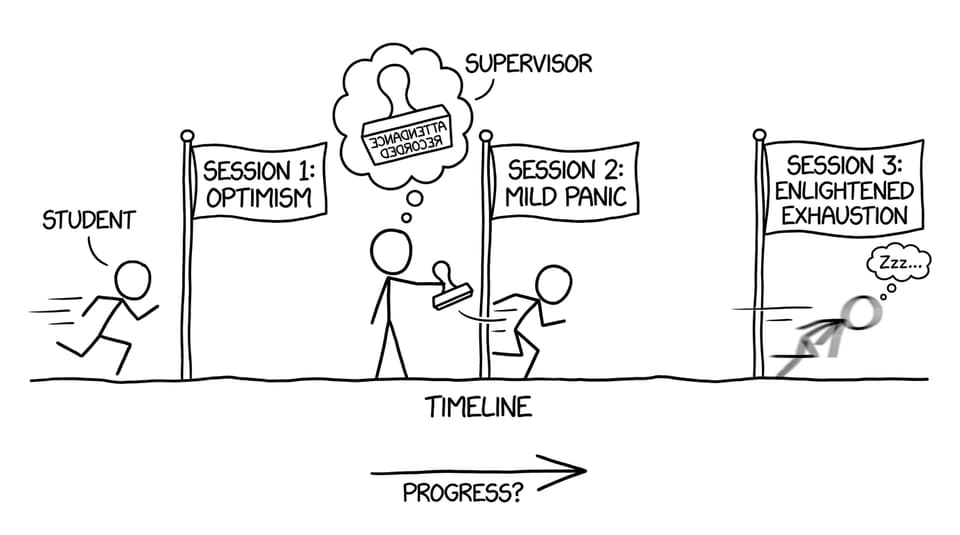
- It records attendance at the three mandatory reflection sessions.
- It contains your final 500-word reflective statement.
- It’s submitted with your EE.
- It’s assessed under Criterion E (engagement/reflection).
- Strong RPF writing shows decision-making, pivots, and learning, not a diary recap.
For deeper background on why reflection matters for marks, see How Reflection Strengthens Your IB Extended Essay.
What is the RPF in the IB Extended Essay (EE)?
The RPF is your IB-required reflection document for the EE process. Think of it as a short, official “proof of thinking” that sits beside the 4,000-word essay.
It does two jobs:
It documents the three reflection sessions
Your school must run three formal sessions with your supervisor. The RPF records that they happened and that you attended. This matters because the EE is a supervised piece of independent research, not an unsupervised project you quietly assemble at 2 a.m.
It holds your 500-word reflective statement
Your reflective statement is where the marks live. Your supervisor isn’t grading how busy you were. Criterion E rewards how thoughtfully you can explain:
- how your research question evolved
- what obstacles appeared and how you adapted
- what you learned about method, evidence, and limitations
- what you would do differently next time
If you want to connect this to the final conversation with your supervisor, read How to Prepare for the IB Extended Essay Viva Voce.
How the EE RPF is assessed (Criterion E in plain language)
Criterion E is where the EE becomes more human. The IB is effectively asking: “Did you actually do independent inquiry, or did you just assemble information?”
A strong EE RPF tends to include:
- Specific turning points (not vague claims like “I learned a lot”)
- Methods and choices (why you picked a text, dataset, experiment design, theory, or case study)
- Responses to setbacks (source limitations, conflicting evidence, an unworkable scope)
- Evidence of growth (your thinking becomes more precise over time)
A weak EE RPF tends to be:
- a timeline of tasks (“first I researched, then I wrote the introduction”)
- a summary of the essay’s content (that’s what the essay is for)
- generic motivation (“this topic is interesting to me”) with no development
If you want a rubric-minded view of the criteria ecosystem, RevisionDojo collects subject-specific resources in IB Extended Essay Guides.
The three reflection sessions: what to bring, what to say
The fastest way to write an excellent EE RPF is to earn it gradually. Each reflection session should create “future sentences” you can later use in your 500 words.
First reflection session: the research question and the plan
In the first session, the best EE reflection is usually about narrowing. Almost every student starts too wide. The strongest students can explain exactly how they reduced scope.
Bring:
- 2-3 possible research questions
- a rough method plan
- 5-8 credible sources you’ve already skimmed
Say (and later write about):
- why your topic is personally or academically compelling
- what makes your question researchable within the EE limits
- what evidence you expect to use and why it fits the subject
If you’re still shaping structure, How to Structure an Extended Essay (EE) helps you see what the final project needs to contain.
Second reflection session: the messy middle (where the best RPF material is)
This is where your EE RPF can become excellent, because something should go wrong. Not catastrophically. Just realistically.
Examples of “good problems”:
- your sources disagree and you have to choose a lens
- your original method produces weak or noisy results
- your scope is still too broad so you cut a section
- you realize you’re being descriptive and need analysis
Write down one sentence each for:
- what failed
- why it failed
- what you changed
- what the change improved
To avoid the common trap of narrative writing, read How to Make Your IB Extended Essay Analytical, Not Descriptive.
Third reflection session: finishing, integrity, and what you learned
The final session often connects to authenticity and your final submission. This is where you can articulate what the EE taught you about research as a process.
Strong angles for the EE RPF here:
- what you learned about evaluating evidence quality
- how you handled uncertainty (especially in sciences, economics, psychology, or history)
- how your conclusion became more nuanced than your starting assumptions
If you’re near the end, How to Format Your EE According to IB Guidelines can save you from losing polish marks through avoidable presentation issues.
How to write the 500-word reflective statement for your EE RPF
A good 500 words feels like a calm voice explaining a difficult project with honesty and precision. Not a dramatic monologue. Not a checklist. Not an apology.
Here’s a structure that works for almost any EE subject:
A simple, high-scoring structure
Paragraph 1: Starting point (60-100 words)
- What you initially wanted to investigate
- Why it mattered to you (briefly)
- What you assumed would be straightforward
Paragraph 2: Key decisions and pivots (200-260 words)
- The most important change you made (research question, method, framework)
- The obstacle that forced the change
- What you learned about research from making it
Paragraph 3: What you would do differently + growth (140-200 words)
- A realistic improvement you’d make next time
- How your thinking matured (about evidence, limitations, or interpretation)
- One insight about yourself as a learner/researcher
If you want extra help tightening the overall project, Mistakes to Avoid in IB Extended Essays pairs well with reflection writing because it gives you concrete “I fixed this” moments.
What to avoid in the EE RPF (the quiet mark-killers)
Most lower-scoring EE RPFs fail in predictable ways:
Writing a diary instead of an evaluation
“On Tuesday I searched JSTOR” is not reflection. The IB wants your judgement: what you discovered about your approach, and what you changed.
Repeating the essay
If the RPF summarizes your argument, it’s duplicating the essay. Reflection should focus on process: uncertainty, method, choices, and learning.
Vague claims with no evidence
“I improved my critical thinking” is weightless unless you attach it to a specific moment: “I realized my sources were all secondary, so I added primary data and changed my line of argument.”
Treating the RPF like a formality
The irony is that the EE RPF is short enough to do well, and important enough to matter. It’s the best marks-per-word opportunity in the whole EE.
How RevisionDojo helps you build a stronger EE and RPF
Students often think of the EE as one giant writing task. High scorers treat it like a system: research, structure, drafting, feedback, then reflection.
RevisionDojo is designed for that system.
- Use the Study Notes to clarify subject concepts you need for analysis (so reflection can describe real choices, not confusion).
- Use Flashcards to keep definitions, theorists, and key claims stable while your argument evolves.
- Use AI Chat to stress-test your research question and identify where your reasoning becomes descriptive.
- Use Grading tools like the IB Coursework Grader to get criterion-aligned feedback, then convert the biggest changes into reflection points for your EE RPF.
- Use the IB EE Feedback Tool mindset to spot gaps before your supervisor meeting.
- Use Mock Exams and Predicted Papers to protect your exam prep time so the EE doesn’t quietly consume the whole term.
- Use the Coursework Library to compare expectations across subjects and avoid format surprises.
- If you’re stuck, Tutors can help you find the single biggest improvement that creates both a better essay and a better RPF reflection.
The result is simple: a cleaner EE, and an EE RPF that sounds like a real researcher speaking.
Closing: your EE RPF is a mirror, not a form
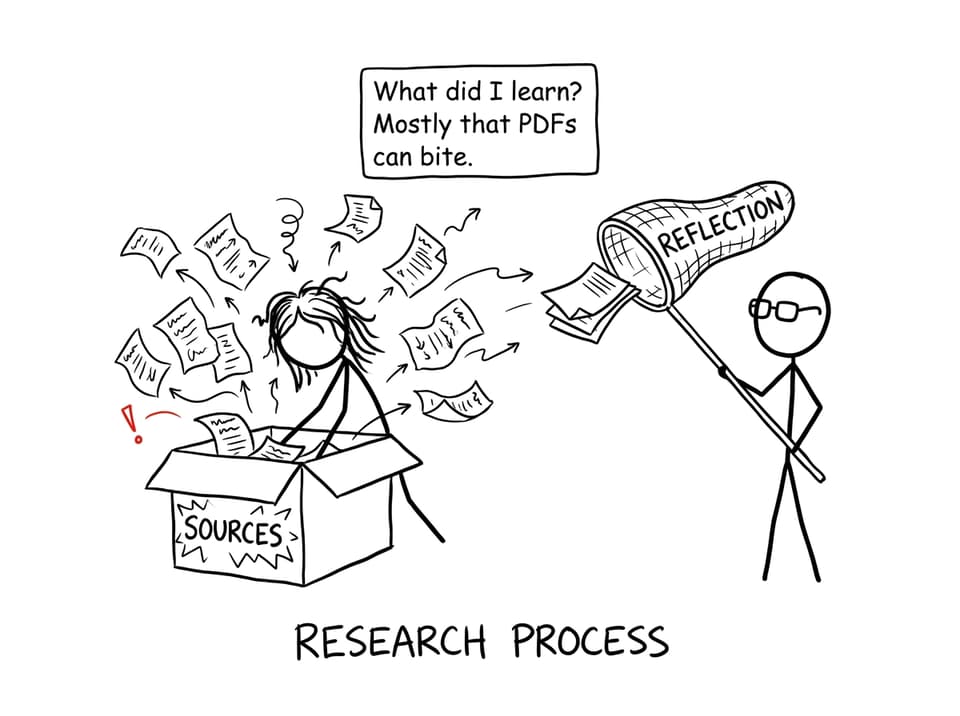
The EE is often remembered as a long document, but it’s really a long sequence of choices. The RPF is where you show that you made those choices on purpose.
If you treat the EE RPF like a box to tick, it will read like one. If you treat it like a mirror held up to your research process, it becomes the most efficient place to earn marks: 500 words that can prove maturity, independence, and academic growth.
When you’re ready to tighten your draft and translate your process into high-quality reflection, use RevisionDojo’s Questionbank, Study Notes, Flashcards, AI Chat, Grading tools, Predicted Papers, Mock Exams, Coursework Library, and Tutors to turn uncertainty into a plan, and a stronger EE RPF near the end of your submission journey.