
Choosing between the IB and A-Levels can feel like choosing a future before you have had enough time to discover what that future might contain. The useful answer is simpler: choose the IB if you value breadth, international perspective and a structured mix of subjects; choose A-Levels if you prefer concentrating deeply on three or four areas.
Neither qualification is universally better. Both are respected by universities, and both can lead to demanding degree programmes. What matters is whether the curriculum suits your strengths, your likely university direction and the way you work across two busy years.
For students beginning in September 2027, the choice should also be practical. Compare the actual subjects offered by your school, check current university prerequisites and ask how each programme is taught locally. A curriculum may look impressive on paper but still be the wrong fit if the subjects or support you need are unavailable.
IB vs A-Levels at a glance
| Question | IB Diploma Programme | A-Levels |
|---|---|---|
| How many subjects? | Six subjects, usually three at Higher Level and three at Standard Level | Usually three subjects, although some students begin with or complete four |
| How broad is it? | Broad across languages, humanities, sciences, mathematics and potentially the arts | Specialised around a smaller group of chosen subjects |
| What else is required? | Theory of Knowledge, Extended Essay and Creativity, Activity, Service | Requirements vary; some schools offer an EPQ or other enrichment |
| How is it assessed? | Final examinations plus subject-specific internal or externally assessed work | Often dominated by final examinations, although the balance depends on subject, exam board and jurisdiction |
| How is it graded? | Subjects receive grades from 1-7, with up to three additional core points and 45 points available overall | Each subject is graded separately, normally from A* to E in the UK system |
| Who may prefer it? | Organised all-rounders who want to retain breadth | Students ready to specialise in a few subjects |
| University recognition | Widely recognised internationally | Widely recognised, particularly in the UK and other systems familiar with A-Levels |
Before deciding, complete this short checklist:
- Identify two or three university subjects you might realistically consider.
- Check whether those courses require particular subjects or levels.
- Compare your school’s actual IB and A-Level options.
- Ask how much you enjoy writing, research, languages and independent planning.
- Consider whether breadth energises you or divides your attention.
- Speak to current students about teaching and support, not only workload.
The central difference is breadth versus specialisation
The IB Diploma normally asks students to take six subjects, with at least three and no more than four at Higher Level. The remaining subjects are taken at Standard Level. According to the IB curriculum framework, Higher Level courses represent 240 recommended teaching hours, while Standard Level courses represent 150.
Students generally build a programme across studies in language and literature, language acquisition, individuals and societies, sciences, mathematics and the arts. In some cases, an arts subject can be replaced by another eligible subject. School availability and programme rules still matter, so use the guide to how many IB subjects students take alongside your school’s own options booklet.
A-Levels usually narrow the field to three subjects. That can be liberating. A student drawn strongly to mathematics, physics and chemistry may prefer spending most of the week inside those disciplines rather than continuing a language and a humanities subject.
But specialisation carries its own risk. At 16, certainty can sometimes be enthusiasm wearing a confident expression. If your interests are still shifting, choosing the IB can preserve more academic directions for longer. RevisionDojo’s guide to IB subjects for students who are undecided about university is a useful starting point.
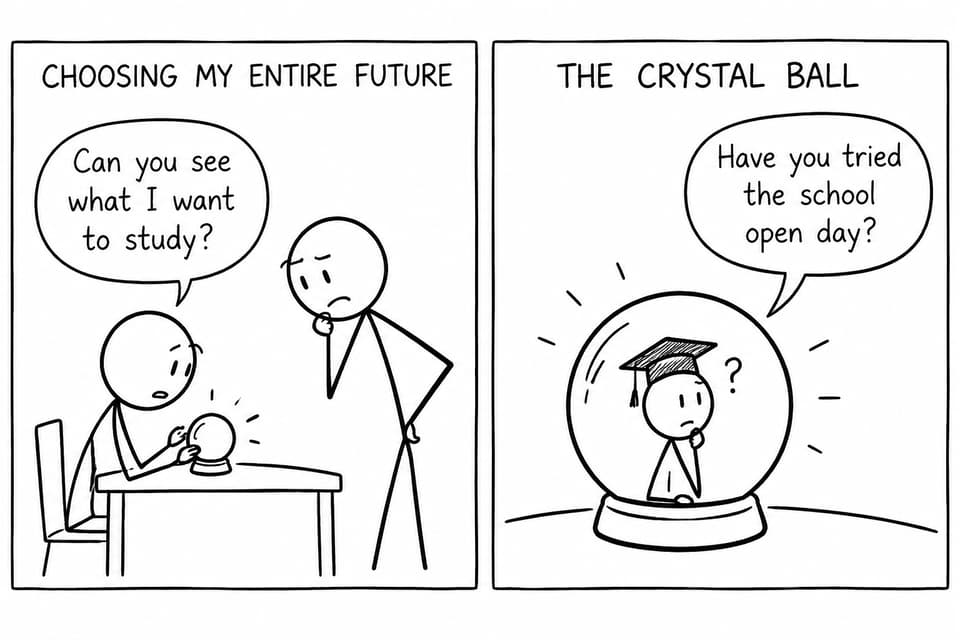
Future plans rarely arrive fully formed, but better questions make the decision clearer.
Workload is different, not automatically greater
People often reduce the comparison to a misleading formula: six IB subjects must mean twice the work of three A-Levels. Subject count alone does not measure difficulty.
The IB distributes attention across six courses and its core. That creates more simultaneous deadlines, more switching between disciplines and less freedom to ignore a weaker area. Theory of Knowledge explores how knowledge claims are constructed. The Extended Essay develops independent research, while Creativity, Activity, Service requires sustained engagement beyond ordinary classes.
A-Levels concentrate the workload. There may be fewer subjects, but each is studied in considerable depth. In England, reformed A-Levels are generally linear, with assessment concentrated at the end of the course. Arrangements elsewhere and for international qualifications can differ, while practical, oral or non-examination components remain relevant in certain subjects.
The better question is not, “Which is easier?” It is, “Which kind of difficulty suits me?”
Choose breadth if you can manage several streams of work, recover quickly when moving between subjects and plan steadily. Choose specialisation if sustained immersion helps you produce your best thinking. A student who dislikes one of six subjects can still find the IB tiring; a student who loses motivation after choosing three overly similar subjects can find A-Levels equally difficult.
Assessment style should influence your decision
The IB combines final examinations with subject-dependent internal assessments and other assessed components. The exact balance varies by course. Its structure rewards students who can maintain progress over time, respond to feedback and manage several long projects without allowing them to collide.
A-Levels often place greater weight on examinations at the end of the course, particularly in England. This may suit students who perform well under timed conditions and prefer a comparatively direct relationship between subject content and final assessment. It can feel less comfortable for someone whose examination performance is inconsistent.
Neither route eliminates pressure. It merely places pressure in different places.
If you choose the IB, preparation becomes easier when each form of work has a home. RevisionDojo brings together IB resources by subject, including Study Notes, Flashcards and a Questionbank. AI Chat and Grading tools can support explanation and feedback, while Predicted Papers and Mock Exams help students practise full assessment conditions. The Coursework Library and Tutors become especially useful when independent projects require clearer models or individual guidance.
These tools do not remove the work. They reduce the friction around deciding what to do next, which is often where otherwise capable students lose time.
University admissions do not produce one universal winner
Universities routinely consider both qualifications, but recognition is not the same as identical offers. An institution may express an A-Level offer through grades such as AAA and an IB offer through a total score plus required Higher Level results.
The decisive issue is often subject preparation. Medicine, engineering, economics and natural sciences may require particular subjects at an advanced level. For example, a university could require mathematics and physics for engineering, regardless of whether the applicant presents A-Levels or the IB Diploma.
That is why choosing the IB should never stop at selecting six enjoyable subjects. Your Higher Levels matter. A prospective engineering student may need Mathematics: Analysis and Approaches HL and Physics HL, depending on the universities being considered. Requirements vary, change over time and can be highly course-specific, so verify them directly before finalising your 2027 choices.
Start with several realistic university courses rather than one dream institution. Record required subjects, preferred subjects and grade expectations. Then compare the patterns with RevisionDojo’s overview of IB subject combinations for university applications.
How to make sensible IB subject choices
Good IB subject choices sit at the intersection of four things:
- subjects you genuinely enjoy;
- subjects in which you can perform strongly;
- subjects needed for plausible university routes;
- combinations your school can teach and timetable well.
Enjoyment matters because two years is a long time to depend on willpower. Performance matters because an attractive combination is not useful if it produces an unrealistic workload. Prerequisites matter because some university doors depend on specific Higher Level preparation.
Begin with likely prerequisites, then choose your Higher Levels. Only after that should you complete the Standard Level combination. Read the IB subject guide for comparing courses, and look beyond subject names. Compare syllabus content, assessment methods and the difference between HL and SL.
Parents can help by asking clarifying questions rather than making the choice on behalf of the student. “Which weekly tasks would you be willing to practise?” is usually more revealing than “Which subject sounds prestigious?” The parent guide to choosing IB subjects provides a framework for having that conversation constructively.
Which is right for you?
The IB may suit you if
- You enjoy several academic areas and are reluctant to abandon them.
- You want to continue studying a language.
- You are comfortable balancing writing, calculation, research and projects.
- You may apply across different countries.
- You value the challenge of the Extended Essay and Theory of Knowledge.
- You can build routines before deadlines become urgent.
A-Levels may suit you if
- You have a clear academic direction.
- Your strongest subjects form a coherent group.
- You prefer depth to breadth.
- You want more timetable space for three principal subjects.
- You would rather avoid compulsory elements outside those choices.
- Your preferred university routes align cleanly with available subjects.
Pause before choosing either route if
You are selecting the IB only because it appears more impressive, or A-Levels only because three subjects sound easier. Prestige is a poor substitute for fit. Also investigate the quality of teaching, class sizes, timetable restrictions and academic support at the schools you are considering.
For a September 2027 start, ask each school which syllabuses it expects to teach, which combinations are possible and how it supports the Extended Essay, coursework planning and university applications. Programme details can change before your cohort sits final examinations, so decisions should use the latest school and university information.
Make the choice concrete
The difference between IB vs A-Levels is not ambition. It is architecture. The IB builds a broad academic structure around six subjects and a shared core. A-Levels create room to go further into fewer disciplines.
Your task is not to identify the qualification that sounds hardest. It is to choose the structure in which you are most likely to remain curious, organised and academically credible for two years.
If the IB appears to fit, the next useful step is turning broad interest into a defensible subject combination. Create a free RevisionDojo account and download the free IB subject-choice guide. It will help you compare HL and SL options, university prerequisites and workload before submitting your choices. You can also review what RevisionDojo offers new IB students for free, then begin exploring subjects before September 2027 rather than meeting them for the first time on day one.