
Choosing six subjects can feel like making a two-year decision about a future your child has not yet fully imagined. That concern is reasonable. IB subject choices influence workload, university eligibility, and the shape of daily school life.
The reassuring answer is that there is no single perfect combination. A sensible choice does four things: follows the IB Diploma rules, preserves likely university routes, places genuine strengths at Higher Level, and leaves enough capacity for the core. Think of this choosing IB subjects parent guide as a framework for reaching that balance rather than a list of supposedly easy or impressive subjects.
The short parent checklist
Before confirming a combination, check that your child has:
- Six subjects meeting the IB group requirements
- Usually three Higher Level subjects and three Standard Level subjects
- The subjects and levels required by likely university courses
- A realistic balance of examinations, essays, practical work, and coursework
- Genuine interest in the three subjects they will study most deeply
- Confirmation that the school can timetable and teach the combination
- A backup combination in case interests or university plans change
The decision should begin with requirements, but it should not end there. A technically valid combination can still be a poor personal fit.
What is the IB Diploma?
The International Baccalaureate Diploma Programme is a two-year course built around six academic subjects and a compulsory core. Students normally choose subjects across the following areas:
- Studies in language and literature
- Language acquisition
- Individuals and societies
- Sciences
- Mathematics
- The arts
The arts choice can normally be replaced by another permitted language, science, or individuals and societies subject. Interdisciplinary courses can also affect how group requirements are satisfied. Because schools offer different subjects and timetable blocks, parents should confirm the precise options with the school’s Diploma Programme coordinator.
Alongside the six subjects, every full Diploma student completes Theory of Knowledge, the Extended Essay, and Creativity, Activity, Service. These components matter when considering workload. Six manageable subjects can become an unmanageable programme if the core is treated as spare-time work.
For a broader introduction, RevisionDojo explains how many subjects IB Diploma students take and provides a current IB syllabus and subject overview.
Understanding IB HL and SL subjects
Higher Level and Standard Level are not labels for important and unimportant subjects. They describe different depth and teaching commitments.
The IB recommends 240 teaching hours for an HL course and 150 hours for an SL course. Both levels are graded from 1 to 7, but HL students generally encounter additional content, greater depth, or more demanding assessment. The exact difference depends on the subject.
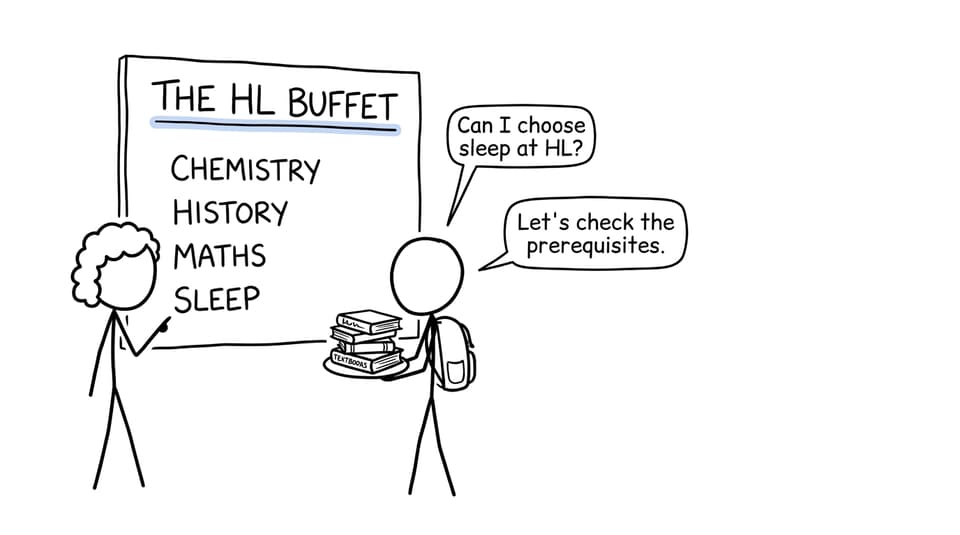
Students take at least three and no more than four subjects at HL, with their remaining subjects at SL. Three HLs and three SLs are the normal pattern. A fourth HL may sound like useful insurance, but it adds work without automatically improving an application. It should only be considered after discussing the purpose and timetable implications with the school.
A practical rule is to place a subject at HL when at least two of these are true:
- A likely university course requires it
- It is one of the student’s strongest subjects
- The student enjoys the way it is learned and assessed
- It develops skills central to a likely degree
RevisionDojo’s detailed comparison of IB HL and SL helps families look beyond the labels and consider depth, pace, and expectations.
Work backwards from university requirements
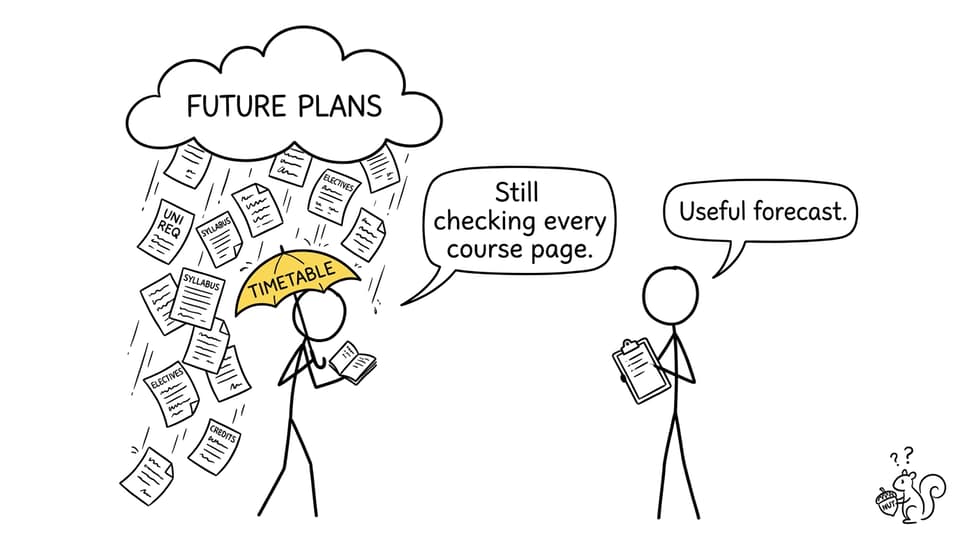
The most expensive subject-choice mistake is not selecting a difficult course. It is discovering too late that a required course was not selected at the right level.
Start by identifying two or three plausible degree areas. Then examine the official admissions page for each specific course at several universities and record:
- Required IB subjects
- Required HL subjects and grades
- Mathematics course expectations
- Required total Diploma score
- Language or national recognition requirements
Requirements vary by university, country, and degree. Medicine may require particular combinations of Chemistry, Biology, Mathematics, or Physics. Engineering programmes often specify HL Mathematics and Physics, while quantitative economics or computer science courses may have precise mathematics expectations. A general internet summary is not enough to make the final decision.
If your child is undecided, preserve the routes they are genuinely considering rather than every theoretical possibility. Keeping medicine, engineering, architecture, law, economics, and fine art open at once may create an incoherent or exhausting programme.
Treat mathematics as a separate decision
IB Mathematics has two courses: Analysis and Approaches, known as AA, and Applications and Interpretation, known as AI. Both are available at HL and SL, producing four possible routes.
AA emphasizes algebraic reasoning, mathematical structure, and analytical problem-solving. AI emphasizes modelling, statistics, technology, and interpretation. Neither course is universally easier. The better fit depends on the student’s mathematical thinking and future plans.
University policies can be specific about both the course and level accepted. Families considering engineering, mathematics, physics, computer science, or highly quantitative economics should check requirements particularly carefully. The RevisionDojo guide to Mathematics AA versus AI offers a useful starting comparison, but each target course’s admissions page remains the final authority.
Build a combination, not six isolated choices
A subject may be manageable alone and still create strain when combined with five others. The useful question is not simply, “Can my child do this subject?” It is, “Can they sustain this complete programme during busy assessment periods?”
Consider the mixture of learning demands. Several laboratory sciences can produce overlapping investigations and practical commitments. Several essay-heavy subjects may concentrate reading and writing deadlines. Arts subjects involve serious creative development and documentation, not a break from academic work.
Illustrative combinations might look like this:
| Possible direction | Illustrative HL focus | Important check |
|---|---|---|
| Medicine or life sciences | Chemistry and Biology, plus a suitable third HL | Requirements differ by country and medical school |
| Engineering or physics | Mathematics and Physics, plus a relevant third HL | Confirm whether Mathematics AA is specified |
| Economics or data-focused social science | Mathematics, Economics, and another strong subject | Check the required mathematics course and level |
| Humanities, law, or international relations | A language and literature course plus essay-based Group 3 subjects | Strong writing preparation matters, but requirements vary |
| Creative arts | A relevant arts subject with complementary academic HLs | Review portfolio, audition, or practical expectations |
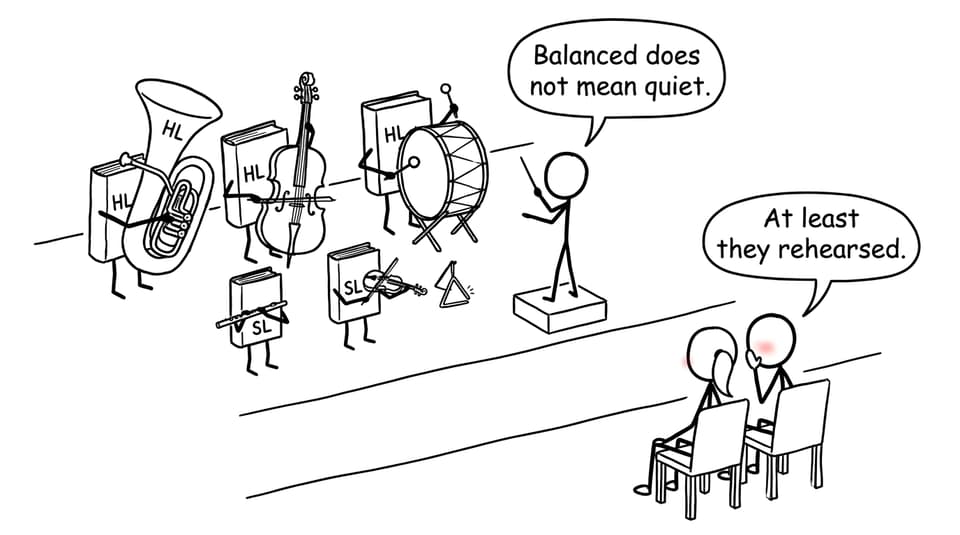
These are patterns, not prescriptions. The best combination is the one that meets actual entry conditions while remaining academically sustainable.
RevisionDojo’s guide to assessing whether an IB class schedule is feasible can help turn an attractive subject list into a realistic weekly plan.
Ask how each subject is actually assessed
Students sometimes choose from the subject name rather than the lived experience of the course. Interest in human behaviour does not automatically mean enjoying Psychology assessment. Enjoying novels does not automatically mean enjoying timed literary analysis.
Before deciding, ask the subject teacher:
- What does a typical lesson involve?
- How much extended writing, calculation, practical work, or performance is expected?
- What are the internal assessment demands?
- Which skills usually distinguish successful HL students?
- Can the student view the current subject brief and sample tasks?
A useful test is whether the student likes the subject’s method, not merely its topic. Physics involves mathematical modelling and problem-solving. History requires evidence-based argument. Visual Arts requires sustained creative inquiry and documentation. The method is what the student will repeatedly practise for two years.
The parent’s role: provide structure, not ownership
Parents are often better at seeing long-term consequences. Students are often better at knowing which classrooms give them energy. A good decision needs both perspectives.
Your role is to ask calm, specific questions. What evidence suggests this should be an HL? Which university options would disappear without it? What does the teacher recommend? Where will the combination become demanding? Avoid turning prestige into the main criterion. A fashionable HL that produces constant struggle may be less useful than a relevant subject in which the student can build deep competence.
Also separate temporary confidence from established evidence. One disappointing test should not automatically remove a subject, just as one easy unit should not justify choosing it at HL. Review teacher feedback, performance over time, study habits, and the student’s willingness to practise difficult material.
Make the choice less abstract with subject previews
A subject list tells families very little about what studying will feel like. Previewing real topics, explanations, and question styles makes the conversation more concrete.
Students can explore RevisionDojo’s IB Biology resources, IB Chemistry resources, IB Mathematics AA resources, and IB Economics resources. Open two or three topics, read a section of the Study Notes, try several Questionbank items, and review some Flashcards. The aim is not to test material the student has never learned. It is to notice whether the thinking feels interesting enough to sustain.
Once subjects are chosen, RevisionDojo becomes the complete IB study environment: Study Notes and Flashcards establish understanding, the Questionbank builds application, and AI Chat resolves confusion. Grading tools and the Coursework Library support written work, while Predicted Papers and Mock Exams develop timing. Tutors can add human guidance when a student needs a more personal plan.
Choose doors your child can realistically walk through
IB subject selection is partly about keeping doors open. But open doors have little value if the journey toward them exhausts the student.
Confirm the Diploma rules, investigate university requirements, choose purposeful HLs, and test the complete workload. Then let your child preview the subjects rather than judging them by reputation. A sound combination will not remove every uncertainty about the future. It will provide something more useful: a demanding but sustainable route toward it.
The next step is simple. Compare two viable combinations with the school coordinator, verify the relevant university requirements, and use RevisionDojo’s subject pages to see what each option actually asks students to learn.