




Your IB predicted score can feel like a number that decides your future in one line.
Not because it actually does. But because it arrives at a moment when everything is unfinished: your coursework is still evolving, your exam technique is still inconsistent, and your confidence can change between Monday and Thursday. And yet, for highly competitive U.S. schools like Georgetown and USC, that IB prediction is often the best academic snapshot admissions teams have.
So let’s be honest about what matters, what doesn’t, and what you really need to do if you’re an IB student preparing for exams and aiming at Georgetown or USC.
The quick IB predicted score checklist (save this)
If you want the practical version before the deeper story, here’s the checklist most IB applicants to Georgetown and USC should follow:
-
Aim for an IB predicted score in the low 40s if you want to be genuinely competitive.
-
Treat HL performance as your headline signal, not an afterthought.
-
Build your prediction with timed evidence (mock exams, structured practice, consistent scoring).
-
Use TOK and the EE strategically because up to 3 points can change your whole range.
-
If your IB predicted score is lower than your target, don’t panic. Build an improvement loop and bring data to your teachers.
Along the way, use RevisionDojo to reduce guesswork: the Questionbank for targeted practice, Study Notes for quick clarity, Flashcards for recall, AI Chat for stuck moments, Grading tools for feedback, and Predicted Papers plus Mock Exams for realism.
How IB predicted scores actually work (and why they matter so much)
An IB predicted score is your school’s best estimate of your final Diploma total. Teachers don’t invent it in a vacuum. They usually pull from a mix of:
-
Your topic tests and classwork trends
-
Internal assessment progress (especially in writing-heavy subjects)
-
Timed mock exams and paper-style practice
-
Professional judgment about consistency under pressure
U.S. universities care because they have to make decisions before final IB results are released. For Georgetown and USC, the IB prediction becomes a proxy for two things at once: academic readiness and academic trajectory.
Trajectory matters. A student predicted 41 who is clearly improving can sometimes read “safer” than a student predicted 43 who is burning out. Your application narrative and your evidence should match.
IB predicted score for Georgetown: what you should realistically target
Georgetown is famously serious about academics and context. It reads applications with a strong “can you handle this?” lens, especially when the curriculum is as rigorous as IB.
A sensible competitive target for Georgetown is an IB predicted score around 43+.
That doesn’t mean Georgetown has an official cutoff. It means that if your goal is to be competitive in the pool, a prediction in that range tends to align with what many successful applicants report across advising platforms and aggregated admissions guidance.
Why Georgetown cares about more than the total IB points
Georgetown tends to notice the shape of your IB program:
-
Are your HLs demanding (math, sciences, essay-heavy humanities)?
-
Do your grades look stable across terms?
-
Does your writing show thought and control?
This is where IB students can shine. IB trains you to argue, synthesize, and show global perspective. Georgetown values that kind of intellectual posture. But the posture has to be backed by performance.
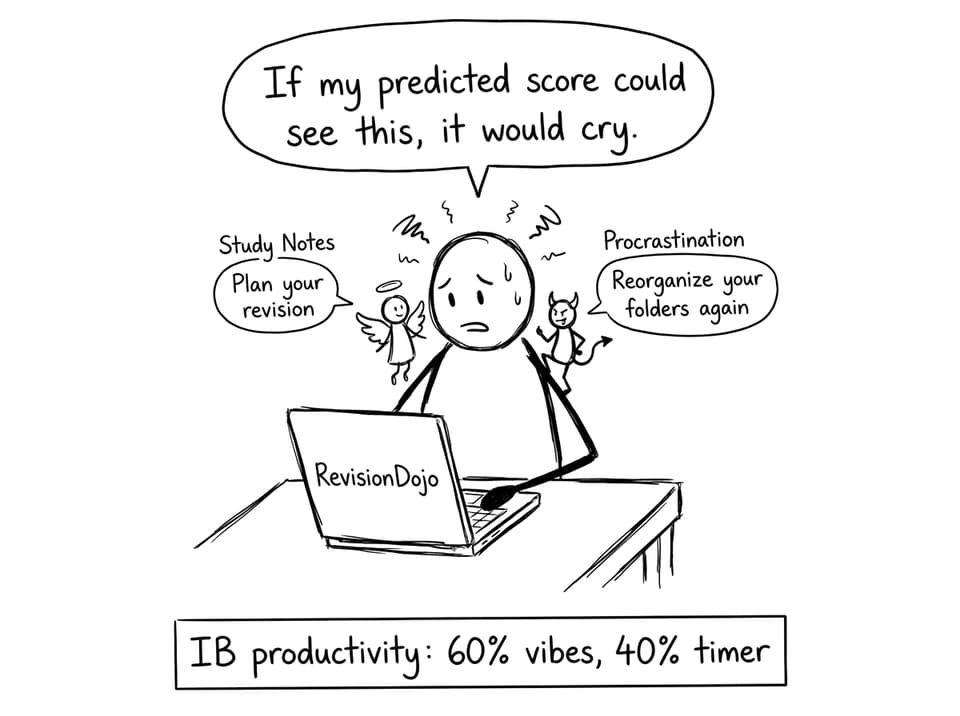
If you’re building confidence in exam technique (not just content), use timed practice. RevisionDojo’s guides on mock practice are a good starting point, especially if you keep drifting into “studying” without measurement: Why IB Mock Exams Matter for Diploma Success.
IB predicted score for USC: what to aim for (and what can compensate)
USC is competitive, but it often reads applications with a slightly different energy: academic strength plus personal momentum. Creative ambition, initiative, and voice can matter a lot.
A realistic competitive target for USC is often an IB predicted score around 41--43, with 42 commonly discussed as a strong “center” of that range.
USC is test-optional, and while standardized tests can support an application, many IB students are applying without them. In that case, your IB prediction and your course rigor do more of the heavy lifting.
The USC difference: the total matters, but so does the story
USC tends to reward applicants who feel like they will build things on campus: projects, communities, creative work, research, service initiatives. That doesn’t replace your IB predicted score, but it can contextualize it.
If your prediction is slightly below where you want it, you’re not automatically out. But you do need to show evidence that your academics are stable and that you’re prepared for the pace.
Georgetown vs USC: a simple comparison
Here’s the clean way to hold it in your head:
-
Georgetown: aim 43+ IB predicted score if possible. Highly academic tone, holistic but rigorous.
-
USC: aim 41--43 IB predicted score. Strong academics plus voice, impact, and initiative.
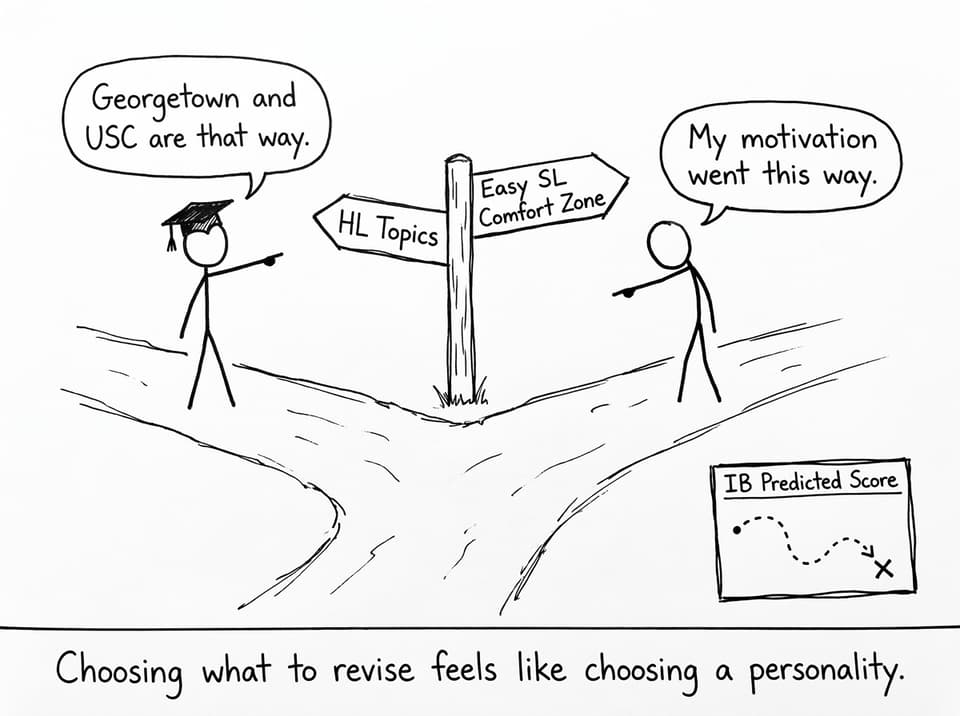
Both schools can admit students outside these ranges. But if you’re an IB student preparing for exams and you want a target that matches real competitiveness, that’s the honest starting point.
How to raise your IB predicted score (the part you can control)
Predictions feel like a verdict. But they’re often more flexible than students assume, especially when you create clear, repeatable evidence.
Build your HLs like they’re your application headline
Universities scan for difficulty. But teachers predict based on performance.
So treat HL work as the place where you build both:
-
Master the markscheme logic (what earns marks, not what feels smart)
-
Practice under time pressure
-
Fix recurring error patterns instead of chasing new topics every day
A simple system is:
-
Learn the idea quickly
-
Test it immediately
-
Review mistakes the same day
-
Re-test within 48 hours
RevisionDojo is built around that loop. Start with the free practice engine: Questionbank.
Use TOK and the EE as score leverage (not background stress)
TOK and the EE can add up to 3 points. That’s not a side quest. That’s the difference between “close” and “comfortably competitive” for many IB applicants.
Use feedback tools early. If your school feedback is slow, make your loop faster using RevisionDojo’s Grading tools mindset: draft, get rubric-aware feedback, revise, repeat. If you’re stuck, use Meet Jojo AI: Your Personal IB Study Assistant to clarify requirements and avoid wasting hours in uncertainty.
Stop studying blindly: simulate the exam earlier than feels comfortable
Most IB students wait too long to do realistic practice. They tell themselves they’re “not ready yet.”
But readiness is often created by simulation.
That’s why timed practice works: it reveals what you forgot, what you rush, and what you misunderstand. Then you can fix the real problems.
A useful structure:
-
Weekly: one timed paper or section per priority subject
-
Next day: targeted drilling on weak skills
-
48 hours later: re-test the same skill timed
To make that easier, use RevisionDojo’s exam-simulation resources:
And if you’re unsure how predicted resources should fit into your plan, this clears it up without the hype: IB Predicted vs Specimen Papers: What They Mean.
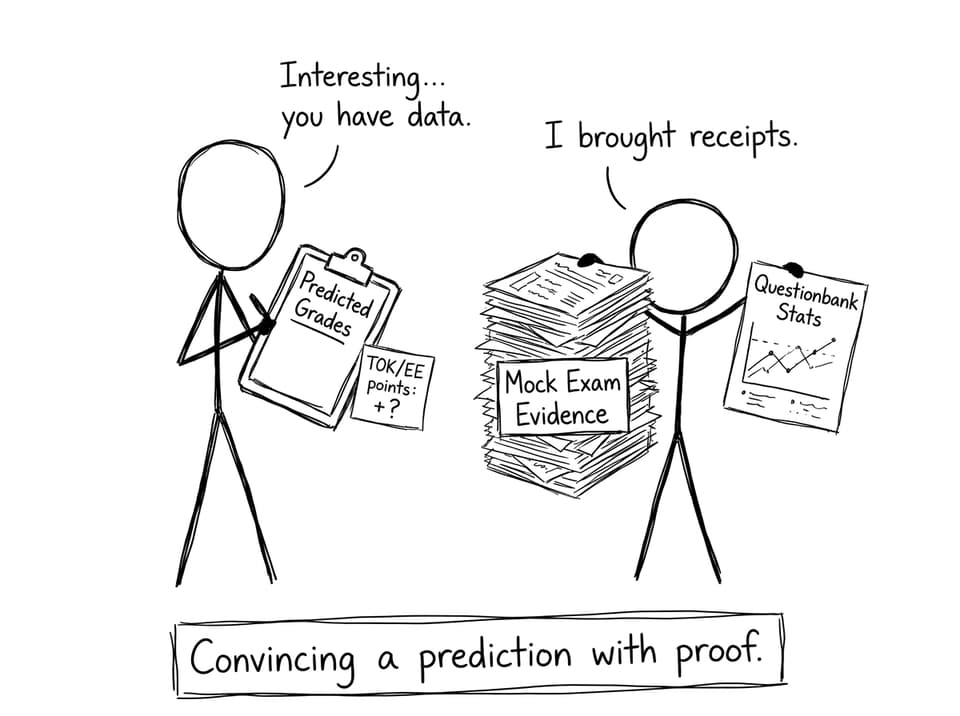
Turn revision into evidence your teachers can trust
Teachers adjust predictions when they see consistency. Not a single great day. Consistency.
So bring them evidence that looks like:
-
A steady trend in timed scores
-
Clear error logs (what you missed and why)
-
Re-attempts that show improvement
-
Better structure in writing-based responses
RevisionDojo supports this in a calm, practical way: Mock Exams for realistic timing, Predicted Papers for full-paper rehearsal, Grading tools for written feedback, and AI Chat to quickly unblock confusion so your practice stays high-quality.
If you want a structured method for forecasting where you are (without spiraling), use: Predict Your IB Score Before Exams (Without Guessing).
A simple RevisionDojo workflow for IB students targeting Georgetown or USC
If you want something you can actually sustain during a busy term, use this weekly rhythm:
Learn fast (2 sessions/week)
-
Use IB Subject Note Collections to cover one syllabus area properly
-
Condense with IB Cheatsheets before practice
Remember daily (5--10 minutes/day)
- Use Flashcards for active recall that survives stress
Practice with intention (3 sessions/week)
-
Drill weak topics in the Questionbank
-
Keep a queue of mistakes (this helps): Bookmarked IB Questions: Save Favorites for Review
Simulate real pressure (1 session/week)
-
Sit a timed full-paper or section using IB Predicted Papers
-
Review immediately, then re-test a smaller section within 48 hours
This is the kind of system that raises an IB predicted score because it changes what teachers see: not effort, but measurable performance.
FAQ: IB predicted score for Georgetown and USC
Is there a minimum IB predicted score for Georgetown?
Georgetown doesn’t publish a single minimum IB predicted score, and it doesn’t admit by a simple threshold. Still, if you want a realistic target, an IB prediction around 43+ is commonly associated with strong competitiveness for highly selective U.S. admissions outcomes. The reason is straightforward: the applicant pool is deep, and many students present near-perfect academic profiles. If your predicted score is lower, that does not automatically end the conversation, but it does mean your application needs to compensate with a clear academic story, strong writing, and rigorous course choices. You should also focus on showing stability across HLs, because Georgetown will care about whether you can sustain performance. The best move is to build timed evidence over several weeks, not a single standout mock.
Can an IB predicted score of 40 get into USC?
Yes, it can, but it depends on context. USC reviews applications holistically, and your predicted score is one part of a larger picture that includes course rigor, school context, and how compelling your overall profile is. A 40 in IB can still be paired with exceptional impact, a distinctive narrative, or strong performance in your most relevant HL subjects. The key is to avoid letting the number look like your ceiling. If you can raise your performance in timed conditions and show an upward trend, you may be able to support a prediction update or at least present stronger mid-year results. Use tools like the RevisionDojo Questionbank and Mock Exams to convert effort into proof, then communicate that proof through your school.
Do Georgetown and USC care more about HLs than the total IB score?
They care about both, but HLs often function like a spotlight. Your total IB predicted score is the easiest headline, yet HL subject difficulty and performance can signal readiness for specific majors and for university-level workload. For example, strong performance in HL Math or HL sciences can carry extra weight for STEM-leaning pathways, while writing-heavy HLs can support a humanities or social science narrative. HLs also reveal consistency: two great SLs don’t offset a collapsing HL pattern. The practical takeaway is to treat HL revision as your priority lane. Build a weekly system that includes content review, timed practice, and quick feedback loops, because HL marks are often where predictions rise or fall.
How can I ask my teachers to improve my IB predicted score without making it awkward?
Make it about evidence, not negotiation. Teachers respond best to consistent data: timed results, structured improvements, and a clear plan that you are following. Bring a short summary of your recent performance, highlight what changed (for example, fewer command-term mistakes or improved timing), and ask what specific evidence they would need to feel confident adjusting the prediction. This approach respects their responsibility while giving them something concrete to work with. If you’ve been using RevisionDojo, you can point to your practice patterns: weak topics you drilled, mock sections you reattempted, and how your accuracy improved. Even if the prediction doesn’t change immediately, you build trust and clarity about what to do next.
Closing: the IB number is real, but it’s not the whole story
If you’re applying to Georgetown or USC, your IB predicted score matters because it’s one of the clearest academic signals you can send before final results. But it’s not destiny. It’s a snapshot.
The students who improve aren’t the ones who “study harder.” They’re the ones who study with feedback, timing, and proof. That’s the difference between hoping for a higher IB prediction and building one that your teachers can confidently stand behind.
If you want that process to feel simpler, build it inside RevisionDojo: learn quickly with Study Notes, remember with Flashcards, practice with the Questionbank, get unstuck with AI Chat, tighten writing with Grading tools, and rehearse with Predicted Papers and Mock Exams. Your IB predicted score becomes less of a mystery when your preparation becomes measurable.