

When you try to predict your IB score, it's rarely curiosity.
It's the quiet question behind your revision timetable: Am I actually on track, or just busy?
Most IB students don't fear the syllabus as much as they fear uncertainty. You can study for hours and still feel like you're floating, because effort isn't the same thing as evidence. But predicting your IB score before exams is possible if you treat revision like a measurement problem, not a motivation problem.
This guide shows you how to estimate your likely IB grades using a calm, data-first approach: timed practice, mark conversion, error tracking, and realistic assumptions. You won't get a perfect prophecy (nobody does). You'll get something better: a forecast you can improve.
A quick IB score prediction checklist
Use this as the simple loop. Then we'll go deeper.
- Do 2-3 timed papers or sections per subject (spaced over 2 weeks)
- Mark consistently (same markscheme logic each time)
- Convert marks to an estimated grade using recent boundaries as a range (not a single number)
- Track errors by type, not just by topic
- Re-test the same weak areas (48-hour loop)
- Build a final forecast using a weighted average: content + exam technique + consistency
If you want the tools that make this loop easier, RevisionDojo is built around it: Study Notes, Flashcards, a Questionbank, AI Chat, Grading tools, Predicted Papers, Mock Exams, a Coursework Library, and Tutors.
Why most IB score predictions fail
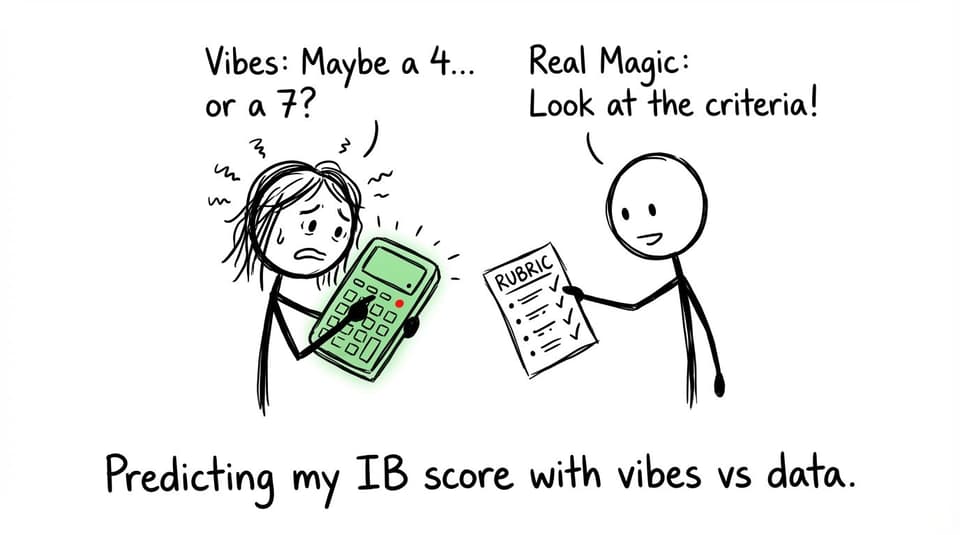
The common mistake is trying to predict your IB score from feelings.
You finish a good revision session and your brain quietly upgrades you to a 7. You do one brutal set of questions and suddenly you're "barely passing." The IB is too structured for that kind of forecasting.
A better model is to think like this:
- The IB doesn't reward effort.
- The IB rewards repeatable performance under constraints.
That means the best IB score prediction is built from repeated timed attempts, marked consistently, then interpreted with humility.
If you need an all-in-one setup to turn practice into evidence, start with RevisionDojo for IB. It's designed to reduce guesswork and increase feedback.
Step one: choose the right data (timed performance, not homework marks)
To predict your IB score, you need data that resembles your real exam conditions.
Homework scores are noisy: hints, extra time, friends, open notes, and the subtle safety of not being assessed. Your prediction should come from:
- Timed paper sections (or full papers)
- Exam-style questions mixed across topics
- Strict mark allocation (no "I basically meant that" marks)
On RevisionDojo, you can build this dataset quickly using the Questionbank and then move to full simulations with Online IB Mock Exams: Practice Anywhere, Anytime.
The minimum viable dataset
For each subject:
- 3 timed attempts (even if they're partial papers)
- 2 different topic mixes
- 1 attempt under "slightly uncomfortable" constraints (tighter time, no pauses)
Three attempts matters because the IB score you get on attempt #1 is often not your knowledge level. It's your nerves plus your pacing habits.
Step two: mark like the IB (consistency beats optimism)
Once you've got timed attempts, you need marking that is consistent. Not harsh, not generous. Consistent.
If your marking swings based on mood, your IB score prediction swings too.
This is where feedback tools matter. With RevisionDojo, many students pair practice with instant, rubric-aware feedback via Jojo, then tighten answers using Grading tools and AI Chat to understand what the markscheme is really rewarding.
For a fast overview of how all the pieces work together, see RevisionDojo App: The Smarter Way to Prep for IB Exams.
A practical marking rule
When you're unsure whether you earned a mark, you didn't.
This rule feels strict, but it stabilizes your prediction. And it mirrors the IB reality: unclear answers don't earn "almost" marks.
Step three: convert raw marks into an estimated IB grade range
Now we translate marks into meaning.
Grade boundaries change, and different papers vary in difficulty. So don't convert your marks into one fixed grade. Convert them into a range.
Your goal is a forecast like:
- "Likely 5, with a realistic path to 6"
- "Usually 6, but unstable under time pressure"
- "Borderline 4/5 because Paper 2 drags me down"
How to build your range
For each timed attempt:
- Calculate percentage score.
- Convert it using boundary bands (low, middle, high).
- Keep all three outcomes.
After 3 attempts, you should see a cluster. That cluster is your working prediction.
If you want practice that behaves like exam rehearsal (not trivia), predicted sets can help. Read IB Predicted vs Specimen Papers: What They Mean and use RevisionDojo's Predicted Papers and Mock Exams to simulate full performance.
Step four: diagnose errors that change your IB score the most
Most marks aren't lost because you "didn't revise." They're lost because the same few mistakes repeat.
When you review, label each mistake as one of these:
- Recall gap (you didn't know it)
- Method gap (you knew the topic but not the process)
- Command term gap (you didn't answer what was asked)
- Evidence gap (you asserted but didn't support)
- Time gap (you rushed, panicked, or left blanks)
A strong IB score prediction improves fastest when you fix the highest-impact category.
The 48-hour loop (the fastest way to move your prediction)
- Day 1: timed attempt
- Immediately: list your top 5 recurring error types
- Day 2: targeted drilling on those exact errors
- Day 3: re-sit a small section timed
RevisionDojo makes this loop smoother because your Questionbank practice, feedback, and revision materials live together. You can read Study Notes, then lock in recall with Flashcards, then drill questions immediately.
To strengthen the "learn quickly" part of the loop, use Digital IB Study Notes: Access Anywhere, Anytime and IB Subject Note Collections: Comprehensive Study Materials.
Step five: create a simple IB score prediction model you can update weekly
Here's a model that's realistic and easy to maintain. It doesn't pretend you're a spreadsheet. It just forces honesty.
The 3-part forecast
For each subject, estimate:
- Content readiness (40%): topic accuracy in mixed sets
- Exam technique (40%): timed performance, structure, command terms
- Consistency (20%): variance across attempts (how stable you are)
Then create a weekly prediction sentence:
"Right now my IB grade in this subject is a stable 5, because my timed scores cluster around mid-5 boundaries, but my consistency is weak on long responses."
That sentence is more useful than any single number.
Using RevisionDojo to predict your IB score with less stress
The hidden cost in the IB isn't just studying. It's deciding what to do next.
RevisionDojo reduces that decision fatigue by making your workflow tighter:
- Study Notes to clarify what the syllabus actually expects
- Flashcards to make recall automatic under pressure
- Questionbank to generate measurable performance data
- AI Chat to unblock confusion quickly (without losing an evening)
- Mock Exams and Predicted Papers to build exam stamina and realism
- Grading tools to get rubric-aligned feedback on writing-heavy subjects
- Coursework Library to reduce background anxiety about IAs and exemplars
- Tutors when you need a human diagnosis of what's holding you back
If you want to start with the free core stack, use Notes + Flashcards + Question Bank (Free).
Closing: your IB score isn't a mystery, it's a trend
The calm truth about the IB is that your final grade usually isn't a surprise. It's a trend you've been living with for months, hidden under adrenaline and deadlines.
If you want to predict your IB score before exams, don't ask your feelings. Ask your timed data. Build a small set of repeatable attempts. Mark consistently. Convert to a range. Fix the error types that matter. Then re-test.
And if you want that whole loop to feel simpler, build it inside RevisionDojo: start with Study Notes and Flashcards, pressure-test with the Questionbank, rehearse with Mock Exams and Predicted Papers, tighten answers using AI Chat and Grading tools, reduce coursework stress with the Coursework Library, and bring in Tutors when you need a human strategy check.
Your predicted IB score isn't there to scare you. It's there to give you a lever. Pull it often enough, and the number moves.