Join 650k+ students breezing through the IBReady to breeze through the IB?
The moment your notes stop helping
Every IB student knows the feeling: you open your notebook to “revise,” and instead you discover a documentary series. Characters include: the half-finished diagram, the mysterious “ASK IN CLASS” margin note, and a definition that seemed obvious in October but reads like a riddle in April.
The hard truth is that exams don’t reward the amount you wrote. They reward what you can retrieve and apply under time pressure. That’s why IB subject note collections matter. Not as aesthetic study inspiration, but as a clean, syllabus-aligned system you can actually use.
RevisionDojo was built for that exact gap: structured Study Notes you can pair with Flashcards, the Questionbank, AI Chat, and timed practice like Predicted Papers and Mock Exams.
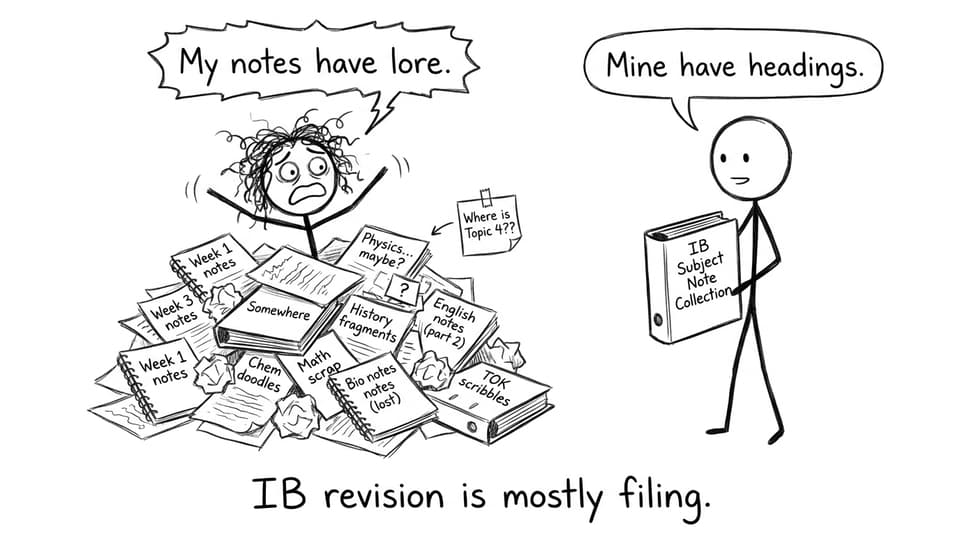
Two students compare messy vs structured notes
IB subject note collections: a quick checklist
Use this checklist to tell whether your IB notes are helping you score marks (not just feel busy):
Syllabus-topic structure (you can jump straight to what’s assessed)
Worked examples or application (especially for Math and Sciences)
Common traps and command-term awareness (how marks are actually earned)
A built-in next step: flashcards + practice questions
If you want a simple starting point, use RevisionDojo’s RevisionDojo for IB hub as your home base.
What makes a strong IB note collection (and why it saves time)
A high-quality IB note collection is basically a shortcut through overwhelm. It compresses the course without flattening it.
On RevisionDojo, the idea is straightforward: your notes should match the way the IB assesses. That means topics are organized so you revise what’s examinable, with explanations that are direct, not “textbook scenic.” When you need quick visual summaries, you can add IB Cheatsheets to your routine as a fast pre-session refresher.
For many students, the real win is emotional: you stop wondering “Am I missing something?” and start thinking “What do I do next?”
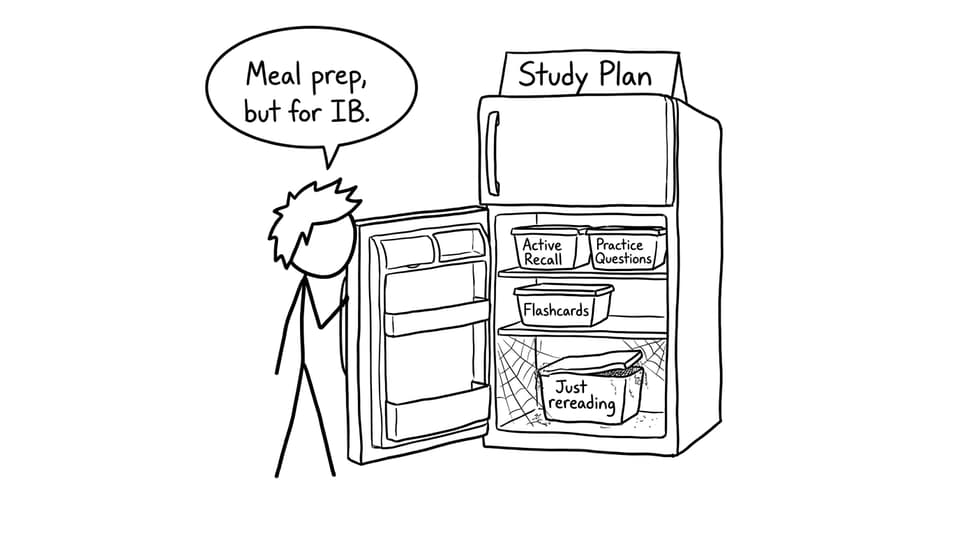
A fridge labeled Study Plan with containers like Active Recall and Practice Questions
How to use IB subject note collections effectively
Study by syllabus topic (not by chapter)
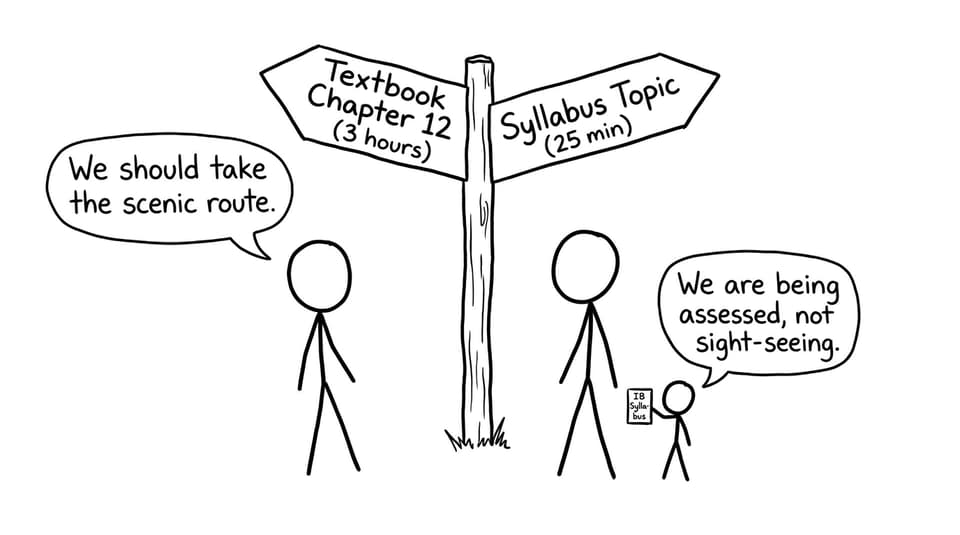
Textbooks teach broadly; the IB assesses specifically. Topic-first studying keeps your time honest. If you need help setting up your system, borrow the routines in Organization hacks for your IB notes and materials.
Turn notes into active recall within 10 minutes
After reading a section of IB notes, don’t reread. Convert it:
3 short “explain it back” prompts
3 flashcards for definitions/processes
1 “application” prompt (how would this show up in a question?)
RevisionDojo makes this loop natural: Notes connect to Flashcards, and you can use AI Chat to clarify confusion before it hardens into a misconception.
Apply immediately with exam-style questions
The fastest way to find weak spots is to practice right after studying. Use the Questionbank to target the exact topic you just covered, then log mistakes and revisit the relevant notes section. For app-style workflow ideas, see RevisionDojo app: the smarter way to prep for IB exams.
A crossroads sign: Textbook Chapter vs Syllabus Topic
FAQ
Are RevisionDojo IB subject note collections aligned with the IB syllabus?
Yes, that’s the point of using a dedicated IB platform instead of collecting random summaries. Syllabus alignment means you can revise by topic in the same shape the course is assessed. It also reduces “panic revision,” where you spend hours on content that won’t meaningfully move your grade. In practice, this makes your revision sessions shorter but more accurate. It also makes your practice question sets more targeted, because your notes and your Questionbank practice speak the same language. If you want a quick orientation to what “IB” means across the program, start at International Baccalaureate (IB).
How do I stop rereading and actually use IB notes to improve marks?
Treat IB notes as a launchpad, not a destination. Your goal isn’t to finish a chapter of notes, it’s to prove you can retrieve and apply the idea. The easiest method is a three-step loop: read briefly, test yourself, then practice questions. Flashcards make the testing automatic because they force retrieval, and spaced repetition keeps old topics alive without you scheduling everything manually. The Questionbank then teaches you how the markscheme rewards structure, accuracy, and command terms. If you get stuck, AI Chat can help you fix a misconception immediately, instead of carrying it into a full practice paper. Over a few weeks, this turns your notes into a living system, not a static document.
Which RevisionDojo tools work best with IB subject note collections?
Most students do best with a simple stack: Study Notes, Flashcards, then the Questionbank. Notes build understanding, flashcards build recall, and the questionbank builds exam performance. When you need feedback on written responses, the Grading tools help you see what “good” looks like in markscheme terms. When you’re approaching exams, Predicted Papers and Mock Exams add timing and realism, so you don’t meet pressure for the first time on exam day. If coursework is stealing your revision time, the Coursework Library and Tutors can reduce friction and uncertainty. The key is not using every feature at once, but letting each tool solve one specific problem in your week.
Closing: make your IB revision feel lighter (without doing less)
The best IB subject note collections don’t just give you information. They give you momentum: the ability to pick a topic, understand it fast, test it, and practice it until it becomes reliable.
If you want your revision to feel organized, efficient, and exam-shaped, start with RevisionDojo’s syllabus-aligned notes and connect them to Flashcards, the Questionbank, AI Chat, Grading tools, Predicted Papers, Mock Exams, the Coursework Library, and Tutors. Your future self doesn’t need more pages of notes; they need a system that turns study time into marks.