
The night your EE became real
You can tell the exact moment the EE turns from “a future problem” into “a today problem.” It happens when you open your document and realize you’ve been collecting ideas like souvenirs, not building an argument like a researcher.
For the IB class of 2027, that moment often comes with a second thought: Wait… didn’t they change the Extended Essay?
Yes, the EE has updates for 2027. But the bigger truth is calmer: the IB can adjust rules, timelines, and emphasis, yet the core of the EE remains stubbornly human. A good EE is still a focused question, pursued honestly, written clearly, and revised without drama.
This guide walks you through IB Extended Essay 2027 changes (and what stayed the same), so your EE becomes a project you can steer instead of a storm you endure.
EE 2027 at a glance: a practical checklist
Use this quick checklist to sanity-check your EE plan before you invest weeks in the wrong direction.
- Your EE topic is narrow enough to answer in 4,000 words.
- Your research question is arguable, specific, and researchable.
- Your method fits your subject (and you can explain it).
- You have a simple system for citations and academic honesty.
- You can describe what changed in your thinking at least 3 times (reflections).
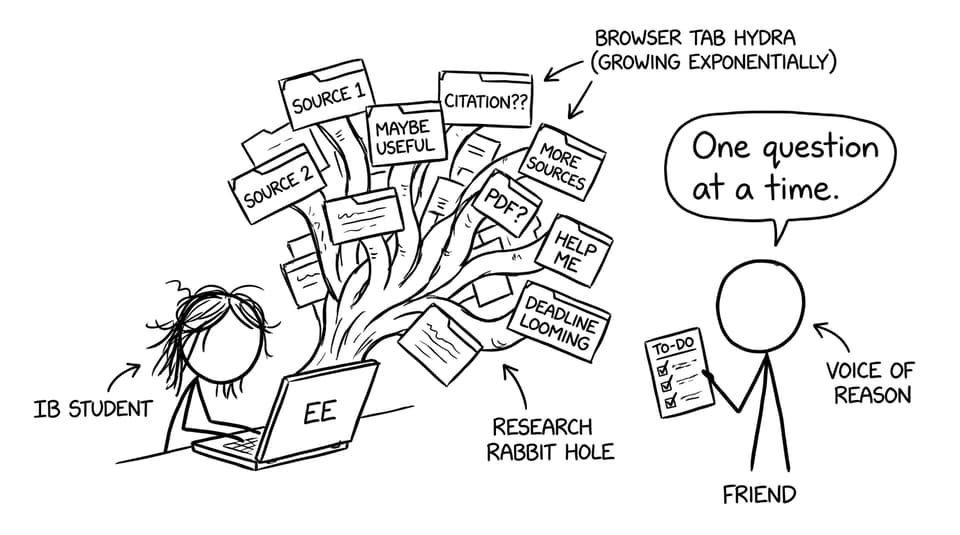
- You’re drafting early enough to revise like a professional, not panic like a person.
If you want a full walkthrough of the process, keep this open as a companion: Mastering IB Extended Essays: How to Research, Write, and Revise.
What changed for the EE in 2027 (and why it matters)
The IB rarely “reinvents” the EE. Instead, it tends to clarify expectations and tighten alignment with what it actually awards marks for. For 2027, think of the changes like a camera lens adjustment: the subject is the same, but the focus is sharper.
Clearer emphasis on process, not just product
The EE was never only about the final essay. But many students treated it that way: write the thing, format the thing, submit the thing.
For the EE in 2027, the IB’s direction (and school practices responding to it) leans even harder into evidence of a research journey: decision-making, scope control, course correction, and honest reflection.
That matters because students who “look smart” on paper but can’t explain their choices often underperform in the EE criteria tied to engagement and method. In other words: you are not being rewarded for being busy. You are being rewarded for thinking.
More pressure on academic honesty and citation habits
Academic honesty has always been part of the EE, but 2027 expectations around citations and source use are harder to bluff. The easiest way to protect your EE is to become boringly consistent:
- Cite as you go, not at the end.
- Keep a clean source log.
- Distinguish what you found from what you concluded.
RevisionDojo’s IB Coursework Grader can help you catch issues early by giving rubric-aware feedback on drafts, including where clarity, sourcing, or argumentation gets shaky.
Supervisor guidance is becoming more structured
Some schools are implementing tighter EE checkpoints for 2027 (planning, question approval, early outline, partial draft) to reduce last-minute disasters. That structure can feel annoying until you realize it protects your time.
If your school is coordinating multiple EEs, this wider shift is part of a bigger push toward trackable workflows and better feedback cycles, like the ones described here: Streamlining IB Extended Essay Supervision with RevisionDojo.
What stayed the same: the unglamorous rules that still decide your EE grade
The temptation is to obsess over what changed in 2027 and ignore what has always been true. That’s how students lose months.
The 4,000-word ceiling still shapes everything
Your EE is still capped at 4,000 words, and that limit is not just a formatting detail. It’s the reason focus matters.
A broad EE question creates a predictable failure mode:
- You spend 2,000 words “setting the scene.”
- You summarize sources.
- You reach your conclusion at the exact moment you finally start analyzing.
A strong EE question forces analysis early, because there’s no room to hide.
The rubric still rewards analysis over information
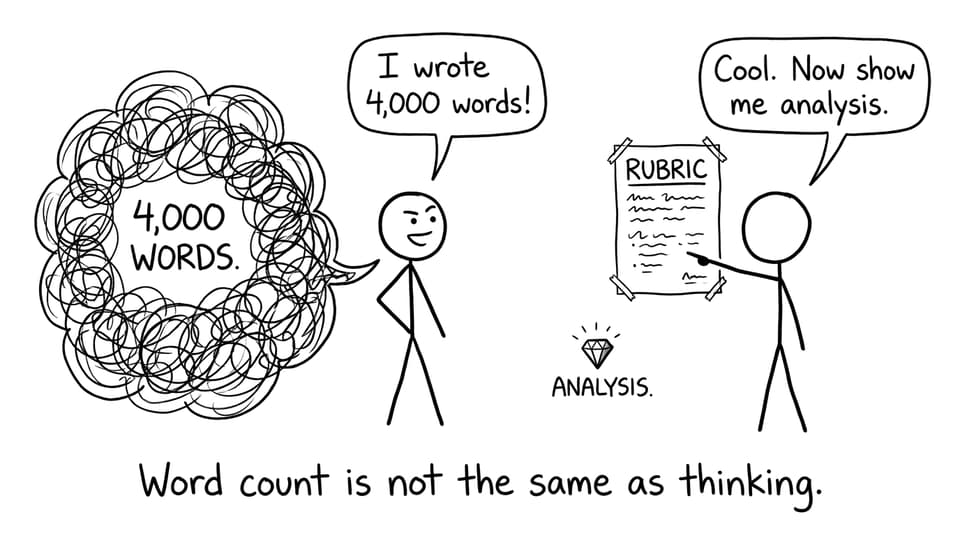
The IB has never handed out top EE marks because you collected lots of facts. It rewards how you use facts: interpretation, evaluation, and a defensible line of reasoning.
If you want a fast way to diagnose what’s going wrong, read: Mistakes to Avoid in IB Extended Essays.
Reflection is still a real part of the EE
Reflection in the EE is not a diary. It’s evidence that you’re making intelligent choices.
Good reflection tends to sound like:
- “I narrowed my question because my initial scope made analysis impossible.”
- “I changed my method after realizing my data could not answer the question.”
- “I rewrote my introduction after my conclusion changed.”
Bad reflection tends to sound like:
- “It was difficult.”
- “Time management was hard.”
- “I learned a lot.”
All true, all useless.
EE research questions in 2027: the skill that saves the whole project
Most EE stress is just a disguised research-question problem.
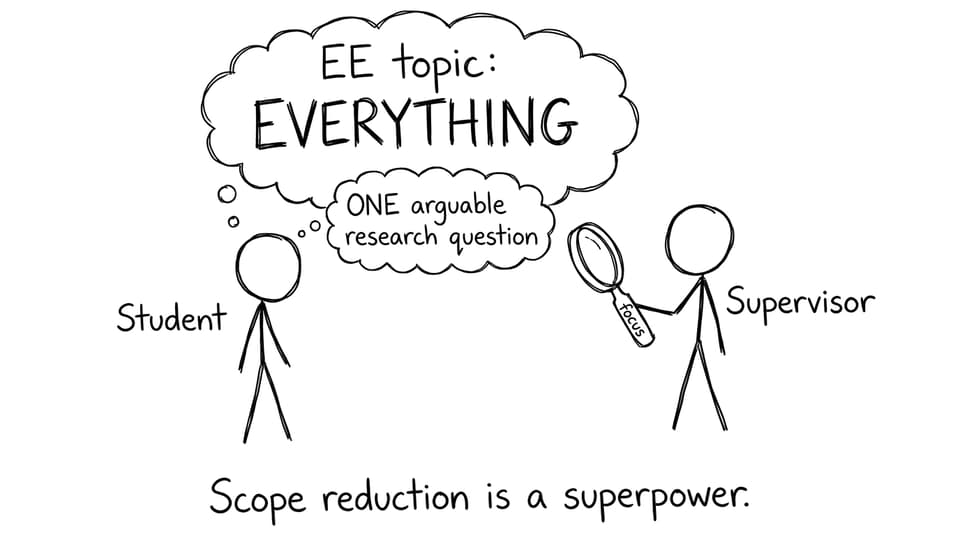
You don’t need the “perfect topic.” You need a question with boundaries.
A workable EE research question usually has:
- A specific text, place, time period, dataset, or case
- A clear lens (economic theory, literary technique, chemical property, historical debate)
- An arguable claim (something a smart person could disagree with)
If you want your EE to feel lighter, start by shrinking it. Shrinking is not quitting. Shrinking is choosing.
A calm EE workflow that actually works (even during exam season)
IB students preparing for exams often treat the EE like an extra subject. That backfires, because the EE demands a different mode: long-form thinking.
Here’s a realistic workflow that keeps your EE moving without stealing your whole week.
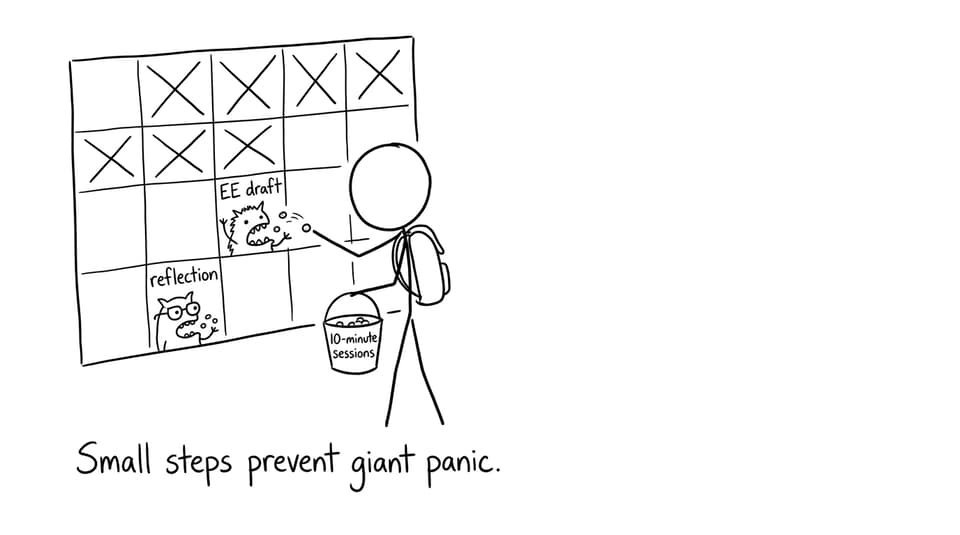
Weekly rhythm: two deep sessions, three tiny sessions
- Two deep sessions (60-90 min): argument building, writing, data analysis, outlining.
- Three tiny sessions (10-15 min): source logging, fixing citations, rewriting one paragraph, writing one reflection note.
Tiny sessions are underrated. They keep the EE warm in your mind, so deep sessions don’t start from zero.
Use RevisionDojo tools as a “support system,” not a distraction
RevisionDojo is built for exam performance, but the same ecosystem helps the EE because it reduces friction.
- Use Jojo AI Chat to pressure-test your EE logic, define terms, and check whether your claim is actually arguable.
- Use the Coursework Grader to get criterion-aware feedback when you have a real draft.
- Use the Coursework Library to calibrate what “good” looks like before you write 4,000 words in the wrong direction.
- When exam prep ramps up, keep your momentum with short sessions using IB Flashcards with Spaced Repetition (SRS).
And when you need your overall study loop to feel organized again, this helps: RevisionDojo App: The Smarter Way to Prep for IB Exams.
How EE work supports exam performance (yes, really)
The best hidden benefit of a well-run EE is that it changes your relationship with “studying.” It teaches you:
- how to define a problem precisely
- how to choose evidence, not just collect it
- how to write with intent
Those skills transfer directly to Paper 2 essays, data-response questions, and any exam where the markscheme rewards reasoning.
To tighten your exam practice system while the EE runs in the background, build your repetition loop using:
- Study Notes for clarity
- Questionbank for targeted practice
- Flashcards for daily recall
- IB Predicted Papers by IB Examiners (Free) | RevisionDojo for realistic exam rehearsal
(And yes, you can do all of that without letting the EE collapse into last-week chaos.)
EE 2027 mini self-audit: “Is my draft actually an EE?”
Ask yourself these questions. If you can’t answer them, your EE is still a collection of paragraphs.
- What is my single-sentence claim right now?
- Which paragraph contains my strongest analysis?
- What evidence would change my conclusion if it turned out differently?
- Where did I make a choice that improved the quality of my method?
- If someone disagrees with me, what is their best argument?
If you need a clean place to explore more EE resources, start here: All IB Extended Essay Posts.
The quiet strategy for EE 2027: fewer surprises, more proof
The EE for 2027 changed in the ways the IB usually changes things: clearer expectations, tighter emphasis on integrity and process, and less tolerance for vague work that looks impressive but says little. What stayed the same is the part that matters: the EE is still a focused argument built from evidence, written with discipline, and improved through revision.
If you want to make the EE feel manageable while preparing for exams, build a system that protects consistency. Use RevisionDojo to keep everything in one place: Study Notes for clarity, Flashcards for recall, Questionbank for skill-building, AI Chat for quick reasoning checks, Grading tools for draft feedback, Predicted Papers and Mock Exams for exam realism, the Coursework Library for exemplars, and Tutors when you want human guidance.
Your goal is not to “finish the EE.” Your goal is to produce proof that you can think like a researcher. That’s what the EE has always been measuring. And in 2027, it’s measuring it even more clearly.