
The night before your next EE meeting, you promise yourself it will be different.
You will bring one clean draft. You will remember what your supervisor asked last time. You will know what your RPPF reflection should say. You will not open an email thread titled “EE: urgent” and discover three contradictory attachments.
And then reality happens: five files, two calendars, a half-written reflection, and the quiet fear that you’re doing the IB Extended Essay “wrong” even though you’re working constantly.
That’s the moment where structure stops being a nice-to-have and becomes the whole point. RevisionDojo is built for IB students and schools who want the Extended Essay to feel like a guided research journey, not a paperwork scavenger hunt.
The core problem with IB Extended Essay supervision
The IB Extended Essay is designed to prove something deep: that you can think independently, choose a method, and build an argument you actually own.
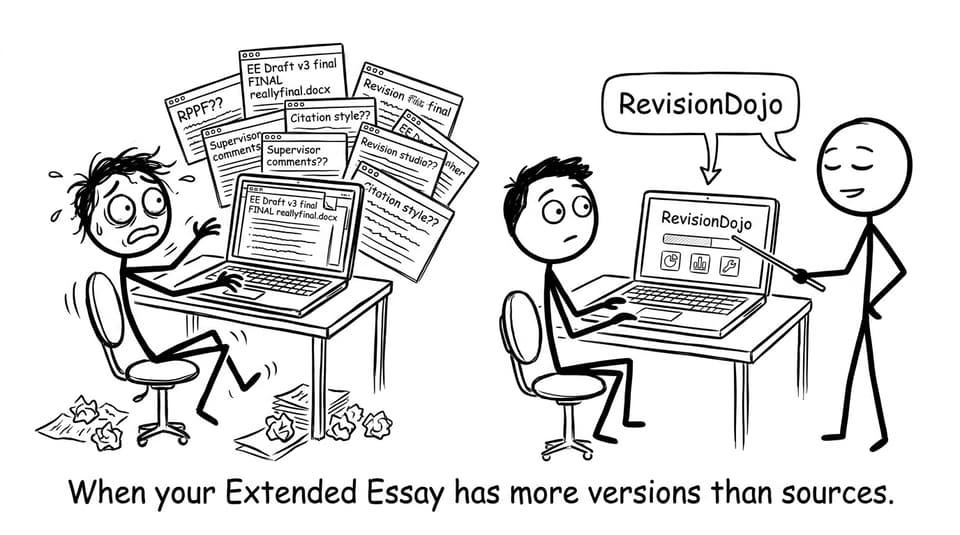
But supervision has hidden friction:
-
Drafts scatter across devices and versions.
-
Feedback gets lost in comments, emails, or vague meeting notes.
-
Reflections become an afterthought because exams are louder.
-
Schools need consistency across subjects, but each supervisor naturally develops their own system.
The result is predictable. Students feel behind even when they’re trying. Supervisors feel like administrators. Coordinators spend too much time chasing evidence.
RevisionDojo flips the dynamic: one shared workflow, visible progress, and reflection that is easy to do well.
Quick checklist: a clean IB EE workflow (that still protects exam prep)
Use this checklist as your “minimum viable system” for IB Extended Essay supervision:
-
Set up a single project hub (one place for drafts, feedback, and deadlines).
-
Use rubric-aligned feedback so comments map to criteria, not vibes.
-
Timebox reflection sessions and capture decisions right away.
-
Keep a supervision log that is easy to review.
-
Use analytics to spot drift early (before the panic phase).
If you’re a student, this reduces mental load. If you’re a school, it reduces supervision inconsistency. If you’re both, it gives the EE room to grow without swallowing exam season.
How RevisionDojo streamlines IB Extended Essay supervision
RevisionDojo works because it treats the EE like what it is: a long project made of small decisions. Small decisions need memory, clarity, and traceability.
A dashboard that keeps your IB EE in one place
When your EE lives in one organized space, you stop paying the “where is that file?” tax.
A dashboard approach helps you:
-
See your current stage at a glance.
-
Track what changed since the last meeting.
-
Keep drafts and supervisor feedback connected.
-
Protect time for IB exam revision by reducing rework.
If you’re coordinating across a year group, this also means less reliance on individual supervisor systems and more consistent student experience.
For schools building a whole-program approach, start with RevisionDojo for Schools.
RPPF reflections become easier when they’re built into the process
Most students don’t struggle with reflection because they’re lazy. They struggle because reflection is usually separated from the actual work.
RevisionDojo supports reflection as a habit: record what you decided, why you decided it, and what you’ll do next. That’s not fluff. That’s Criterion E.
If you want to understand what strong reflection sessions look like, use EE Reflection Sessions: A Supervisor's Guide as a practical template you can run every time.
Rubric-linked feedback keeps the EE fair and specific
In the IB world, “good job” is not feedback. Feedback has to attach to criteria, because criteria are what the examiner actually rewards.
RevisionDojo’s approach to feedback and grading tools helps you:
-
Link comments to EE criteria (A-E).
-
Separate “structure and argument” issues from “presentation” issues.
-
Make revision plans that are measurable (not emotional).
If you want a criteria-level view of what examiners look for, see EE Assessment Criteria Explained (2027 Guide).
The one-draft rule becomes less scary when you prepare smarter
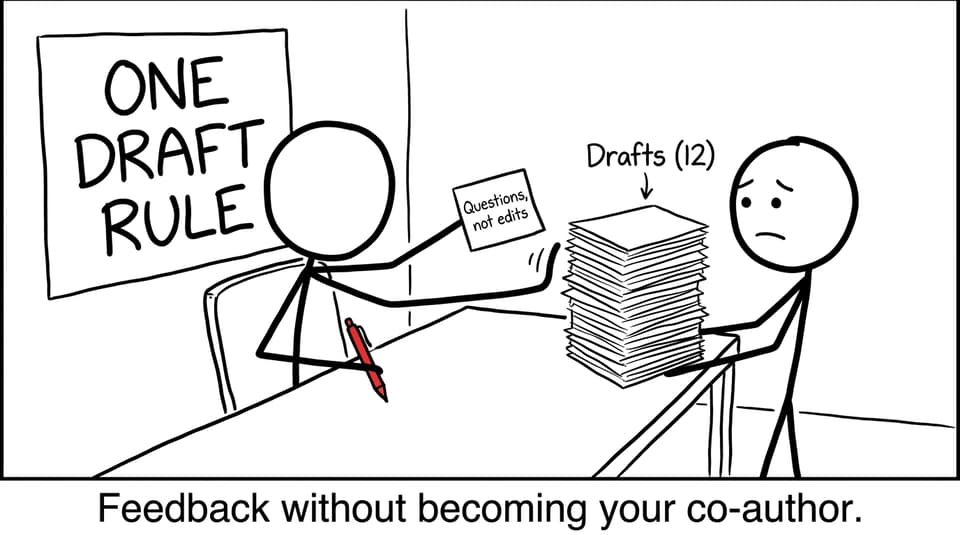
One of the most misunderstood realities of IB Extended Essay supervision is the boundary around draft feedback.
Students often assume: “If I send more drafts, I’ll get more detailed edits.”
But IB rules are designed to protect authorship. Your supervisor can guide, question, and flag problems. They can’t become your editor.
RevisionDojo helps by making your draft submission more intentional. Before your official supervisor-commented draft, you can use:
-
Grading tools to get rubric-aligned diagnostics.
-
AI Chat to ask targeted questions like “Where am I describing instead of analyzing?”
-
Study Notes and Flashcards to tighten subject language so your EE sounds like your subject.
To get the rules straight, read EE Drafts: How Many Can Your Supervisor Read? and One Draft Rule for EE: What Supervisors Can't Do.
Analytics that help you catch drift early
The Extended Essay doesn’t usually fail dramatically. It drifts.
It drifts when the research question stays too wide. It drifts when “reading more sources” replaces analysis. It drifts when reflection becomes a rushed paragraph two days before submission.
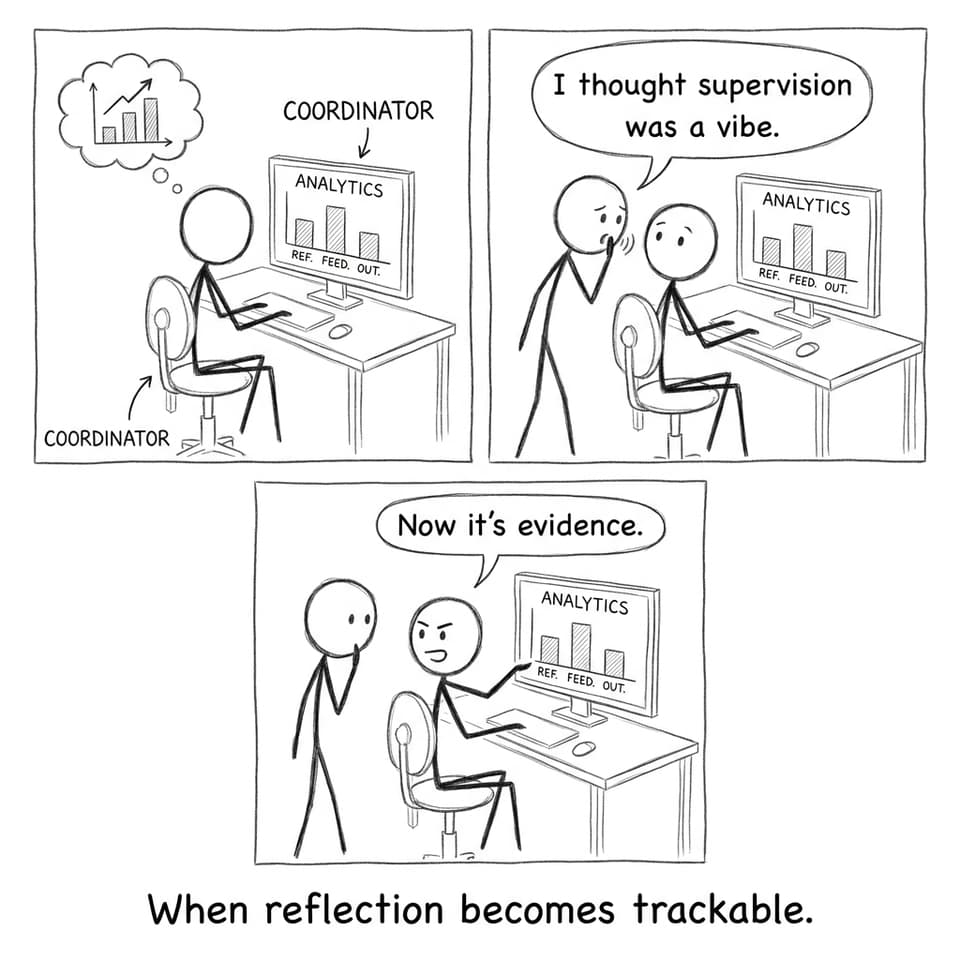
A shared analytics view gives schools and students early warning:
-
Are reflections being completed on time?
-
Is feedback happening consistently?
-
Are deadlines slipping quietly?
This matters because students are also trying to prepare for IB exams. When drift is visible, you fix it quickly and return your attention to practice.
For broader exam readiness systems that run in parallel with coursework, see How RevisionDojo Transforms IB Exam Readiness Across the Diploma Programme.
A student-centered supervision rhythm (that fits IB exam season)
Here’s a rhythm that keeps your IB EE moving without stealing your entire week.
Weekly (30-45 minutes)
-
Update your EE hub: what changed, what’s next, what you need.
-
Do one small “evidence action”: source map, outline improvement, method note, or paragraph rewrite.
Biweekly (20-30 minutes)
-
Hold a timeboxed supervisor conversation.
-
End with one decision and one next action.
Daily (10-20 minutes)
- Maintain exam momentum using RevisionDojo’s core loop: Study Notes, Flashcards, and the Questionbank.
If you need a sustainable study structure while the EE runs in the background, use How to Study for IB Exams Without Burning Out and RevisionDojo App: The Smarter Way to Prep for IB Exams.
And when you want exam-style practice at scale, the RevisionDojo Questionbank is designed for repetition with feedback, not random drilling.
Where RevisionDojo fits beyond the Extended Essay
Most students don’t struggle because they lack motivation. They struggle because their tools don’t agree with each other.
RevisionDojo tries to make your IB life feel like one system:
-
Questionbank for exam-style practice.
-
Study Notes for fast clarity.
-
Flashcards for daily recall.
-
AI Chat for unblocking confusion without waiting.
-
Grading tools for rubric-aligned feedback.
-
Predicted Papers and Mock Exams for timed realism.
-
Coursework Library for examples and structure support.
-
Tutors when you need human guidance and accountability.
The EE becomes less overwhelming when it’s one part of a coherent routine, not a separate universe.
Closing: turn IB EE supervision into a calm, repeatable system
The Extended Essay is one of the most “IB” things you’ll ever do: independent, demanding, and quietly transformative.
But it should not require chaos to prove you’re learning.
RevisionDojo helps you streamline IB Extended Essay supervision by making the work visible, the feedback criteria-based, and the reflections easy to complete with integrity. It also protects what matters in the final months: consistent exam practice through Study Notes, Flashcards, the Questionbank, AI Chat, Grading tools, Predicted Papers, and Mock Exams.
If your school wants a supervision workflow that feels fair, consistent, and evidence-ready, explore RevisionDojo for Schools. And if you’re a student, build your next week around one simple promise: one dashboard, one plan, steady progress, the way IB work is supposed to feel.