


Introduction
There’s a specific kind of stress that shows up when someone asks, “So… are you doing Chinese B at SL or HL?”
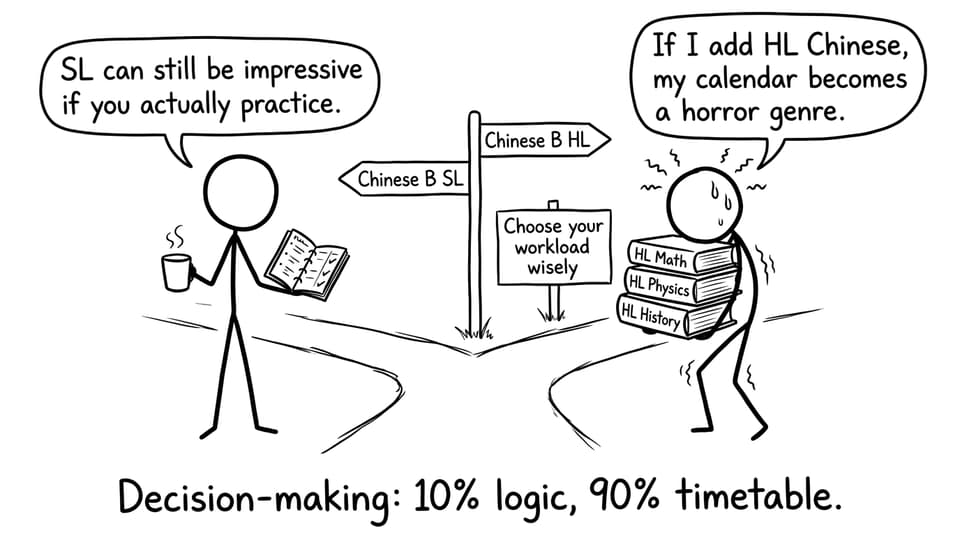
It’s not because the labels matter socially. It’s because you can already picture the domino effect. One extra demanding Higher Level can turn a manageable week into a constant negotiation with your own energy.
That’s why choosing between Chinese B SL and HL is one of the most practical decisions you’ll make in IB Languages. Same course family, same overall assessment split, but a different expectation of depth, stamina, and control of language.
If you want a central hub to explore what both pathways look like in one place, start with IB Chinese B Resources and treat it as your base camp.
Quick checklist: SL vs HL in IB Chinese B
Use this quick checklist to anchor your decision in realities, not vibes:
-
Guided teaching time: SL = 150 hours, HL = 240 hours.
-
Same assessed components in IB Languages: Paper 1 (writing), Paper 2 (listening + reading), Individual Oral.
-
Same weightings: Paper 1 25%, Paper 2 50%, Oral 25%.
-
Key difference: HL expects more developed language, more nuanced understanding, and more consistent detail under time pressure.
For an exam-format refresher, keep IB Chinese B Exams 2025 Overview bookmarked.
What actually changes between Chinese B SL and HL?
In most IB Languages courses, the trap is assuming SL and HL are separate worlds. They aren’t. They’re the same world with different zoom levels.
At SL, you’re rewarded for clear communication, good organization, and reliable control of common structures.
At HL, you’re rewarded for those same things plus the ability to push further: richer vocabulary, more precise register, better development of ideas, and more cultural or thematic depth that feels intentional rather than sprinkled on top.
A helpful way to think about it: SL is about being understood well. HL is about being understood well while sounding more natural, more flexible, and more thoughtful.
Exam differences that matter (Paper 1, Paper 2, Individual Oral)
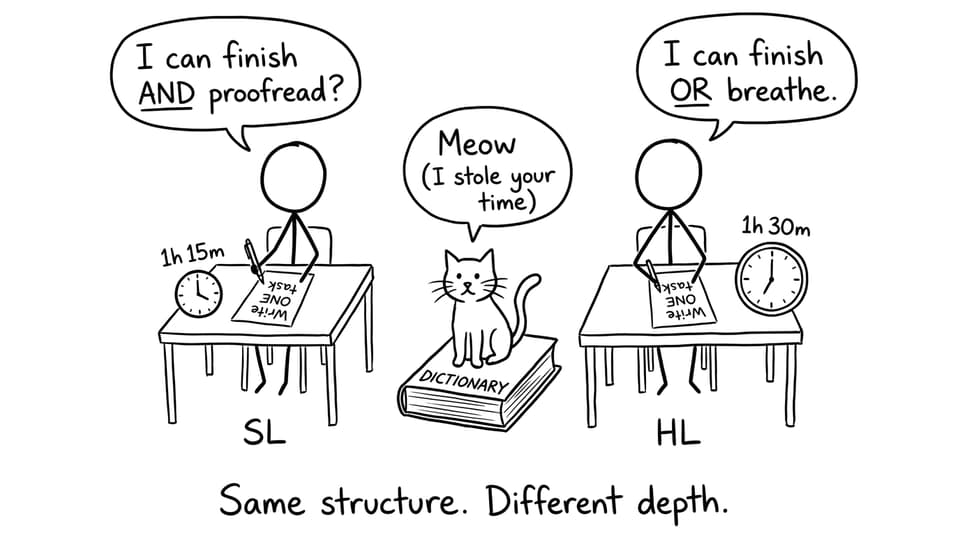
Paper 1: Writing (same task, different depth)
Paper 1 is where many students feel the level difference first.
-
SL timing: 1h 15m
-
HL timing: 1h 30m
-
Both write one task from the available prompts
The extra time at HL isn’t a gift. It’s a signal. HL responses are expected to show more development: clearer viewpoint, more specific examples, stronger cohesion, and broader language.
If you want a practical guide to score higher in IB Languages writing, these are worth reading and reusing:
Paper 2: Listening + Reading (stamina and inference)
-
SL timing: 1h 45m
-
HL timing: 2h
Both levels test comprehension, detail, and inference. The HL difference tends to show up as longer texts, less predictable vocabulary, and questions that reward nuance (tone, intention, implied meaning).
To build the exact habits Paper 2 rewards in IB Languages, work from strategy first, then volume:
And if you want targeted practice by theme, RevisionDojo’s Chinese B Questionbank style workflow helps you repeat what the exam actually asks you to do, then learn from patterns in your mistakes.
Individual Oral (same length, higher expectation)
The Individual Oral is 12-15 minutes for both SL and HL, but the examiner’s ear is different.
At HL, you’ll generally need:
-
More sustained development (not short answers)
-
More conscious theme awareness
-
Stronger ability to connect an example to a broader idea
-
More comfort discussing cultural perspectives and implications
A huge shortcut in IB Languages is building your oral around the course themes so your ideas come faster. Use The Five Core Themes of IB Chinese B as your organizing map.

Workload: the part students underestimate
The official hours (150 vs 240) tell the truth quietly: HL has more runway, and you’re supposed to use it.
In real student time, a workable baseline often looks like:
-
SL: about 3-4 hours/week outside class (more near exams)
-
HL: about 5-6 hours/week outside class (plus extra reading and writing)
But the bigger factor is not hours. It’s friction.
HL Chinese becomes heavy when you don’t have systems: vocabulary review that sticks, feedback loops on writing, and regular speaking practice that feels routine.
If your schedule is already crowded, read IB Languages: Balance Study With Work & Extracurriculars and build a plan that doesn’t rely on last-minute motivation.
Who should choose SL? Who should choose HL?
Choose Chinese B SL if…
You’ll usually thrive at SL if:
-
You already have three demanding HLs and need Chinese to add balance
-
You want strong functional ability without carrying the full HL intensity
-
Your current Chinese foundation is still uneven (basic accuracy and vocabulary aren’t stable yet)
SL in IB Languages is not a “lesser” choice. It’s often the strategic one that protects your overall diploma performance.
Choose Chinese B HL if…
HL is a good fit if:
-
You already have a strong base and want to push fluency and sophistication
-
You enjoy reading and writing enough to practice consistently
-
Your future plans connect to Chinese (business, international relations, Asian studies, living abroad)
A subtle sign you’re ready for HL: you can explain an opinion in Chinese and expand it with a reason, an example, and a consequence without panicking.
How universities tend to view SL vs HL
Universities rarely treat IB Languages choices as a simple hierarchy. They read them in context.
-
SL can look very strong when paired with intense HLs elsewhere, showing balance and breadth.
-
HL can be a clear advantage when it aligns with your academic direction or demonstrates rigor in a competitive profile.
The best choice is the one you can perform in consistently. A solid 6 at SL often beats an exhausted 4 at HL.
A decision framework you can use today
Ask yourself four questions and answer honestly:
-
Current level: Can I write coherently without translating every sentence in my head?
-
Time budget: Do I have 5-6 hours a week available for Chinese during busy months?
-
Interest: Do I want to read, listen, and speak beyond homework?
-
Diploma balance: Will HL Chinese create a fragile schedule where one bad week ruins the next?
If you want a structured self-study rhythm that fits either option, use How to Revise Effectively for IB Chinese B Exams as your weekly template.
How RevisionDojo helps for SL and HL (without making your plan messy)
The fastest way to improve in IB Languages is to stop collecting resources and start running a loop: learn, practice, get feedback, repeat.
RevisionDojo is built for exactly that loop:
-
Study Notes to learn by theme, not random chapters
-
Flashcards for spaced vocabulary you actually use in writing and speaking
-
Questionbank for exam-style Paper 1 and Paper 2 practice
-
AI Chat when you need explanations or rephrasing help without waiting for a teacher
-
Grading tools (including essay marking) to spot what’s holding you back
-
Mock Exams and Predicted Papers when you need exam stamina and pacing
-
A Coursework Library plus Tutors when you need human feedback and accountability
If you’re comparing resources, Best Resources for IB Chinese B Students lays out a clean, minimal toolkit.
Frequently asked questions
Can I switch from SL to HL later?
Yes, many students do, but the timing matters. Switching is easiest early, before you’ve built too many habits around the SL depth of response. The practical issue is not the exam format, because the structure is similar across IB Languages levels. The issue is catching up on the extra reading, writing development, and the expectation that your responses sound more mature and sustained. Before you switch, run a two-week trial where you complete HL-length writing practice and an extra reading block each week. If that feels demanding but sustainable, the jump is realistic. If it collapses your schedule, it’s usually smarter to stay at SL and aim for a top grade.
Is Chinese B HL much harder than SL?
It’s harder in a specific way: not because you’re learning an entirely different course, but because the exam rewards a higher ceiling. In IB Languages, HL tends to punish vagueness more quickly. You can’t rely on safe phrases forever; you need precision, variety, and development. The time pressure also feels different because HL responses are expected to say more while staying accurate. That said, HL becomes manageable when you build routines for vocabulary, timed writing, and short speaking practice. The difficulty is real, but it is trainable.
Which level is better for university applications?
“Better” depends on what story your subject choices tell together. Universities usually look for readiness and consistency, and IB Languages choices are interpreted in the context of your whole diploma. HL can help when it aligns with your intended course or shows a willingness to take on academic challenge. SL can be equally smart when your other HLs are already demanding and you’re optimizing for strong overall results. A strong grade at either level signals discipline and communication skill. The real advantage comes from performance, not the label.
Conclusion: choose the level you can sustain
Choosing between Chinese B SL and HL is really choosing a lifestyle for the next two years. SL protects balance and still builds serious communication skill. HL asks for more depth, more stamina, and more deliberate language control, which can pay off when it matches your goals.
Whichever route you take, treat it like what it is: a skill-based subject inside IB Languages. Skills grow through repetition, feedback, and calm consistency.
If you want that process to feel organized instead of overwhelming, make IB Chinese B Resources your home base on RevisionDojo, then use the Questionbank, Flashcards, AI Chat, Grading tools, Mock Exams, and Tutors to build confidence that actually shows up on exam day.