Join 650k+ students breezing through the IBReady to breeze through the IB?
If you have ever opened a Chinese B Paper 2 reading booklet and felt your confidence quietly leak out, you are not alone. The page looks calm, but the clock is not. One minute you are reading an article about a city policy; the next you are being asked to justify True/False in Chinese, infer attitude, and find one tiny detail that is hiding in paragraph four.
That is why IB Languages reading success is not about knowing every character. It is about knowing what to do when you do not. Paper 2 rewards calm, repeatable habits: skim, scan, infer, and answer with precision. This guide gives you those habits, plus a simple practice system you can run every week.
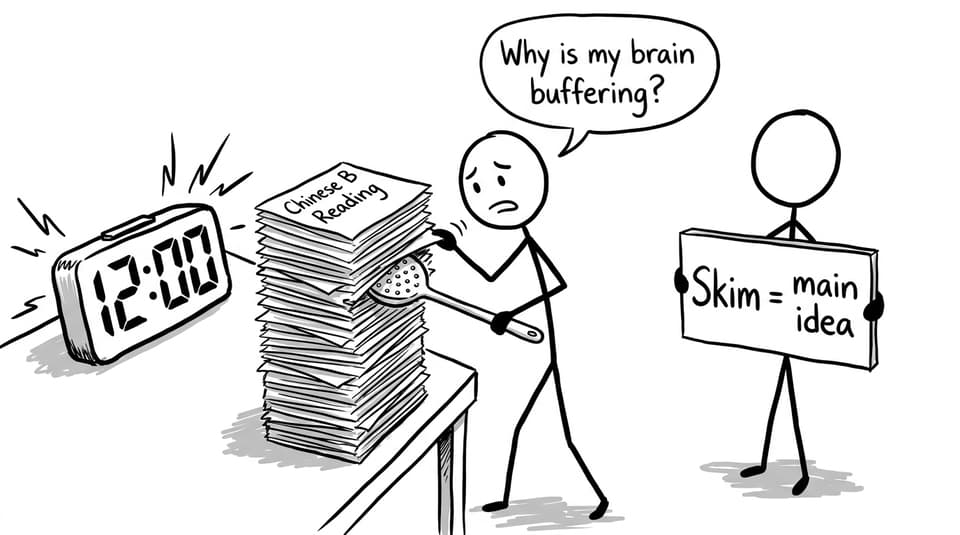
Skimming joke comic
Paper 2 reading in one glance (keep this checklist)
Use this as your “before I start” routine in IB Languages Chinese B:
Confirm your time pressure: Paper 2 combines listening and reading (SL is part of 1h 45m, HL is part of 2h).
What the examiners are really looking for in IB Languages reading
In IB Languages, reading marks are rarely lost because a student “did not know enough vocabulary.” They are usually lost because the student did not show the right evidence.
Examiners are looking for:
Main idea control: you can state what the text is doing, not just what it says.
Detail accuracy: you can locate and lift the correct detail without adding your own.
Inference: you can read between lines (purpose, implication, stance).
Tone and audience: you sense whether the writer is persuading, warning, celebrating, criticizing, or simply informing.
Concise answers: especially in short-answer tasks, more writing can mean more mistakes.
The 4-step method: a repeatable IB Languages reading strategy
Skim like you are hunting for the author’s purpose
Skimming is not speed-reading. It is purpose-reading.
Do this in 60-90 seconds per text:
Read the title and any obvious formatting (bullet points, subheadings, dates).
Read the first 1-2 sentences of each paragraph.
Circle repeated nouns: places, groups, topics (环保, 科技, 学校, 政策).
Decide the text’s job: to inform, persuade, complain, advertise, reflect.
A useful mindset in IB Languages is: “I am not reading for beauty; I am reading for function.” Once you know the function, the questions stop feeling random.
Scan with a question-led finger (yes, literally)
After skimming, go straight to the questions and turn them into targets.
Scanning tips that work especially well in Chinese:
Look for numbers, dates, names, locations (often easy visual anchors).
Match question keywords to synonyms in the text (often the text paraphrases).
For True/False/Justify tasks, scan for the sentence that contains the claim, then read two sentences before and after to confirm context.
If you want structured exam-style practice, use RevisionDojo’s Questionbank to drill scanning and evidence selection under timed conditions.
Infer tone with “signal words,” not gut feeling
Tone questions feel subjective until you treat them like a pattern-recognition game.
In IB Languages Chinese B reading, tone often reveals itself through:
Modal verbs: 应该, 必须, 可以 (strength of recommendation)
Evaluative adjectives: 重要, 可惜, 值得, 糟糕 (judgment)
Contrast markers: 然而, 不过, 尽管 (argument and stance)
Calls to action: 让我们, 请大家, 希望 (persuasion)
When you infer tone, always anchor it to a visible clue. If your answer cannot point to a phrase, it is too fragile.
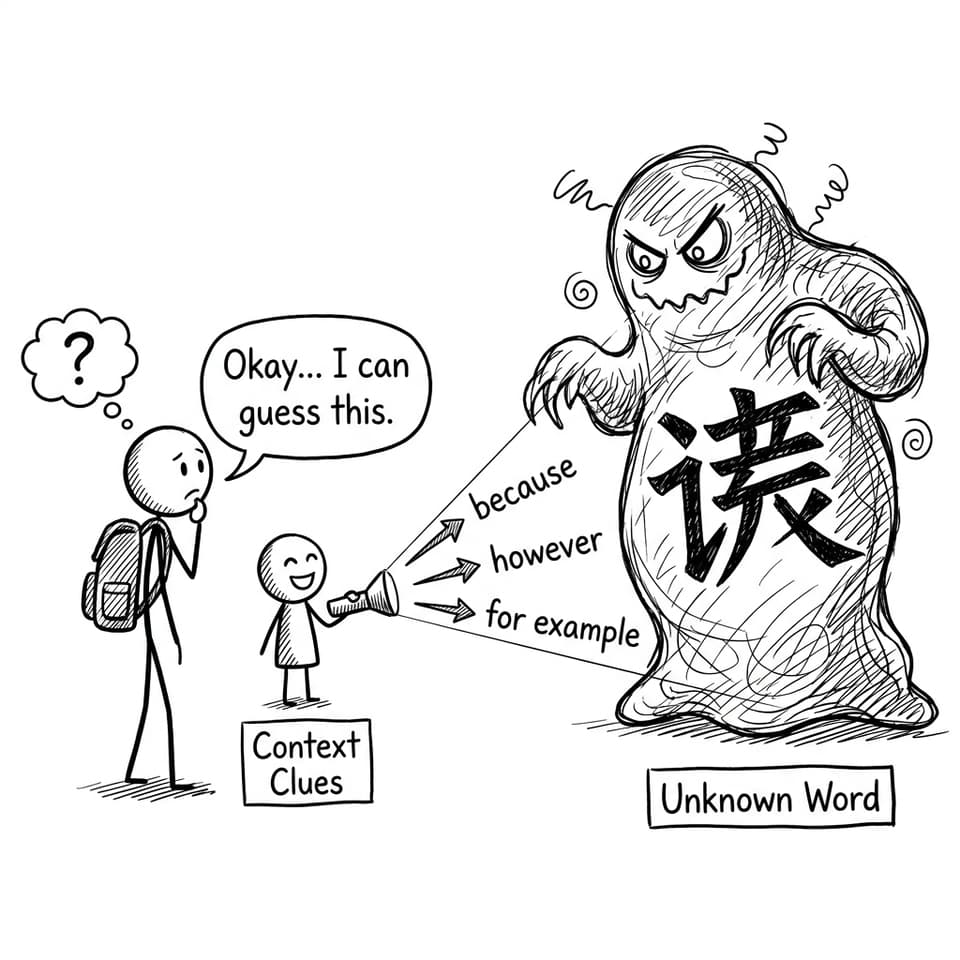
Context clues comic
Handle unknown vocabulary using context, not panic
Unknown words are guaranteed. Your job is to keep them from becoming the main character.
A reliable IB Languages approach:
First, ask: is the unknown word necessary for this question?
If yes, use the nearby structure: examples, contrasts, definitions, repetition.
Replace the unknown word with a placeholder meaning: “something negative,” “a type of policy,” “a feeling,” and test if the paragraph still makes sense.
Move on. Return only if a later question forces precision.
Time management that actually works in Paper 2 reading
Most students do not run out of time because they read slowly. They run out of time because they read evenly, as if every line is equally valuable.
Try this pacing:
3-5 minutes: quick skim across all texts to reduce surprise.
Main block: spend most time answering, not rereading.
Final 5-8 minutes: revisit only starred questions (inference, justify, tricky paraphrases).
A good rule for IB Languages is: if you have read the same sentence three times, you are no longer reading. You are negotiating with anxiety. Switch tactics: scan for anchors, then reread just that local area.
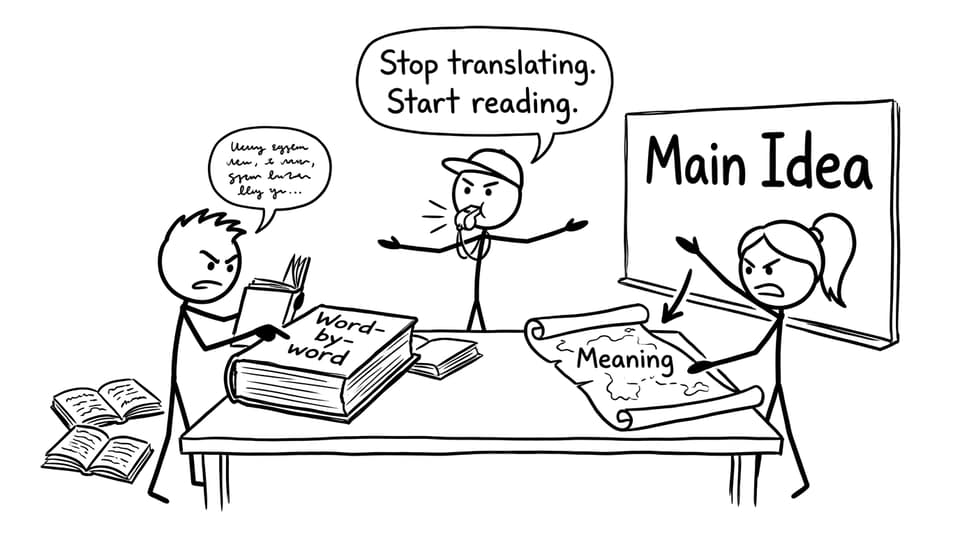
Stop translating comic
SL vs HL: what changes for IB Languages Chinese B reading?
The core skills are the same, but HL expects more stamina and more nuance.
SL: generally shorter texts, more direct questions, less layered argument.
HL: longer passages, denser ideas, more cultural references, more “why” questions.
HL students should practice identifying perspective: whose interests are being protected, which group is criticized, what assumption is being made. That is the kind of inference that moves you from comprehension to insight.
A simple weekly practice loop (15-25 minutes a day)
In IB Languages, progress comes from small repetitions that train your brain to stay calm in unfamiliar texts.
Day 1: read one short authentic text, write a 2-sentence summary in Chinese.
Day 2: do one timed set of comprehension questions (focus on evidence).
Day 3: tone practice: underline signal words and label tone in one line.
Day 4: vocabulary log by theme (Identities, Experiences, Human Ingenuity, Social Organization, Sharing the Planet).
Day 5: build a mini mock using RevisionDojo tools: Questionbank + Flashcards + quick review.
To make this easier, RevisionDojo supports the full workflow: Study Notes for theme revision, Flashcards for spaced repetition, AI Chat for clarifying tricky explanations, and Mock Exams and Predicted Papers for exam-style pressure without guesswork. If you also write short-answer responses, the Grading tools can keep your phrasing tight and accurate.
Closing: make IB Languages reading feel predictable
Paper 2 reading becomes manageable when you stop treating it as a vocabulary test and start treating it as a decision-making test. Skim for purpose. Scan for evidence. Infer tone with signal words. Use context to survive unknown vocabulary. Then repeat those steps until they feel boring.
If you want that repetition without guessing what to study next, build your routine inside RevisionDojo: use the Questionbank for exam-style reading sets, Study Notes and Flashcards for theme vocabulary, AI Chat for instant explanations, and Mock Exams and Predicted Papers for pressure practice that matches real IB Languages expectations. Start with the IB hub and make reading your most predictable score.