
When you’re revising IB Chinese B, vocabulary doesn’t usually fail because you “didn’t study enough.” It fails because your words have nowhere to live.
You learn 环保 on Monday, 压力 on Tuesday, and 传统 on Wednesday. They float around your head like loose papers in a windy hallway. Then the exam asks you to write about community, technology, or the environment, and suddenly you can’t find the words you swear you knew.
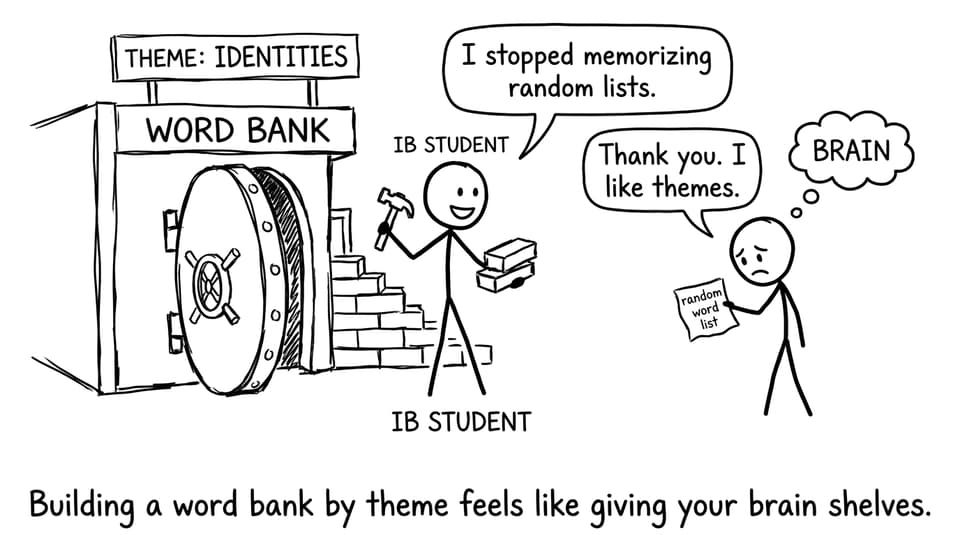
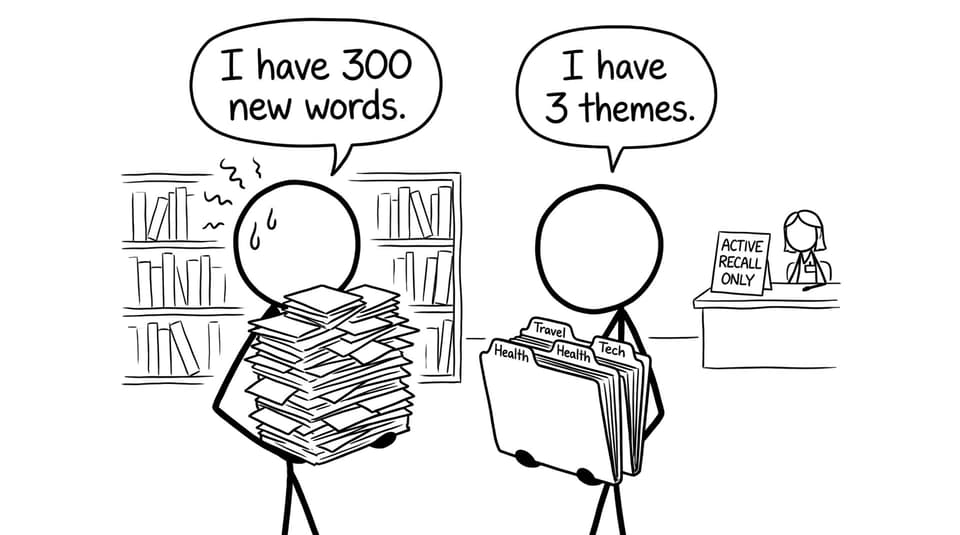
That’s why the most dependable strategy in IB Languages is also the simplest: build word banks by theme. Not one massive list. Not a thousand disconnected flashcards. Themes give your vocabulary a structure your brain can actually retrieve under pressure.
Quick checklist: build a themed word bank in 30 minutes
Use this when you’re tired and you still want progress.
-
Pick one IB theme (Identities, Experiences, Human Ingenuity, Social Organization, Sharing the Planet)
-
Add 20 high-utility words (not rare, not poetic, actually usable)
-
Add 10 collocations (verb + noun pairs you can write without thinking)
-
Add 6 opinion frames ("In my view...", "It is undeniable that...")
-
Add 4 flexible examples (one personal, one local, one global, one future-looking)
-
Convert it into spaced repetition Flashcards and review for 5 minutes daily
If you want the theme map first, bookmark: IB Languages: The 5 Core Themes of IB Chinese B.
Why themed vocabulary is the quiet advantage in IB Languages
A good word bank isn’t about sounding advanced. It’s about being fast.
The IB Languages exams reward students who can produce relevant language quickly: the right register, the right topic vocabulary, the right connectors, and just enough variety to show range. Themed word banks help because they match the way prompts are built and the way your memory retrieves.
It mirrors the IB Chinese B course design
The IB doesn’t test “random Mandarin.” It tests communication inside recurring contexts. If you revise inside those same contexts, your vocabulary becomes exam-shaped.
You can see that structure reflected across RevisionDojo’s course hub: IB Chinese B Resources.
It upgrades recall under time pressure
In exams, you don’t have time to search your memory. You need a small set of words that appear automatically when you see a theme.
Think of themes as mental folders. When the folder opens, the words fall out.
It improves every assessment, not just writing
Themed vocabulary supports:
-
Paper 1 writing: clearer ideas, fewer repeats, more precise phrasing
-
Reading and listening: faster recognition of topic signals
-
Individual Oral: smoother discussion with less stalling
For a bigger picture of what’s assessed, use: IB Languages: IB Chinese B Exams 2025 Overview.
The five themes to build your IB Chinese B vocabulary around
These are the core themes you’ll keep meeting in IB Languages prompts, texts, and oral discussions.
Identities: make it personal, not generic
This theme gets easier when you stop collecting “nice words” and start collecting words you can use to describe your routine, values, health, and relationships.
Your word bank should include:
-
relationships and personality traits
-
health and wellbeing language
-
hobbies, lifestyle, and daily habits
-
cultural identity and traditions
If you’re still clarifying what Chinese B expects overall, read: IB Languages: What Is IB Chinese B? Beginner Guide.
Experiences: build story vocabulary
Experiences is where students often write flat narratives. The fix is not “more adjectives.” The fix is verbs + sequencing + reflection.
Include:
-
travel and transport words you can actually use
-
school life and learning routines
-
milestone events (moving, joining, failing, improving)
-
time markers and sequencing connectors
Human Ingenuity: prepare for modern-life prompts
Technology and media prompts are common because they create debate. A strong word bank here should include both tools and opinions.
To ground this theme with ready-made practice, explore: 传播与媒体 (Communication and Media).
Social Organization: learn “society words” that fit any prompt
This theme is broad: education, work, law, community, institutions. Students often avoid it because it feels abstract. Your word bank should make it concrete.
Include:
-
community roles and volunteering
-
education system language
-
workplace and career terms
-
rules, fairness, and participation
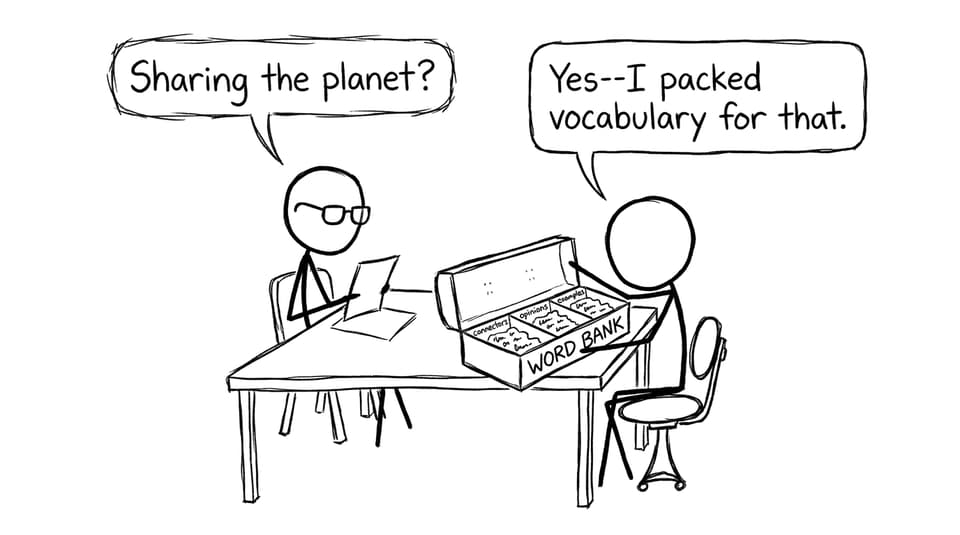
Sharing the Planet: combine environment + ethics
This theme is the classic trap: students memorize environmental nouns but can’t form persuasive sentences.
Build vocabulary for:
-
causes and effects (pollution, consumption, policy)
-
sustainability solutions
-
equality and human rights language
-
global cooperation and responsibility
How to build an IB Chinese B word bank that you can actually use
A word bank is only useful if it becomes active vocabulary: words you can produce without translating.
Start with a template, not a blank page
For each theme, create the same sections:
-
Core nouns (10-15): the objects and concepts
-
Core verbs (10): what people do with those nouns
-
Collocations (10): the default pairings
-
Opinion frames (6): sentence starters you can reuse
-
Connectors (8): because, however, therefore, in addition
-
Micro-examples (4): short, flexible examples
If you want a ready place to drill theme vocabulary directly, use: IB Chinese B Vocabulary Practice.
Record phrases and sentence patterns, not single words
Single words are fragile. Phrases are stable.
Instead of saving one term, save something you can drop into writing:
-
a verb phrase you can reuse
-
a comparison structure
-
a cause-effect structure
This is where RevisionDojo’s Flashcards shine: you can build cards that test full chunks, not isolated translations. See: Flashcards.
Use active recall with feedback loops
In IB Languages, recall matters more than recognition. You need to produce vocabulary inside sentences.
A simple loop many students stick to:
-
Review 10 Flashcards
-
Write 6 sentences using today’s theme
-
Get quick feedback and rewrite 2 sentences better
RevisionDojo supports this “tight loop” with the Questionbank, AI Chat, and Grading tools, so your word bank turns into usable exam language, not just notes. Start here: Questionbank.
Rotate themes weekly (and recycle old ones)
Don’t binge one theme for three weeks and then abandon it. Rotate.
Example:
-
Week A: Identities + Experiences
-
Week B: Human Ingenuity + Social Organization
-
Week C: Sharing the Planet + mixed review
If you need a broader system for long-term retention, this article pairs well: Use RevisionDojo Notes to Boost IB Retention.
How themed vocabulary shows up in each IB Chinese B assessment
The goal is not “know more words.” The goal is “retrieve the right words at the right time.”
Paper 1 writing: vocabulary range with control
Themed word banks help you avoid repeating basic words and help you stay aligned to the prompt’s theme.
Use this as your writing setup: How to Prepare for IB Chinese B Paper 1 (Writing Exam Guide).
Reading and listening: faster comprehension through topic signals
Texts often reveal their theme early. When you recognize theme vocabulary quickly, you waste less energy decoding and more energy answering.
RevisionDojo’s Study Notes can help you rebuild weak theme areas quickly: Study Notes.
Individual Oral: fluent theme discussion without stalling
In the oral, pauses are expensive. A themed word bank gives you:
-
topic vocabulary
-
connectors for logic
-
opinion frames for evaluation
-
examples for development
FAQ: IB Chinese B vocabulary and themed word banks
How many words do I need for IB Chinese B in IB Languages?
There isn’t a single magic number, because IB Languages grading is based on how well you communicate, not how many words you can list. Many students aim for around 1,500-2,000 words of active vocabulary, but “active” is the key word. Active means you can produce the word correctly in a sentence, with the right tone and context, under time pressure. A themed word bank helps because it prioritizes usable vocabulary for recurring prompts rather than rare vocabulary you’ll never deploy. If your vocabulary feels big but your writing still repeats the same phrases, your issue is usually organization and retrieval, not effort. Build smaller, theme-focused banks and practice producing them daily.
Are flashcards enough, or do I need writing and speaking practice too?
Flashcards are necessary but not sufficient for IB Languages, because exams demand production, not recognition. Flashcards train fast recall, which matters, but they can trick you into thinking you “know” a word because you recognize it. Writing and speaking force you to choose words, connect ideas, and handle grammar at the same time. The best routine is a loop: flashcards for recall, short writing for control, and speaking for fluency. On RevisionDojo, you can combine Flashcards with the Questionbank and AI Chat to turn recall into application with feedback. When you do that, your vocabulary stops being theoretical and starts becoming exam language.
How do I stop forgetting themed vocabulary after I learn it?
Forgetting is normal. The fix is not cramming harder; it’s scheduling review before the memory fades. Use spaced repetition and keep each review session short enough that you’ll actually do it on busy days. Themed word banks help because you can revisit a whole cluster of related words quickly, which rebuilds the network in your brain. Also, recycle vocabulary through tiny outputs: two sentences, a 60-second mini speech, or a short paragraph using only one theme. If you keep an error log of words you missed in practice, those become your highest-value flashcards. Over time, your theme folders get stronger, and retrieval becomes automatic.
Conclusion: make your IB Chinese B vocabulary feel findable
The difference between “I studied vocab” and “I can use vocab” is usually structure.
When you build word banks by theme, you’re studying the way IB Languages assessments actually work. You’re creating a system your brain can retrieve in the minute you need it: during a timed writing task, a listening text, or an oral follow-up question.
If you want an all-in-one workflow for this, RevisionDojo is built for it: Study Notes to understand the theme, Flashcards to lock in recall, Questionbank to apply vocabulary in exam-style practice, AI Chat and Grading tools to tighten your expression, plus Mock Exams, Predicted Papers, the Coursework Library, and Tutors when you want more structure and support.
Start today with one theme, one word bank, and one short output. Then repeat. That’s how IB Chinese B vocabulary becomes dependable.