Join 650k+ students breezing through the IBReady to breeze through the IB?
If you’ve ever finished one language exam and thought, “I survived,” only to remember you have another one tomorrow, you already understand the real challenge of IB Languages: not difficulty, but endurance. Back-to-back exams punish panic and reward pacing. The goal isn’t to squeeze in more learning between papers. It’s to protect your attention span so it lasts.
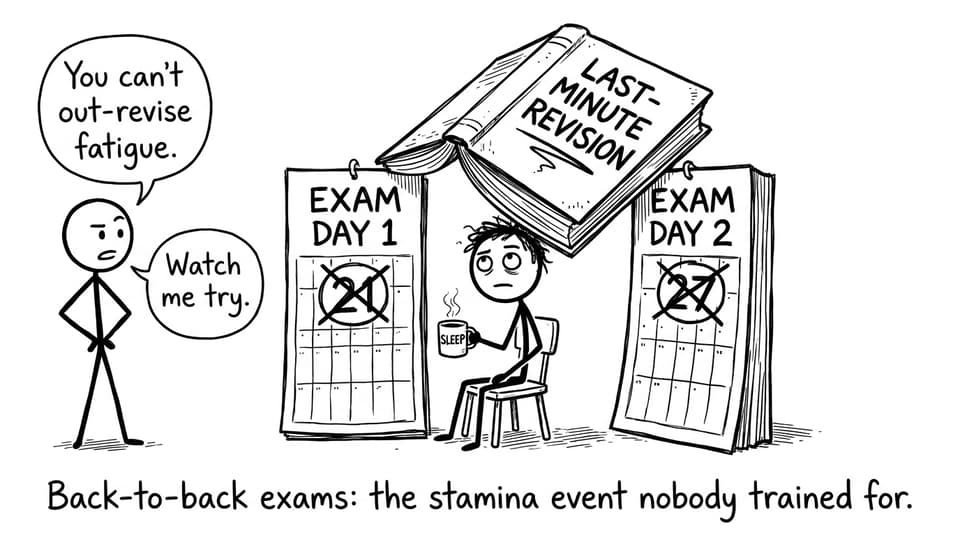
Student crushed by revision book
A quick checklist for back-to-back IB Languages
Front-load your IB Languages revision (weeks before)
Keep each language in separate “lanes” (materials, time blocks, habits)
Practice listening when you’re slightly tired (on purpose)
In the final 48 hours, switch to light, confidence-building review
Between exam days, cap review at 30-45 minutes, then prioritize sleep
The biggest mistake with IB Languages back-to-back exams
The classic error is cramming in the gap between exams. It feels responsible. It also quietly breaks the two things you need most for IB Languages: sleep and clean recall.
Listening and reading comprehension depend on concentration, not heroics. When you overload your working memory, you don’t become “more prepared”; you become noisier. The second exam then feels harder, and that feeling can spiral into doubt.
The students who stay consistent across IB Languages exams do one unglamorous thing well: they make revision automatic before exam week.
Separate your languages so your brain stops blending them
Keep separate folders, separate playlists, separate flashcard decks. Even separate pens if that helps. Your brain builds context cues faster than it builds vocabulary.
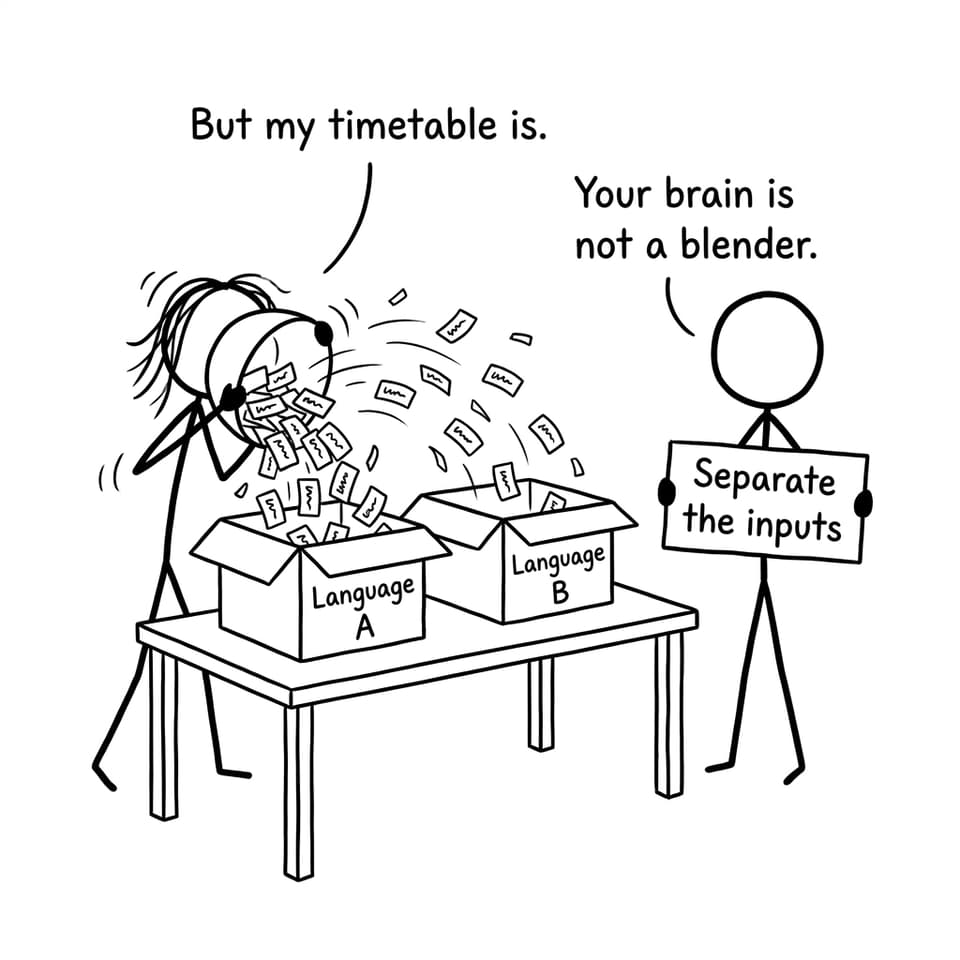
Your brain is not a blender
RevisionDojo makes this easier because your practice can live in one place but stay organized by subject. Use Study Notes to clarify what “good” looks like, then reinforce it with Flashcards and spaced repetition via IB Flashcards with Spaced Repetition (SRS).
Practice the exam skills under realistic energy levels
Once a week, do a short listening block when you’re not at peak freshness (after school, after sports, late afternoon). This is a controlled stress test. Back-to-back IB Languages exams are a stamina sport, and training only when you feel amazing leaves you fragile.
For targeted practice, build quick drills with the Questionbank (and review mistakes immediately). If you’re taking English A alongside another language, this page is a useful example of focused practice: IB English A Lang & Lit English Paper 2 Questionbank.
The final days: lighter, familiar, confidence-building
In the last 2-3 days, your job is to stop chasing new material and start protecting performance.
Good final review for IB Languages looks like:
High-yield vocabulary and connectors
Your common errors (agreement, register, tense switching)
Text type structures (openings, closings, paragraph logic)
Short listening clips for pattern recognition, not “more content”
The day between exams: protect the second performance
Treat the day between exams like a bridge, not a battlefield.
Aim for:
30-45 minutes of review max (a single timed mini-task or a short error log pass)
One language only (no switching back and forth)
A normal meal, hydration, and a consistent bedtime
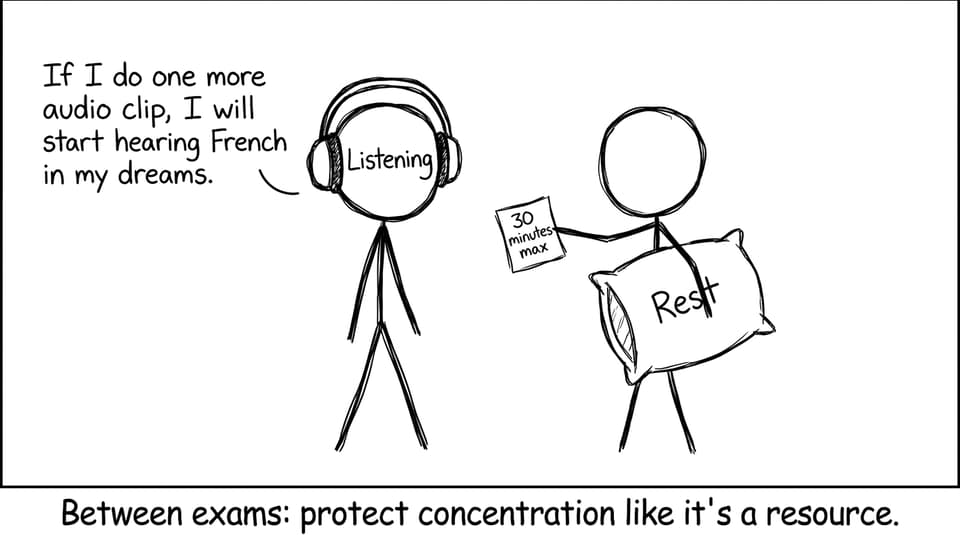
Between exams: protect concentration
If you want structure without overthinking, use a planner that tells you what to do and what to stop doing. Start with the RevisionDojo Study Planner and let it help you front-load the heavy work.
How high-scoring students stay consistent in IB Languages
They accept one truth early: the second exam often feels worse, even when you perform just as well.
So they focus on controllables:
Routine over emotion
Technique over panic
Mistake patterns over “more revision”
On RevisionDojo, that looks like running a tight loop: Study Notes for clarity, Flashcards for retention, Questionbank for application, and AI Chat for fast explanations when you get stuck. If you want a full system view, RevisionDojo App: The Smarter Way to Prep for IB Exams shows how the tools connect (including Mock Exams, Predicted Papers, Grading tools, the Coursework Library, and Tutors).
Conclusion: prepare earlier, recover harder
Back-to-back IB Languages exams don’t require more effort; they require better timing. Front-load the heavy revision, separate your languages, practice listening under realistic energy levels, and keep the gap between exams calm and light.
If you want one place to run that plan, use the RevisionDojo Study Planner alongside RevisionDojo’s Questionbank, Study Notes, Flashcards, AI Chat, and examiner-style Mock Exams and Predicted Papers. Your best advantage in IB Languages isn’t cramming. It’s showing up for the second exam with your focus intact.