
Writing in IB Chinese B can feel like trying to build a neat house while the timer is already ticking.
You read the prompt, you know the theme, you even know some good vocabulary. But then the page stays empty for just a little too long. And suddenly your brain starts bargaining: Maybe I can skip planning. Maybe I can improvise the format. Maybe the conclusion isn’t that important.
That’s the moment IB Languages students often lose marks they didn’t need to lose.
This post walks you through a calm, repeatable writing process for IB Chinese B, from planning to proofreading, so your ideas land clearly, your structure matches the text type, and your language looks intentional. Along the way, you’ll see how RevisionDojo can make your IB Languages writing practice more measurable, less stressful, and a lot more consistent.
A quick checklist you can run in 30 seconds
When you’re practicing IB Chinese B writing, keep this IB Languages checklist on a sticky note:
-
Identify text type, audience, purpose, and theme
-
Plan 2-3 main points with 1 example each
-
Use clear paragraph roles: opening, development, closing
-
Add connectors to show logic (not decoration)
-
Build sentence variety (short for punch, longer for explanation)
-
Proofread for characters, register, and missing conventions
If you want a single hub that matches this workflow, start with IB Chinese B Resources and treat it as your home base.
Start with the task, not the words
Most writing mistakes in IB Languages are not “bad Chinese.” They’re misread tasks.
Before you draft anything, translate the prompt into four decisions:
Text type
Diary, blog, letter/email, article, speech, report: each comes with conventions. If you’re unsure what they look like in IB Chinese B, review IB Chinese B Writing: Mastering Different Text Types and save one opening and one ending model for each.
Audience and register
Ask: Who am I speaking to? A friend? The school principal? The public? IB Languages examiners reward register control because it proves you can communicate appropriately, not just accurately.
Purpose
Are you informing, persuading, reflecting, recommending, complaining, or inviting? Your verbs and connectors change depending on purpose.
Theme
Paper 1 prompts always sit inside a prescribed theme. If you want a quick refresher, keep The Five Core Themes of IB Chinese B Explained open when you practice and build a phrase bank per theme.
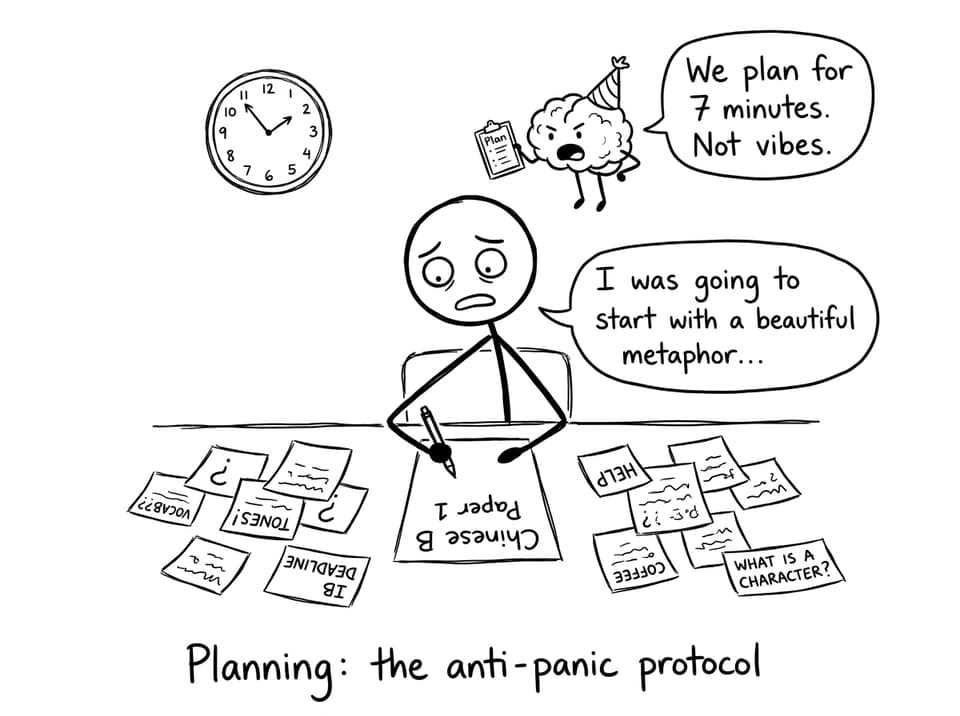
Planning: 7 minutes that buy you 20
Planning feels slow only when you haven’t felt the cost of not planning.
A student once told me they “saved time” by starting immediately. They wrote fast, finished early, and still walked out annoyed. When they reread their work later, the problem wasn’t grammar; it was drift. Their second paragraph contradicted the first. Their examples didn’t match the audience. Their conclusion introduced a new idea with no closure.
That is exactly why the best IB Languages writers plan like it’s part of the grade.
Use this 3-part plan (5-10 minutes):
Build a mini vocabulary map
Write 8-12 words/phrases you might use. Include:
-
2 connectors for contrast and cause
-
2 theme-specific nouns
-
2 opinion phrases
-
1 idiom or set phrase (only if you can use it correctly)
RevisionDojo’s Flashcards make this easier because you can build theme decks that you actually reuse in writing. Pair that with the IB Languages tag hub when you want broader language-acquisition strategies.
Choose 2-3 points (not 5)
Depth beats breadth in IB Languages writing. Two well-developed points with examples and consequences usually score better than five thin points.
Outline paragraph jobs
-
Opening: context + purpose + tone
-
Body 1: point + reason + example
-
Body 2: point + reason + example (or counterargument)
-
Closing: summary + reflection/call-to-action
Drafting: write for the reader, not the dictionary
Once you begin writing, your main goal is easy to forget: clear communication.
In IB Languages, complexity is only useful when it increases precision. If it makes the message harder to follow, it’s not sophistication; it’s noise.
Openings that do their job
Match the opening to the text type:
-
Diary: date/day + mood + what happened
-
Blog: title + friendly hook + question to engage
-
Formal letter/email: appropriate greeting + reason for writing
-
Article: define the issue + why it matters
-
Speech: greeting + topic + what you want the audience to do/think
For more targeted advice on building skill across formats, see How to Improve Writing in IB Chinese B.
Body paragraphs that earn “Message” marks
A strong body paragraph in IB Chinese B usually includes:
-
A clear topic sentence
-
One reason (because)
-
One example (for example)
-
One consequence (therefore/so)
-
A link back to purpose or audience
Useful expansion patterns:
-
因为…所以…
-
不仅…而且…
-
如果…就…
-
比如…
This is how IB Languages writing starts to sound “controlled”: your sentences show relationships, not just facts.
Connectors: the invisible scoring tool
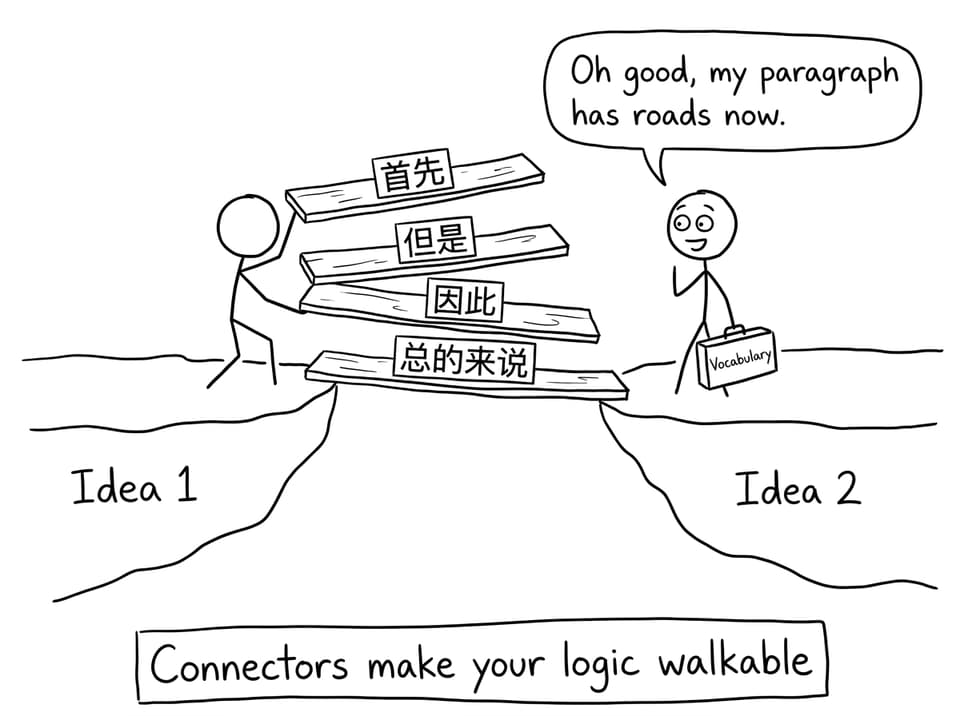
Connectors are not decoration. They are signposts. They tell the examiner your thinking is organized.
Build a small, reliable set you can use naturally:
-
Sequencing: 首先 / 其次 / 然后 / 最后
-
Contrast: 但是 / 虽然…可是…
-
Cause/effect: 因此 / 所以
-
Conclusion: 总的来说 / 简而言之
Time management: protect the final 10 minutes
In IB Languages exams, the final minutes are where quiet gains live.
A practical timing model for Paper 1 practice:
-
5-10 minutes: plan
-
35-55 minutes: write (depending on SL/HL pacing)
-
5-10 minutes: proofread
If timing is your weak point, use How to Manage Time in IB Chinese B Exams and run at least one timed writing session per week.
Proofreading: a simple loop that saves marks
Proofreading isn’t “reading it again.” It’s scanning in layers.
Use this 3-pass loop:
Pass 1: conventions and structure
Check the required format:
-
Did you include date/title/greeting/sign-off if needed?
-
Do you have a real conclusion, not a sudden stop?
Pass 2: register and audience
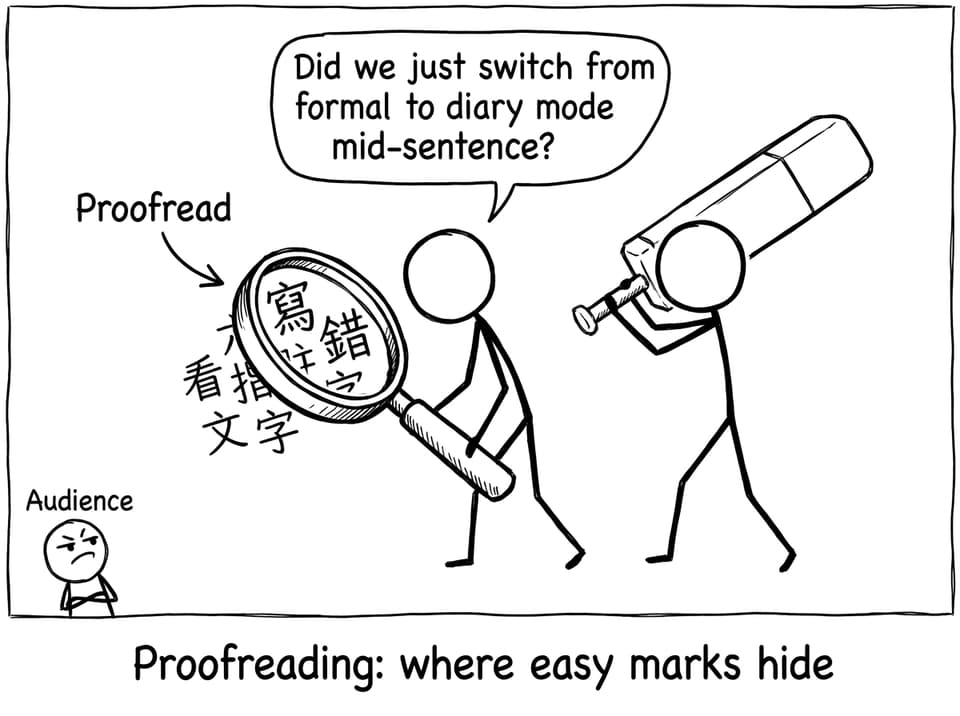
Ask: Did I accidentally switch tone? This is common in IB Languages writing: students start formally and drift into diary-style opinions.
Pass 3: characters and repetition
-
Fix common character mistakes you know you make
-
Replace repeated basic adjectives (好, 大, 小) with more specific choices
RevisionDojo’s Grading tools and AI Chat can help here: paste a practice response, ask for feedback on register and clarity, then rewrite once. That rewrite step is where improvement becomes permanent.
A weekly practice routine that actually works
If you want steady progress in IB Languages, avoid “random practice.” Use a loop:
-
1 timed Paper 1 writing per week
-
1 focused text-type drill (openings and closings only)
-
1 connector practice: rewrite one paragraph with clearer logic
-
Maintain an error log (your personal list of repeat mistakes)
For a broader plan that balances all skills, combine this with How to Revise Effectively for IB Chinese B Exams and keep your resources in one place.
Closing: make writing practice feel predictable
The best IB Chinese B writers don’t rely on inspiration. They rely on a process: read the task correctly, plan with intention, draft with structure, then proofread in layers. That process turns IB Languages writing from a high-stakes performance into something closer to routine.
If you want that routine supported by tools that match how IB assesses you, use RevisionDojo to build the loop: practice with the Questionbank, revise with Study Notes, retain phrasing with Flashcards, get targeted feedback through AI Chat and Grading tools, and pressure-test your progress with Mock Exams and Predicted Papers. When you do that consistently, planning to proofreading stops being a checklist you forget, and becomes the way you write.