
Introduction
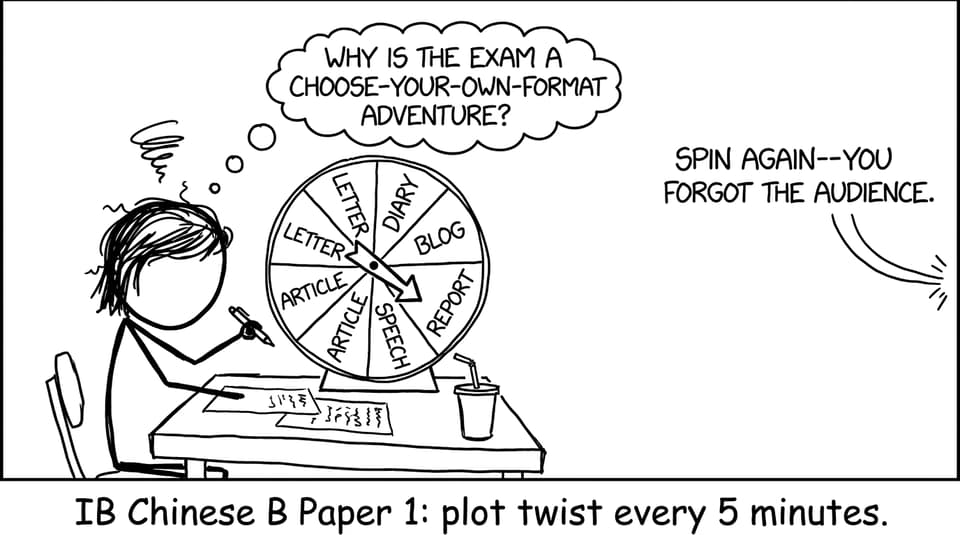
The first time you sit down for IB Chinese B Paper 1, it can feel like the exam is testing a secret skill: not just whether you can write Chinese, but whether you can shape Chinese into the right real-world container. A friendly email. A reflective diary. A persuasive speech. Same language, different rules.
That is the quiet challenge at the heart of IB Languages writing. Examiners reward students who can match purpose, audience, and format with the kind of precision that makes your response feel believable. If you can do that, your grammar gets to shine instead of getting lost.
This guide breaks down the most common IB Chinese B text types, the conventions that earn marks, and a practice routine you can repeat until it feels automatic.
Quick checklist for IB Languages text types
Keep this as your pre-writing ritual:
-
Identify text type + audience + purpose + theme in one sentence.
-
List 2-3 points you will develop with reason + example.
-
Add 6-10 connectors you can use naturally (not as decoration).
-
Reserve 7-10 minutes to check format conventions and accuracy.
-
Use a feedback loop: self-check, peer/teacher check, then rewrite.
If you want a structured hub for this workflow, start with IB Chinese B Resources, then pair practice with RevisionDojo tools like Questionbank, Study Notes, Flashcards, AI Chat, Grading tools, Predicted Papers, and Mock Exams.
What Paper 1 is actually rewarding in IB Languages
In IB Languages, Paper 1 writing is assessed through:
-
Language: grammar, vocabulary range, and accuracy.
-
Message: relevance, development, and clarity.
-
Conceptual understanding: how well you match context, audience, and text type.
Your text type is not “presentation.” It is evidence that you understand what communication looks like in real life.
For a calm overview of timing and what to expect, see How to Prepare for IB Chinese B Paper 1 and What to Expect From IB Chinese B Exams 2025.
Letters and emails: format that signals control
Conventions to lock in
Letters and emails are common because they test audience awareness fast.
-
Greeting: 亲爱的… (informal) vs 尊敬的… (formal).
-
Reason for writing early: 我写信是想… / 我想向您请教…
-
Closing: 祝好 (neutral) or 此致敬礼 (formal).
-
Sign-off: 你的朋友… / 学生…
Practice move
Write the same prompt twice: once to a friend, once to a school principal. In IB Languages, that single switch forces better register control.
For more targeted writing process tips, use IB Languages: Writing Strategies for IB Chinese B.
Diary entries: the art of sounding human
Conventions to lock in
-
Date and day at the top: 2026年6月19日 星期五.
-
First-person voice with reflection: 今天我意识到… / 让我最惊讶的是…
-
Emotional nuance without drama: show, then explain.
Practice move
Keep a micro-diary: 80-120 characters, three times a week. It builds fluency without exhausting you. Add one connector each time so the writing flows.
Blogs: friendly, direct, and still structured
Conventions to lock in
-
A clear title.
-
Direct address: 大家好! or 你有没有…的经历?
-
Personal voice, but organized paragraphs.
-
A closing that invites response: 欢迎留言分享你的想法。
Practice move
Read one authentic Chinese blog post weekly and steal three usable phrases. Then write your own 250-350 character entry using those phrases in your own situation.
To build this into a repeatable improvement loop, follow IB Languages: Improve Writing in IB Chinese B.
Articles and reports: the “serious voice” without stiffness
In IB Languages, articles and reports can look similar, but your intention should be different.
Articles
-
Can be informative or persuasive.
-
Use a strong opening line to hook attention.
-
Include opinion markers: 我认为… / 值得注意的是…
Reports
-
More objective and structured.
-
Use factual framing: 根据调查… / 结果显示…
-
Headings or clear sections help readability.
Practice move
Turn school life into data: survey five classmates on a theme (sleep, stress, phones) and write a mini-report. Then rewrite it as an article with a viewpoint. That one exercise trains register, evidence, and structure at once.
If you need syllabus-aligned support while you practise, use IB Chinese B Revision Notes (SL/HL) and IB Chinese B Lessons.
Speeches: rhythm, persuasion, and a clear call to action
Conventions to lock in
-
Opening greeting: 大家好!
-
Rhetorical questions: 你们有没有想过…?
-
Inclusive language: 我们 / 一起
-
Ending: 谢谢大家! plus a final push.
Practice move
Read your speech out loud once. If you run out of breath, your sentences are too long. Fixing rhythm is a hidden advantage in IB Languages writing because it often improves clarity on the page too.
Connectors that work across every IB Languages text type
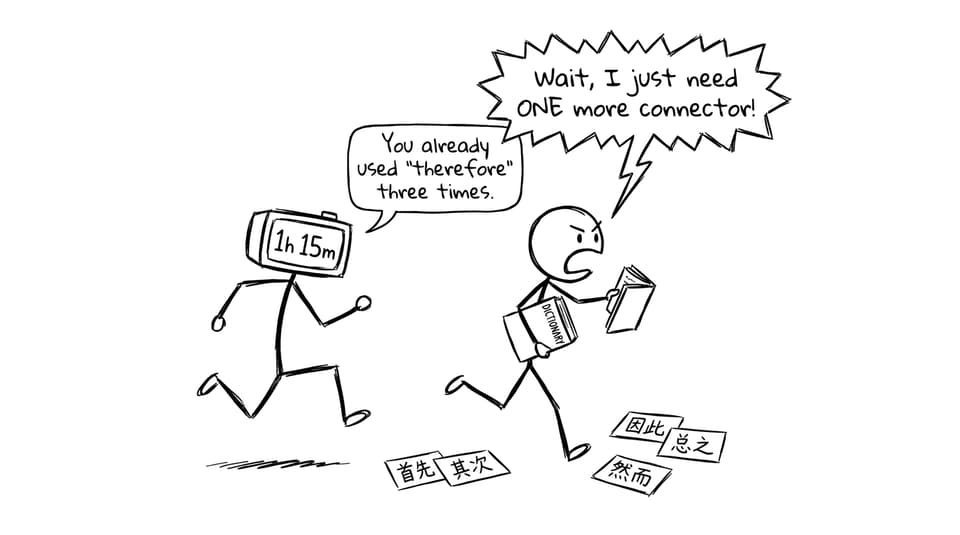
Connectors should feel like signposts, not stickers.
-
Sequencing: 首先 / 其次 / 然后 / 最后
-
Contrast: 虽然…但是… / 然而
-
Cause-effect: 因为…所以… / 因此
-
Wrap-up: 总的来说 / 总之
A simple drill: take five plain sentences and rewrite them using two different connector patterns. You will start to hear what sounds natural.
A realistic weekly practice plan
-
One timed task per week (your weakest text type).
-
One untimed rewrite using feedback.
-
One vocabulary session with Flashcards focused on the week’s theme.
On RevisionDojo, many students pair this with:
-
Questionbank for prompt practice and progression tracking
-
Flashcards for connectors and opening/closing phrases
-
AI Chat to clarify register and improve phrasing
-
Grading tools to see where marks are being lost
-
Mock Exams and Predicted Papers to reduce exam-day surprise
-
Coursework Library and Tutors when you need examples or human feedback
For a broader revision system, see How to Revise Effectively for IB Chinese B Exams and IB Chinese B Grading Explained.
FAQ
Do I need to memorize text-type phrases for IB Languages writing?
Memorising a small bank of text-type phrases is one of the highest ROI moves in IB Languages because it saves time and prevents format mistakes. Openings and closings are especially valuable: greetings for emails, dates for diaries, and a clear sign-off for letters. The key is to memorise “flexible templates,” not full paragraphs. For example, learn 我写信是想… and then practise finishing it with different purposes. If you only memorise fixed lines, your writing can sound robotic and may not match the prompt well. A good balance is 10 openings, 10 closings, and 15 connectors you can use across themes.
What happens if I mix up text-type conventions in IB Chinese B?
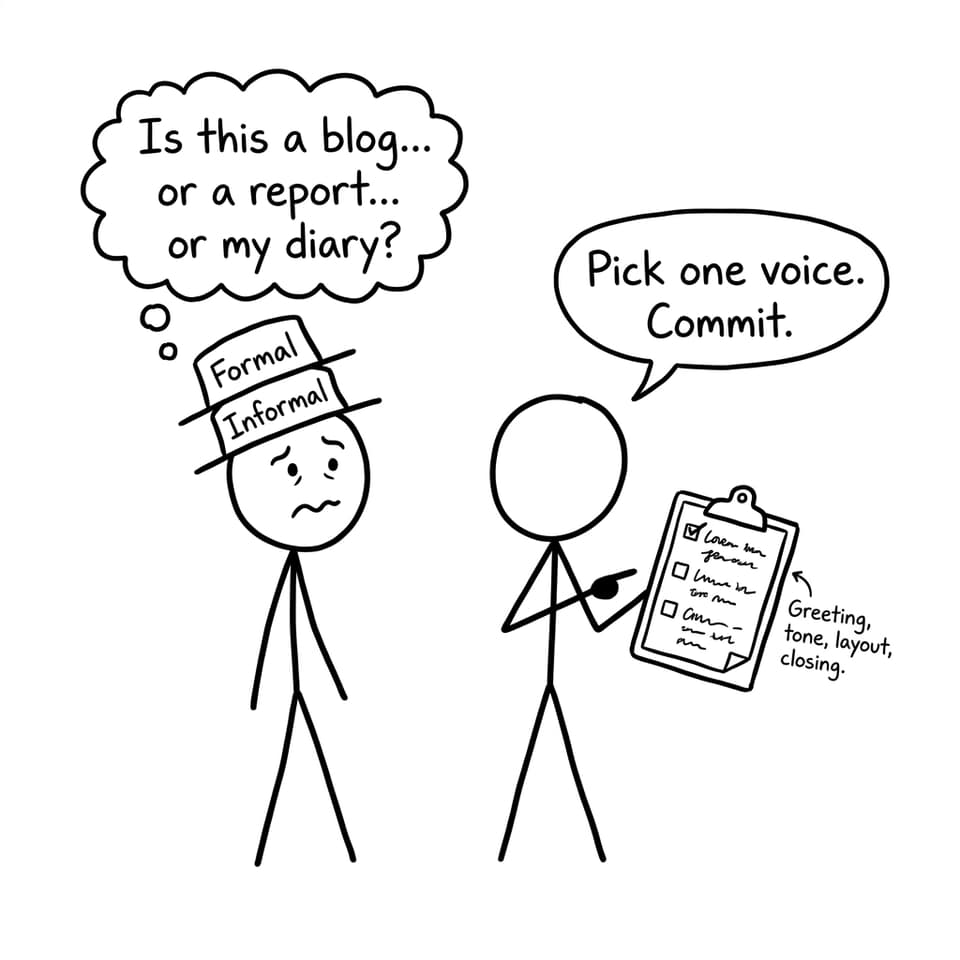
In IB Languages, mixing conventions usually affects conceptual understanding because it signals weak awareness of audience and purpose. A diary entry without a date feels incomplete, and a report written like a personal blog feels mismatched. Examiners are not hunting for perfection, but they do reward control. If you realise mid-way that your format is drifting, you can still recover by adding missing features quickly (a heading, a greeting, a closing line). The bigger danger is tone: slang in a formal report, or overly official language in a friendly blog. The best prevention is a 20-second “format scan” before you write: list the three required features and tick them off.
How do I choose which Paper 1 task to answer under time pressure?
Choose the task where you can be specific quickly: theme vocabulary, a clear viewpoint, and a text type you can execute without hesitation. In IB Languages, confidence often comes from familiarity with the container, not just the topic. If one prompt demands a report and you have not practised reports recently, that task is expensive in time and marks. Spend 2 minutes reading all three prompts, then decide using a simple rule: pick the option where you can generate 2-3 examples immediately. Your examples are what turn a vague message into a developed one. Once you choose, commit and start planning, and switching late is usually worse than improving the plan you already have.
Conclusion: make IB Languages writing feel predictable
Text types are only scary when they feel random. Once you see them as repeatable structures, IB Languages writing becomes calmer: identify audience, pick the right voice, follow conventions, develop two or three strong points, and close cleanly.
If you want one place to practise every format with feedback and structure, use IB Chinese B Resources as your base. Build your routine with RevisionDojo Study Notes, Flashcards, Questionbank prompts, AI Chat support, and Grading tools, then pressure-test it with Mock Exams and Predicted Papers. The goal is simple: walk into Paper 1 knowing that whatever text type appears, you have already written it better at home.