
Starting your IA early does not mean writing an introduction during your first month of DP1. It means understanding the task, collecting possible questions, and testing whether an idea is workable before deadlines make every decision feel urgent.
An IB internal assessment is really a sequence of smaller decisions. You choose a direction, investigate its feasibility, gather appropriate evidence, analyze it, and communicate your findings. Early preparation gives each decision room to breathe.
The best first step is simple: identify the current subject guide used by your school, read the internal assessment section with your teacher, and create somewhere to collect questions. You do not need a polished title yet. You need an informed starting point.
Your IA early-preparation checklist
Use this checklist during DP1:
- Confirm the subject guide and first-assessment year your class follows.
- Read the current task description and assessment criteria.
- Record three topics that genuinely make you curious.
- Turn each topic into a provisional question or aim.
- Check access to data, sources, equipment, participants, or texts.
- Identify ethical, safety, time, and scope constraints.
- Ask your teacher which school deadlines and checkpoints apply.
- Keep complete source details from the beginning.
- Test one promising idea on a small scale.
- Choose feasibility and analytical depth over unnecessary complexity.
The goal is not to finish prematurely. It is to uncover the assumptions hiding inside your plan while they are still easy to change.
First understand what the internal assessment is
The Diploma Programme uses internally and externally assessed components. An internal assessment is normally marked by your teacher, while the IB uses moderation to help maintain common standards across schools. The exact task, weighting, format, criteria, permitted support, and submission process depend on the subject and guide version.
There is no universal IA formula. A scientific investigation, mathematical exploration, historical investigation, and language oral do not demand the same evidence or structure. Advice that is useful in one subject may be unsuitable in another.
Before following any online checklist, confirm these points with your teacher:
| What to confirm | Why it matters |
|---|---|
| Subject guide version | Requirements can change between course cycles. |
| First-assessment year | This identifies the guide applying to your cohort. |
| School milestones | Schools establish their own calendars and approval stages. |
| Required conduct | Collaboration, safety, referencing, and teacher support vary. |
Universal word counts, criterion names, weightings, and official submission dates are intentionally avoided here. Check those details against the current subject guide and your school's instructions.
Treat DP1 as a year for collecting questions
Students sometimes wait for a brilliant topic to arrive fully formed. Strong investigations usually begin with something smaller: a surprising classroom result, a disagreement between historians, a pattern in a novel, or a mathematical relationship worth exploring.
Create a question bank for every subject with an IA component. After an interesting lesson, ask:
- What surprised me?
- What might happen if one condition changed?
- What evidence could answer this?
- Is there a debate, pattern, or relationship here?
- Could I investigate it with the resources available?
Do not judge every entry immediately. Collection benefits from openness; selection requires discipline. RevisionDojo's guide to choosing a feasible IA topic can help you distinguish genuine curiosity from an idea that merely sounds impressive.
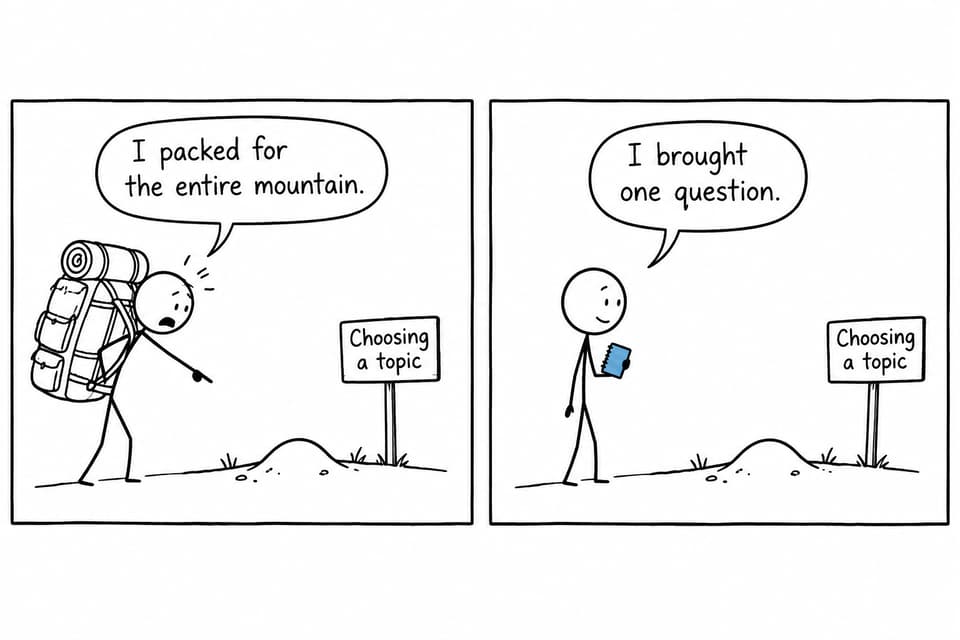
A student prepares for an entire mountain while another begins with one question.
Test feasibility before choosing a topic
An idea can be fascinating and still make a poor IA. The essential skill is recognizing which ideas can survive contact with time, evidence, ethics, and school resources.
Check the requirements
Can the idea produce the kind of work required by the current subject guide? Begin with the task and criteria rather than forcing a favourite topic into the wrong assessment shape.
Check the evidence
Can you obtain suitable evidence? Depending on the subject, this might involve reliable sources, measurable data, appropriate texts, mathematical processes, or ethically gathered responses. Access should be realistic rather than hypothetical.
Check the scope
Can you answer the question with enough depth within the stated constraints? Broad questions often produce description. A focused question creates space to analyze, evaluate, and recognize limitations.
Use the IA research question guide to move from general interest toward an answerable problem.
Check the method and risks
Can you outline how you would investigate the question and analyze the evidence? You need not settle every detail in early DP1, but the basic process should make sense.
Also consider safety, privacy, consent, environmental impact, cultural sensitivity, and academic integrity. Discuss concerns with your teacher before collecting evidence. An elegant question is not worth pursuing through an unsuitable method.
Build a provisional question and test it
A provisional research question directs early reading and experimentation. It is a tool, not a promise.
Compare these two shapes:
- Broad: How does temperature affect reactions?
- Focused: How does changing a defined temperature range affect a measurable outcome in a specified system under controlled conditions?
The second is still only a template. Its value lies in exposing decisions about variables, measurement, controls, and scope. Subject conventions differ, so an experimental question structure may be inappropriate for literature or history.
Once you have a possible question, run a small pilot. For an experiment, take a limited set of measurements. For a source-based investigation, locate several genuinely relevant sources. For mathematics, test whether the approach generates meaningful reasoning. For textual analysis, determine whether the selected passages support sustained interpretation.
Ask whether the method produced usable evidence, what limitations appeared, and whether the project remains manageable alongside other subjects. A pilot that disproves your original plan has not wasted time. It has protected the larger project.
Create a stage-based DP1 timeline
Do not copy another student's calendar without checking your school's schedule. Plan around stages, then attach local dates after speaking to your teacher.
| Stage | Useful outcome |
|---|---|
| Orientation | Correct guide, criteria, instructions, and deadlines identified |
| Exploration | Several interests and provisional questions recorded |
| Feasibility | Access, scope, ethics, safety, and resources checked |
| Pilot | A small trial completed and problems documented |
| Approval | Teacher feedback considered and direction confirmed |
| Development | Evidence and analysis built progressively |
| Review | Work checked against current criteria and instructions |
RevisionDojo's IA and EE timeline for busy students provides a starting framework. The guide to planning an IA without falling behind can help turn stages into regular work sessions, while these common IA planning mistakes show where sensible plans often break down.
Start managing sources immediately
Citation problems often begin before drafting. A student reads something useful, closes the tab, and assumes it will be easy to find later. The idea remains, but its origin disappears.
For every useful source, record the author or organization, title, publication details, URL where relevant, required access date, and a note explaining how it may help. Clearly separate quotations from paraphrased notes.
Follow your school's referencing conventions and current academic-integrity expectations. RevisionDojo's guide to ethical IA research and referencing explains how to build responsible habits before your source list becomes complicated.
Use examples and AI as mirrors
Examples are useful when you study decisions instead of copying outcomes. In RevisionDojo's Coursework Library and feedback tools, examine how work establishes focus, handles evidence, develops analysis, and addresses limitations. Then return to the current criteria and decide how your own investigation should respond.
Jojo AI can challenge the scope of a provisional question, identify assumptions, or explain unfamiliar assessment language. It should not produce assessed writing for submission. Verify its responses and follow current school and IB guidance for disclosure or citation.
RevisionDojo works best as a connected IB resource. Study Notes and Flashcards strengthen the knowledge behind your investigation. The Questionbank develops analytical habits, while Grading tools can reveal weaknesses in work you authored. Predicted Papers and Mock Exams support later exam preparation, and Tutors provide human, subject-specific guidance.
Make early progress count
Starting early cannot guarantee a particular mark. It gives you time to discover that a source is unavailable, a question is too broad, a variable is difficult to measure, or a method needs approval.
A strong DP1 outcome is a credible direction supported by the correct guide, a feasibility check, a small pilot, organized sources, and a schedule reflecting your school's deadlines. When you have a provisional question or your own analysis, create a free RevisionDojo account and use Jojo to test where your reasoning remains unclear. Treat the response as feedback to evaluate, never as text to submit.