
A friend once told me their IB Internal Assessment nearly broke them.
Not because the research question was impossible, or because the analysis was weak.
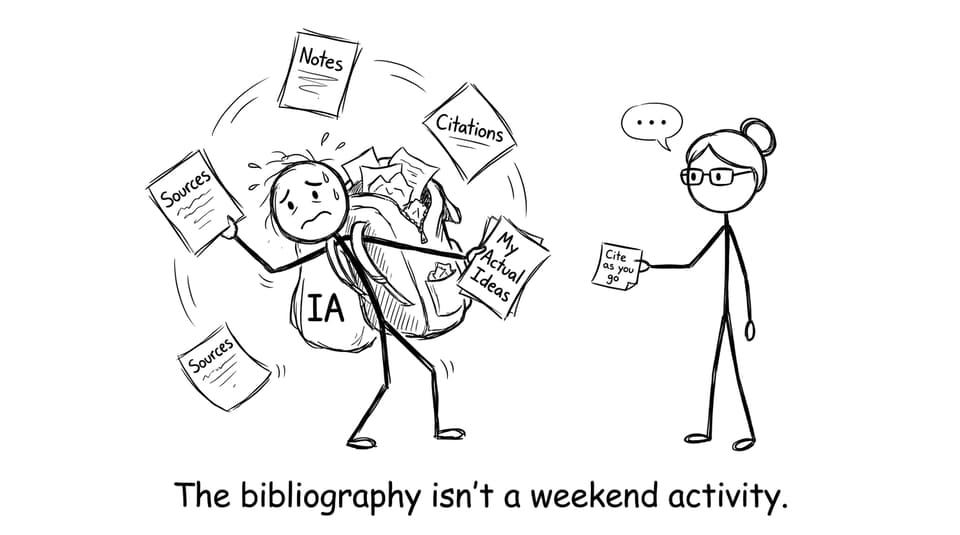
It was a smaller, quieter problem that grew teeth over time: they had great notes, scattered screenshots, half-remembered quotations, and a vague promise to “fix the citations later.” Later arrived like a deadline does: suddenly, all at once.
In the IB, ethical research and referencing are not decoration. They are part of your credibility. They’re the difference between “I found something interesting” and “I can prove what I used, where it came from, and why it matters.”
This guide is a practical set of strategies for ethical research and referencing in IB Internal Assessments, written for students who want calm, repeatable habits that protect both their grade and their integrity.
Quick checklist: ethical research and referencing in IB IAs
Use this as your “before you write another paragraph” check. In the IB, these small habits save hours.
-
Choose one referencing style early (APA, MLA, Chicago) and stick to it.
-
Keep a live source log: links, page numbers, access dates, screenshots.
-
Separate your notes into three columns: quotes, paraphrases, and your own ideas.
-
Cite every borrowed idea: words, interpretations, statistics, images, tables, and methods.
-
Treat data honestly: record raw results, report anomalies, do not edit outcomes to look better.
-
Do a final “claim to citation” audit before submission.
If you want a deeper breakdown of citation mechanics, keep How to Cite Sources Correctly in Your IA open while you edit.
What ethical research means in the IB (beyond “don’t plagiarize”)
Most IB students think research ethics is mainly about avoiding plagiarism. That’s part of it, but the real idea is bigger: fairness, transparency, and traceability.
Ethical research in an IB IA means:
-
Authenticity: the thinking and writing are yours.
-
Accuracy: claims are supported by evidence you can verify.
-
Accountability: the examiner (and your teacher) can trace key ideas back to their sources.
This matters in every subject. In IB Biology or Psychology it includes participant privacy and honest data reporting. In IB History it includes careful handling of primary vs. secondary sources. In IB English it includes properly crediting interpretations you build from critics.
If you want a clean definition of what crosses the line, read IB Academic Misconduct Explained: How to Avoid Plagiarism and Collusion.
Build a “source trail” while researching (the habit that prevents panic)
The simplest IB strategy is also the most ignored: cite as you go.
Not because you’re trying to impress anyone with formatting. Because your brain cannot reliably reconstruct where something came from two weeks later.
A simple source-log system that works
Create a document (or spreadsheet) with these fields:
-
Full source details (author, title, date, publisher)
-
Link or database info
-
Page number(s) or section
-
What you used it for (definition, method, counterargument, data)
-
A copy-paste quote (if relevant)
-
Your paraphrase in plain language
This is ethical research in the IB in its most practical form: you are building traceability.
RevisionDojo makes this workflow easier because you can study content quickly in one place (Study Notes, Flashcards), then move into application without losing your thread. Start at the IB Internal Assessment Guides to see how expectations shift across subjects.
Choose credible sources like you’re building a case, not collecting links
In the IB, weak sources create weak reasoning. Strong sources give your analysis a backbone.
Here’s a calm hierarchy many IB students use:
-
Course companions and textbooks (often your best “foundation” sources)
-
Peer-reviewed articles (use selectively, explain simply)
-
Reputable institutions (universities, government databases, WHO, UN)
-
Quality journalism for context (when appropriate)
A good test is whether an examiner could quickly find and verify the source.
If you’re unsure how many sources is “enough,” use How Many Sources Should an IA Have? as a sanity check. It helps you stop chasing quantity and start supporting each claim.
Paraphrasing ethically in IB: the “close the tab” rule
Paraphrasing is where many IB academic integrity issues happen accidentally.
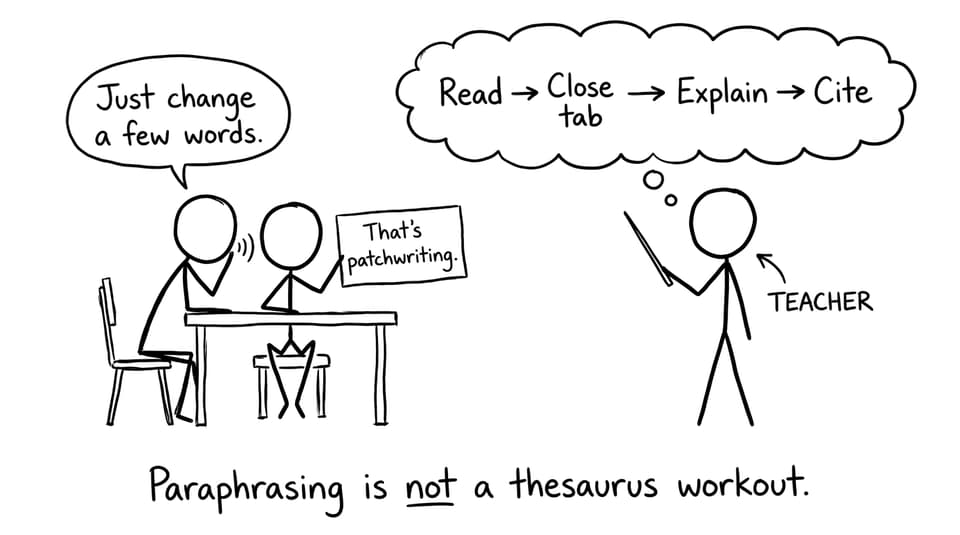
A student reads a sentence, swaps a few words, keeps the structure, and tells themselves it’s paraphrased. That’s not paraphrasing. That’s patchwriting, and it can still be flagged.
The ethical paraphrase method
-
Read the source until you understand it.
-
Close the tab or turn the page.
-
Explain the idea like you’re teaching a younger student.
-
Reopen the source and check you didn’t copy the structure.
-
Cite the source anyway (because the idea is still theirs).
For an IA-specific breakdown, keep How to Avoid Plagiarism in Your IA nearby while drafting.
Direct quotes, visuals, and data: referencing what students forget
In IB IAs, students usually remember to cite quotations. They forget the quieter borrowings.
What must be referenced in IB work
-
Direct quotes (with page numbers when possible)
-
Paraphrased ideas
-
Data you didn’t collect (tables, statistics, datasets)
-
Methods and protocols (especially in sciences)
-
Images, graphs, maps, and diagrams
-
Specific interpretations (especially in humanities)
If you use an image or figure, the ethical move is simple: cite it in the caption and include it in the reference list.
Also remember a small but relieving detail: in many IB subjects, references typically do not count toward the word count, so don’t delete citations to “save words.” See Do References Count in the IA Word Count?.
Data ethics in IB science and psychology IAs
Ethical research in the IB is not only about writing. It’s about how you handle evidence.
If your IA involves experiments, surveys, or replications:
-
Record raw data as it happens.
-
Do not remove “messy” results just to make a graph cleaner.
-
Report anomalies and limitations openly.
-
Protect participant privacy: anonymous responses, informed consent where required.
A surprising truth: honest imperfections often strengthen evaluation. They show you understand method limits and real-world uncertainty.
To improve evidence quality (and reduce the temptation to pad your IA with irrelevant material), read How IB Students Should Select Evidence Strategically in an IA.
Using AI ethically in IB research and referencing
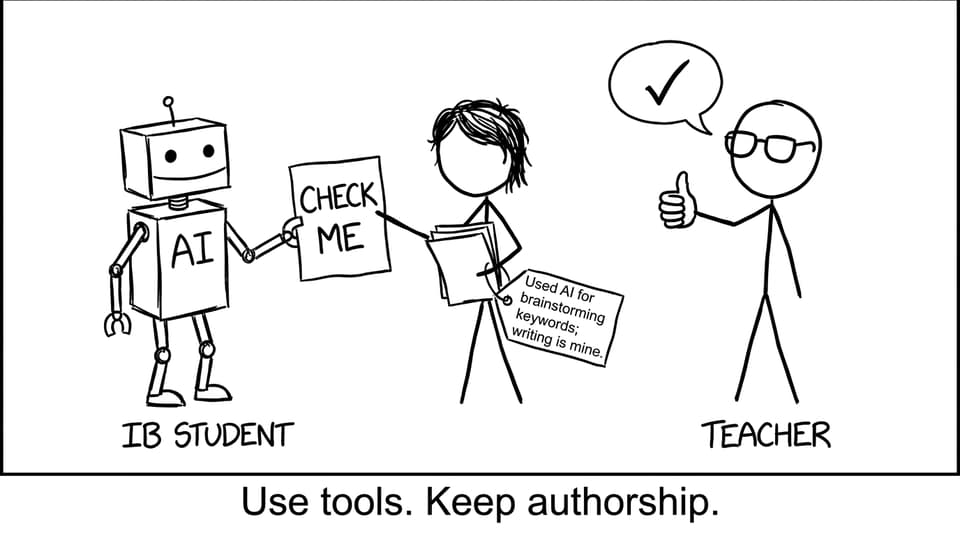
AI tools can be genuinely helpful in the IB when they support understanding rather than replace thinking.
Ethical use usually looks like:
-
brainstorming research angles
-
generating search terms for databases
-
clarifying confusing concepts
-
checking whether your argument has gaps
Unethical use usually looks like:
-
generating full analysis paragraphs
-
paraphrasing entire sources through an AI tool
-
producing conclusions you cannot defend orally
If you use AI, the safest IB standard is: you must still be able to explain and justify every part of the work in your own voice.
For a student-friendly integrity framework, read How RevisionDojo Helps You Maintain Academic Integrity While Studying.
RevisionDojo’s AI Chat is best used the same way you’d use a strong tutor: ask questions, test your understanding, then write your IB IA in your own words. Pair that with Study Notes, Flashcards, and the Questionbank to keep your thinking active, not copied.
A practical “final hour” referencing audit for IB students
Right before submission, do an audit like an examiner.
-
Highlight every sentence that contains a specific claim, statistic, or interpretation.
-
Ask: “Could someone challenge this?” If yes, it needs a source.
-
Match every in-text citation to the reference list.
-
Check captions for figures and tables.
-
Confirm one consistent citation style.
If you want subject-specific referencing help, humanities students often find IB History IA Referencing: Cite Sources Properly especially useful.
Closing: Make IB integrity a strategy, not a fear
The best IB research doesn’t feel like a scramble to “prove you didn’t cheat.” It feels like a trail of careful decisions: you chose sources you trust, you kept your process visible, and you treated other people’s work with respect.
When you do ethical research and referencing well, your IA becomes lighter to carry. You stop relying on memory. You stop negotiating with your conscience at midnight. And you walk into final submission knowing you can defend every line.
If you want a system that supports that calm, use RevisionDojo as your backbone: Study Notes for clarity, Flashcards for recall, Questionbank for application, AI Chat for targeted questions, and Grading tools to check rubric alignment. Add Predicted Papers and Mock Exams to keep your exam prep moving while your IA stays clean.
In the IB, integrity is not a rule. It’s a competitive advantage. And it starts with the next citation you add, right now.