
For IB students sitting exams in May 2028 (started DP1 in August 2026).
To get a 7 in IB English Literature in 2028, you must consistently interpret texts perceptively, analyse how authorial choices create meaning, and shape that analysis into a focused argument. That means training for the precise demands of Paper 1, Paper 2, the Individual Oral, and, at HL, the HL Essay, rather than relying on plot knowledge or memorised technique lists.
There is an important qualification for this cohort. As of 21 October 2026, the current official Language A: literature guide is the version first assessed in 2026, and it is the relevant published guide for May 2028 students. The IB has not published the exact May 2028 examination timetable, final grade boundaries, or session-specific examination materials, so none of those details can responsibly be predicted yet.
The encouraging part is that the essential standard is already clear. A 7-level response does not merely notice metaphor, structure, or tone. It explains why a particular choice matters, how it shapes an interpretation, and how that interpretation answers the task.
Your 7-level checklist
Use this short checklist throughout the two-year course:
- Know each assessed component, its timing, and its criteria.
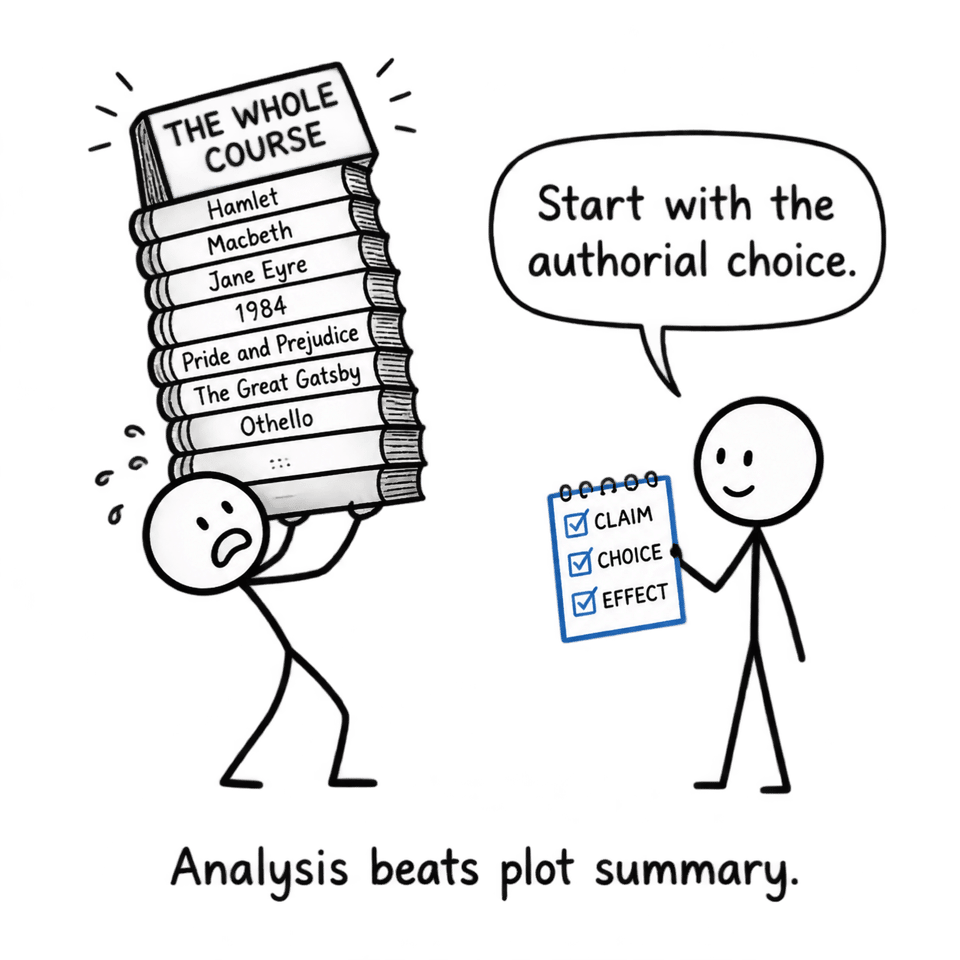
- Replace plot summary with analysis of specific authorial choices.
- Build arguments before collecting evidence.
- Practise unfamiliar literary passages regularly.
- Compare works throughout Paper 2 paragraphs, not only in the conclusion.
- Connect extracts to the wider works in the Individual Oral.
- Use feedback to identify one recurring weakness at a time.
- Confirm all work-selection and submission rules with your teacher.
The RevisionDojo IB English A Literature hub brings together Questionbank practice, Study Notes, lessons, and syllabus-focused revision for both SL and HL.
The current May 2028 assessment structure
The current published model distinguishes between SL and HL as follows:
| Component | SL | HL | What you do |
|---|---|---|---|
| Paper 1 | 1 hour 15 minutes, 35% | 2 hours 15 minutes, 35% | Analyse one unseen literary passage at SL or both passages at HL |
| Paper 2 | 1 hour 45 minutes, 35% | 1 hour 45 minutes, 25% | Answer one of four questions through a comparative literary essay |
| Individual Oral | 15 minutes, 30% | 15 minutes, 20% | Give a 10-minute analysis followed by 5 minutes of teacher questions |
| HL Essay | Not applicable | 1,200-1,500 words, 20% | Develop a literary line of inquiry about one studied work |
The Individual Oral is the internal assessment. The HL Essay is written coursework, but it is externally assessed rather than being the IA.
The revised Paper 2 criteria used from first assessment 2026 divide the available marks across knowledge and interpretation, analysis of each work and comparison between them, focus and organisation, and language. Students should use the criteria supplied by their school because May 2028 session documents may receive clarifications before the examination.
Work reuse restrictions also affect assessment planning. Map your intended Oral, HL Essay, and Paper 2 works with your teacher before committing to a choice.
What 7-level Paper 1 performance looks like
Paper 1 rewards understanding and interpretation, analysis and evaluation, focus and organisation, and language. At SL, you select one of two unseen literary passages. At HL, you analyse both.
The central move is simple:
authorial choice + precise evidence + effect + interpretive significance
Consider this invented practice line:
At dawn, the bell counted the workers into the factory.
A limited observation might say, “The bell is personified, showing that factory life is oppressive.” The technique is identified, but the interpretation remains broad.
A stronger annotation would be:
- Choice: The bell is given the human action “counted.”
- Immediate effect: Workers appear to be processed as units rather than welcomed as individuals.
- Wider implication: The sentence transfers agency from people to an industrial object, suggesting that the institution controls both time and identity.
- Argument link: The apparently ordinary dawn becomes the beginning of repeated dehumanisation.
The stronger version does not use a more complicated technique name. It follows the consequences of the language further.
Build this habit with the Paper 1 Literature notes and questions, then apply the planning process in the step-by-step Paper 1 revision guide. After writing, the English Literature Paper 1 Grader can help you compare your response with the assessment criteria. Treat AI feedback as a diagnostic tool, not as a replacement for your teacher’s judgment.
What 7-level Paper 2 performance looks like
Paper 2 is not two separate essays placed beside each other. It is one comparative argument about how two authors approach the chosen question.
Suppose a question asks how conflict changes characters. A weak plan lists conflict in Work A, then conflict in Work B. A stronger plan creates comparative claims such as:
- Both authors represent conflict as a pressure on identity, but one uses fragmented chronology while the other uses dramatic confrontation.
- Private conflict becomes visible through contrasting patterns of setting.
- The endings differ because each author assigns a different value to reconciliation.
Each body paragraph should therefore contain a claim, evidence from both works, analysis of authorial choices, and a comparative judgment. Detailed references matter, but the current course does not require exact quotations in Paper 2. Accurate knowledge of scenes, patterns, structures, and choices is more valuable than a memorised quotation forced into the wrong argument.
Use the IB English Paper 2 structure guide alongside the Paper 2 criteria breakdown. RevisionDojo Flashcards can hold compact evidence clusters, while AI Chat can challenge whether a proposed comparison genuinely answers the wording of a prompt.
What 7-level Individual Oral performance looks like
In Literature, the Individual Oral examines how a global issue is presented through the content and form of two literary works. One work is originally written in the language studied, while the other is studied in translation. Your extracts support the analysis, but the task also requires knowledge of each wider work.
A strong Oral moves repeatedly between two scales:
- Close view: What does this phrase, image, voice, or structural shift do in the extract?
- Wide view: How does that choice represent a pattern across the work?
For example, an analytical claim might follow this form: “The extract’s interrupted dialogue makes authority sound unstable; elsewhere in the work, repeated interruptions widen that instability from a family relationship into a social hierarchy.” This is illustrative scaffolding, not a sentence to memorise.
Balance matters. If one work receives rich analysis and the other receives summary, the argument cannot fully demonstrate comparative control. Rehearse aloud, use your permitted outline as navigation rather than a script, and prepare for questions that test the implications of your interpretation.
The RevisionDojo Individual Oral guide explains the task and rehearsal process in more depth. The Coursework Library and grading tools can show how rubric language applies, while a RevisionDojo Tutor can help you test your reasoning without writing the oral for you.
What 7-level HL Essay performance looks like
The HL Essay is a formal 1,200-1,500-word literary argument driven by a line of inquiry. Its strength depends less on choosing an impressive topic than on asking a question narrow enough to sustain close analysis.
Compare these approaches:
- Too broad: How does the author present power?
- More workable: How does the author’s use of shifting narrative distance complicate the reader’s judgment of institutional power?
The second version identifies an authorial choice, an interpretive problem, and a manageable direction. Every paragraph can then contribute to the same inquiry rather than becoming an isolated commentary on a different technique.
Draft early enough to revise the argument, not just correct grammar. The RevisionDojo HL Essay guide can support planning, while Study Notes and AI Chat can help you test alternative interpretations. Any secondary material you use must be acknowledged appropriately, and the submitted thinking and writing must remain your own.
A two-year plan for August 2026-May 2028
August-December 2026: learn to notice accurately
Create a learner portfolio for every work. Record recurring choices involving voice, imagery, form, structure, setting, characterisation, and perspective. Write one analytical paragraph each week, focusing on the connection between choice and meaning rather than length.
January-June 2027: turn observations into arguments
Begin regular Paper 1 plans and short timed responses. Build comparison grids for studied works, organised by authorial choices and conceptual questions rather than themes alone. Explore possible global issues, but do not commit before testing whether both extracts and both wider works support sustained analysis.
August-December 2027: complete coursework deliberately
Prepare the Individual Oral according to your school’s internal calendar. HL students should refine the HL Essay line of inquiry and draft through an evidence-led plan. Keep a feedback log containing the issue, an example from your writing, and the adjustment you will make next time.
January-March 2028: practise complete performances
Alternate full Paper 1 and Paper 2 work with narrower drills. One session might focus only on introductions; another might repair comparative topic sentences. Use RevisionDojo Mock Exams and Predicted Papers as simulations, not predictions of exact May questions.
April-May 2028: reduce uncertainty
Practise under the official timings, review flexible evidence clusters, and protect sleep and routine. Check the eventual May 2028 timetable through your school and the official IB schedule once published. Do not build your plan around an unofficial date or an assumed grade boundary.
The habit that makes a 7 possible
Students often imagine that top English performance comes from seeing hidden meanings instantly. More often, it comes from a quieter loop: write, receive criterion-specific feedback, revise one weakness, and try again.
RevisionDojo is designed to keep that loop in one place through its Questionbank, Study Notes, Flashcards, AI Chat, Grading tools, Predicted Papers, Mock Exams, Coursework Library, and Tutors. The platform cannot guarantee an IB English Literature top grade, but it can make your practice more focused, visible, and consistent.
Your next step is specific: open the RevisionDojo IB English A Literature Questionbank, choose one Paper 1 passage, and write a single timed paragraph that traces one authorial choice from evidence to effect to interpretation.