
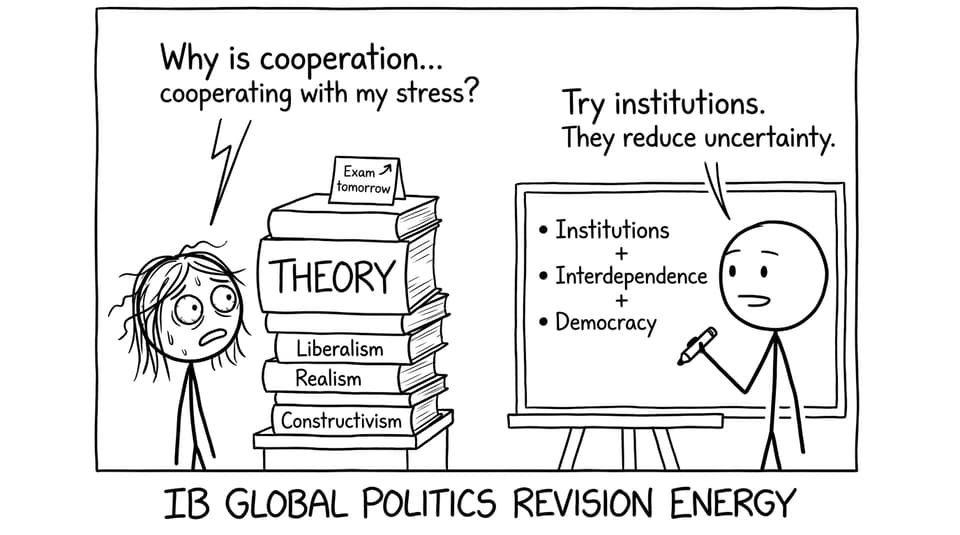
In the last week before exams, cooperation starts to feel like a myth. Your group chat says “let’s revise together,” and then everyone disappears. Yet in the real world, states that don’t “trust” each other still sign treaties, share data, coordinate trade rules, and build joint responses to crises.
That puzzle sits at the heart of IB Global Politics. Liberalism is the theory that looks at an anarchic world (no global government) and still says: cooperation can happen, and it can last.
A quick checklist: Liberalism’s cooperation toolkit
If you need a fast exam framework for IB Global Politics, liberalism usually explains cooperation through:
-
Multiple actors: states + IGOs + NGOs + domestic politics
-
Institutions: rules, monitoring, dispute resolution, predictable expectations
-
Interdependence: trade and investment make conflict costly
-
Democracy and norms: accountability and shared values support collaboration
For definitions you can quote precisely, keep IB Global Politics Key Definitions open while you practise.
Liberalism in IB Global Politics: Why cooperation isn’t naive
Liberalism doesn’t claim states are angels. It assumes actors are often self-interested, but it argues self-interest can be structured into mutual gains.
A useful way to phrase it in IB Global Politics essays: liberalism treats cooperation as a repeated game. When states expect to meet again, reputation matters. Cheating has consequences. Over time, that changes behaviour.
If you’re revising the theory comparisons, Realism vs Liberalism in Global Politics is a strong anchor for contrast paragraphs.
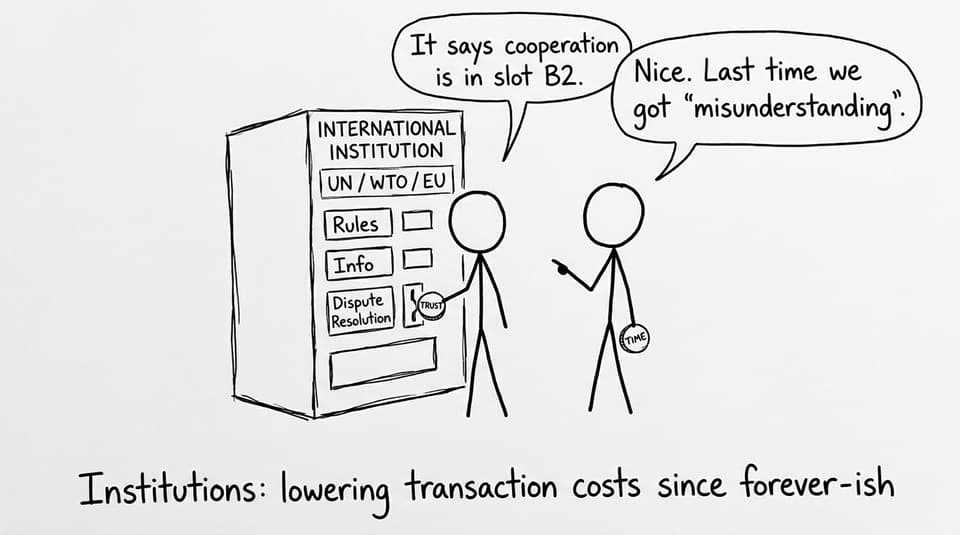
Institutions: the “rules of the room” that make cooperation easier
In liberal thinking, institutions matter because they reduce the friction that usually kills cooperation: uncertainty, fear of cheating, and miscommunication.
Institutions can:
-
share information (so states aren’t guessing)
-
set standards (so everyone knows the rules)
-
lower negotiation costs (fewer resets, more routine)
-
create enforcement pathways (naming, shaming, sanctions, courts)
That’s why liberalism links cooperation to global governance. To deepen this idea, review Theoretical Foundations in IB Global Politics and connect it to Intergovernmental organizations notes.
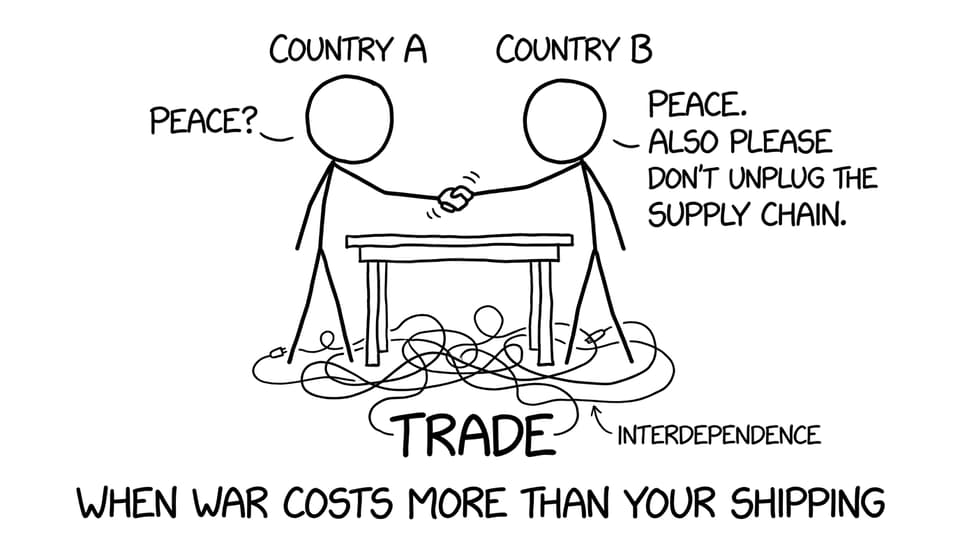
Interdependence: when conflict breaks your own supply chain
Liberalism also explains cooperation through economic interdependence: when states rely on each other for goods, finance, and markets, conflict becomes expensive.
In IB Global Politics, this is a great place to show evaluation: interdependence can promote cooperation, but it can also create vulnerability and leverage. You can build that nuance with Interdependence notes and then practise applying it via the IB Global Politics Interdependence Questionbank.
Democracy and domestic politics: why leaders sometimes choose restraint
Liberalism pays attention to what happens inside states. Leaders face voters, interest groups, courts, media, and civil society. That accountability can push states toward cooperation, because the costs of war and instability land on citizens.
To link this to the course, use concepts like legitimacy and power. The Types and definitions of power notes help you connect “soft power” and institutions to liberal explanations.
How to turn this into exam marks (fast)
For Paper 2 and Paper 3, liberalism becomes high-scoring when you use it as a lens, not a label.
Try this structure:
-
Define liberalism in one sentence (cooperation through institutions, interdependence, domestic politics).
-
Apply to the question with a mechanism (“institutions reduce uncertainty by…”) not just a claim.
-
Evaluate limits (power asymmetries, unequal benefits, selective rule-following).
For writing under time pressure, align your technique with IB Global Politics Paper 2 Guide notes and practise source-based precision with How to Answer IB Global Politics Paper 1 Questions.
Conclusion: Make liberalism work for your next answer
Liberalism’s core claim in IB Global Politics is simple but useful: cooperation is possible when institutions, interdependence, and domestic pressures align incentives over time.
If you want to turn that into higher marks, build one paragraph at a time using RevisionDojo’s Study Notes, drill mechanisms with the Questionbank, lock in terms with Flashcards, and test your structure with Mock Exams and Predicted Papers. When your argument feels shaky, use AI Chat to pressure-test your claims, then polish with the Grading tools. That’s how cooperation becomes not just a theory, but an exam advantage.