
The first term of IB Global Politics often begins with a strange realization: following the news is not the same as understanding politics.
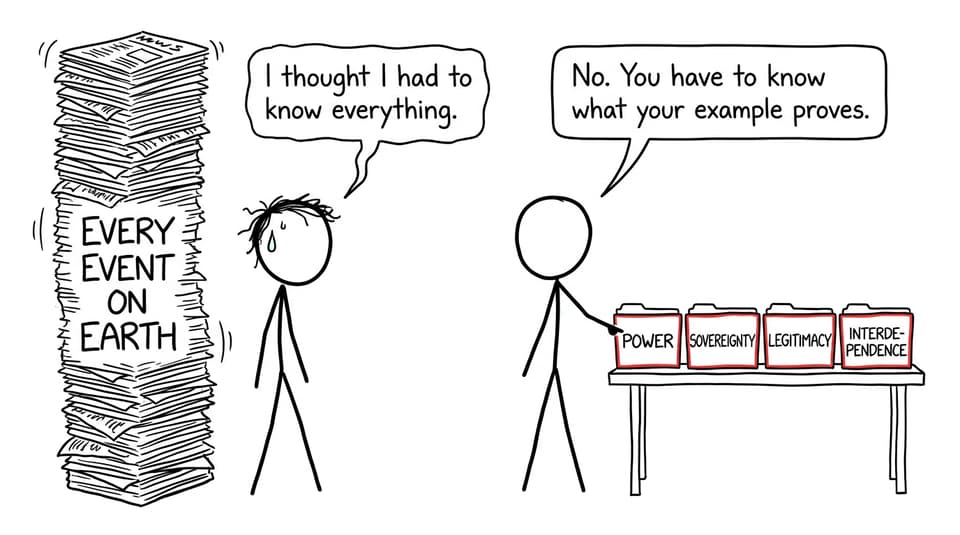
You may enter knowing about elections, conflicts, protests, or climate negotiations. Soon, your teacher will ask different questions. Who has power? Why is that authority considered legitimate? Whose perspective is missing? What does this example actually demonstrate?
That shift defines the first term IB Global Politics experience. Most classes introduce core concepts, apply them to contemporary cases, develop source analysis and argumentative writing, and begin preparing students for longer-term work such as the Engagement Project. HL students may also start exploring global political challenges.
There is no universal weekly sequence. The current IB course allows schools to organize required content around local contexts, student interests, and contemporary events. Still, most first terms follow a recognizable arc.
Your first-term overview
By the end of a typical 10-14 week term, you will probably have:
- learned concepts including power, sovereignty, legitimacy, and interdependence
- examined issues at local, national, international, and global levels
- built a small bank of contemporary examples
- analysed written, visual, or statistical sources
- practised short responses and longer arguments
- encountered Paper 1 and Paper 2 expectations
- considered directions for the Engagement Project
- begun HL case study work, if applicable
The order varies, but the progression is consistent: learn the vocabulary, apply it to reality, then make a defensible judgment.
Weeks 1-3: Learning to see power
Early lessons often feel broad. Your class might begin with a protest, election, court decision, humanitarian crisis, or dispute between governments. The event is the doorway, not the destination.
Your first task is recognizing political concepts within it. Power can operate through law, money, institutions, expertise, persuasion, technology, or control over information. Sovereignty concerns authority and independence, but globalization complicates both. Legitimacy asks why people accept an actor's right to exercise authority. Interdependence reveals how decisions in one place create consequences elsewhere.
The RevisionDojo notes on understanding power and global politics can help consolidate these foundations. Treat definitions as starting points, then connect each concept to a real situation.
| Element | What to record |
|---|---|
| Political issue | One focused sentence describing the dispute |
| Actors | States, organizations, groups, institutions, or individuals involved |
| Core concept | The concept that best exposes what is happening |
| Evidence | Two or three precise facts from credible sources |
| Perspectives | How different actors interpret the issue |
| Limitation | What the example cannot prove by itself |
This structure is more useful than pages of copied news. Global Politics rewards selection. One carefully understood example can support several arguments; ten vaguely remembered examples cannot.
Weeks 4-7: Concepts become arguments
Once the vocabulary feels familiar, the pace usually increases. You may move deeper into the core or begin rights and justice, development and sustainability, or peace and conflict.
This is where students meet an important distinction. An interesting opinion is not yet an IB argument. You need a claim, relevant evidence, conceptual analysis, alternative perspectives, and a justified conclusion.
Suppose your class asks whether international cooperation weakens sovereignty. A descriptive response lists treaties and organizations. An analytical response distinguishes legal sovereignty from practical freedom of action, examines why states voluntarily accept constraints, and evaluates whether interdependence changes what meaningful sovereignty looks like.
Homework may include reading, source annotation, case research, or a paragraph responding to a command term. A sensible estimate outside class is 1-3 focused hours weekly, depending on your school, level, reading speed, and assignments. This is a planning range, not an IB-prescribed total.
Weeks 6-9: Assessment language appears
Teachers often introduce assessment skills before students feel ready. Political analysis improves through repeated attempts, not by waiting until every topic is complete.
Paper 1 is source-based and compulsory at both SL and HL. You will interpret evidence, identify claims and perspectives, apply concepts, and construct developed responses. The IB Global Politics Paper 1 guide explains this progression.
Paper 2 involves extended responses based on thematic studies. Early in the course, you can still practise introductions, thesis statements, paragraph plans, evidence selection, and evaluation. RevisionDojo's Paper 2 guide and essay structure notes make those expectations concrete.
The workload can feel harder here because you are learning political content while learning how the IB expects you to use it.
Weeks 8-12: The course starts connecting
Toward the end of term, isolated lessons form a network. Migration may connect sovereignty, identity, rights, security, and interdependence. A development case can raise questions about legitimacy, inequality, environmental responsibility, and non-state influence.
HL students may begin inquiries into challenges involving borders, environment, equality, health, identity, poverty, security, or technology. The important change is learning to compare cases and recognize relationships between challenges.
A case study matrix helps. For each case, record the timeline, actors, contested claims, evidence, concepts, and possible counterarguments. The IB Global Politics study and revision notes provide a syllabus-aligned structure for organizing this knowledge.
The Engagement Project may begin quietly
The Engagement Project combines research with active engagement around a political issue in a local or community context. Depending on your school, the first term may involve only an introduction, topic exploration, or preliminary planning.
A workable project needs access to relevant stakeholders and meaningful engagement, not merely a dramatic global theme. A focused inquiry into youth transport, local housing, language policy, environmental campaigning, or community representation may be more practical than an enormous question about global democracy.
Keep an issue journal recording local questions, actors, engagement opportunities, ethical concerns, and conceptual links. Before committing, consult the RevisionDojo Engagement Project guide and its explanation of Engagement Project essentials.
What surprises new students most
There is less memorization than many expect, but more precision. Facts matter only when you explain why they matter, which concept they illuminate, and where their limits lie.
Being informed is also different from being analytical. Reading headlines provides examples, but it does not automatically teach you to compare perspectives or evaluate claims. You do not need an opinion about everything. You need careful reasoning about focused questions.
Examples also age faster than concepts. Build understanding around durable ideas, then update the evidence supporting them. RevisionDojo's Global Politics resource hub keeps Study Notes, Flashcards, case studies, and assessment guidance together.
A manageable first-term routine
Build a system that works on an ordinary Wednesday. After each lesson, spend 10 minutes cleaning your notes and identifying the central concept. Twice a week, review definitions with Flashcards. Once a week, add one case to your evidence bank and complete a short Questionbank task.
Use AI Chat to clarify distinctions or challenge your reasoning, but draft your response first. As assessment practice grows, Grading tools can reveal patterns such as weak evaluation or unsupported claims. Mock Exams and Predicted Papers become more useful later, once you have enough content for realistic timed practice. The Coursework Library can clarify Engagement Project standards, while Tutors help translate feedback into action.
For a broader view, read RevisionDojo's complete guide to IB Global Politics.
Your first term is about building lenses
IB Global Politics first term expectations can sound intimidating because the world itself is the subject matter. Yet the course does not ask you to know every event. It asks you to develop a disciplined way of looking.
By the end of term, progress may mean recognizing that one policy appears legitimate to one group and coercive to another, or that formal sovereignty does not remove economic dependence. Those distinctions are the course taking root.
RevisionDojo turns that awareness into a repeatable system. Use Study Notes and Flashcards for clarity, the Questionbank for application, AI Chat and Grading tools for stronger reasoning, and the Coursework Library, Mock Exams, Predicted Papers, and Tutors as the course develops. Your first term does not need to make you an expert on the world. It needs to teach you how to examine it.