
For IB students sitting exams in May 2028 (started DP1 in August 2026).
The best May 2028 IB global politics study advice is to build reusable concept-case connections, practise assessed task types every week, and treat evaluation as a skill rather than a final paragraph. Base your preparation on the Global Politics course first assessed in 2026, because older resources may reflect an assessment model you will not sit.
Global Politics can create a comforting illusion. You read the news, recognize the actors and understand the dispute, so you feel prepared. But recognition is not the same as interpreting a source, constructing a comparative argument or evaluating a political claim under time pressure.
Preparation needs two layers: knowledge worth remembering and repeated practice using it. The complete IB Global Politics resource hub brings those layers together through syllabus-aligned Study Notes, Flashcards, Questionbank practice, AI Chat and grading tools.
Your May 2028 study checklist
- Use the official course structure first assessed in 2026.
- Organize notes around concepts, prescribed content and debates.
- Build a small case-study bank that supports several arguments.
- Practise source analysis and essay planning weekly from DP1.
- Add timed responses gradually rather than waiting for 2028.
- Treat the engagement project as analysis grounded in engagement and research.
- At HL, maintain separate preparation for Paper 3 and its researched cases.
- Check every resource against the current syllabus.
Know the course you will actually be assessed on
The current official IB Global Politics guide is marked first assessment 2026. As of October 2026, it is the relevant syllabus for students expecting to sit the subject in May 2028, unless the IB announces a change. RevisionDojo’s IB syllabus changes tracker can help you monitor announcements.
Both SL and HL students study the core theme, understanding power and global politics. They also study rights and justice, development and sustainability, and peace and conflict. Both levels complete an internally assessed engagement project.
The published assessment model is:
| Component | SL | HL |
|---|---|---|
| Paper 1 | 1 hour 15 minutes, 30% | 1 hour 15 minutes, 20% |
| Paper 2 | 1 hour 30 minutes, 40% | 1 hour 30 minutes, 30% |
| Paper 3 | Not taken | 1 hour 30 minutes, 30% |
| Engagement project | 30% | 20% |
Paper 1 is source-based and integrates elements of the core theme. Paper 2 assesses extended responses connected to the three thematic studies. Paper 3 is an HL-only, stimulus-based assessment linked to global political challenges and students’ researched case studies.
The exact May 2028 timetable, examination questions and grade boundaries have not yet been published. Nor can anyone responsibly promise which contemporary events will appear. Build your plan around the published syllabus, then check official information through your coordinator as 2028 approaches.
Make Global Politics notes that produce arguments
A weak set of notes records what happened. A useful set records how the event changes an argument.
For each major concept or debate, use a five-part note:
- Working definition: Write a precise definition in your own words.
- Competing interpretation: Record how another perspective, actor or level of analysis changes the concept.
- Case evidence: Add a specific event, policy, institution or political decision.
- Analytical connection: Explain why that evidence supports the claim.
- Limitation: Identify what the example cannot prove or where another interpretation is stronger.
Suppose your topic is sovereignty. A page of definitions and news summaries may feel thorough yet remain difficult to use. Instead, connect sovereignty to power, legitimacy, intervention, borders and interdependence. Attach a carefully selected case to each connection.
RevisionDojo’s Global Politics Study Notes provide a syllabus-aligned foundation. Convert important ideas into Flashcards for retrieval, but do not reduce the subject to isolated definitions. A concept becomes examinable when you can apply, compare and question it.
Build a compact case-study bank
More cases do not automatically produce better essays. Ten half-remembered headlines are usually less valuable than four cases understood from several angles.
For every selected case, record:
- the political issue and relevant context
- the principal actors and their interests
- two or three precise pieces of evidence
- the concepts and themes it illuminates
- contrasting perspectives or contested interpretations
- limitations on comparison or generalization
- the questions for which it could be useful
Update each case periodically and distinguish the date of an event from the date on which a source reported it. Contemporary understanding matters, but relevance depends on analysis rather than novelty.
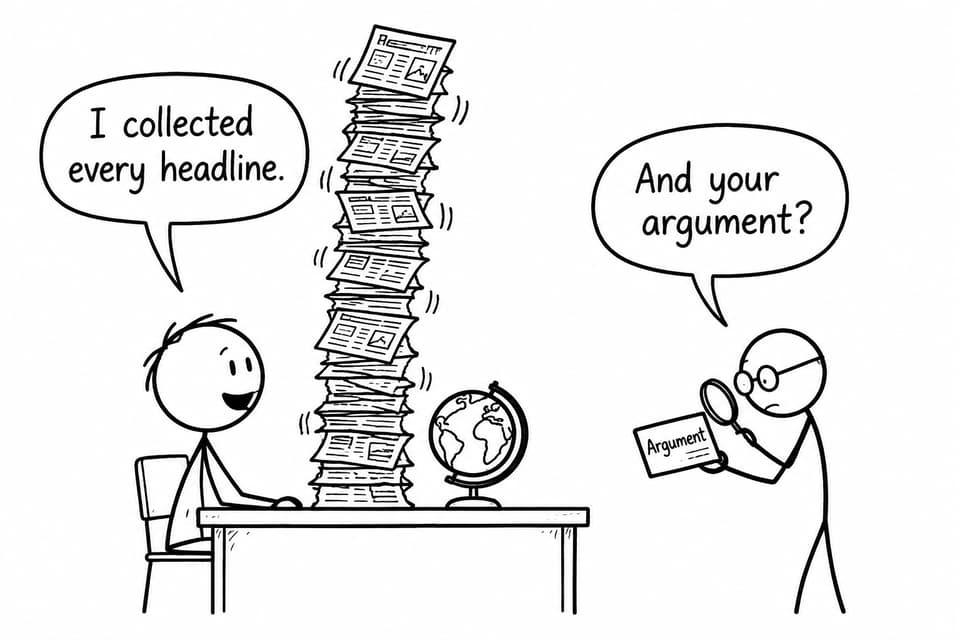
Collecting headlines feels productive. The assessment still asks what they prove.
What to practise and how often
Political analysis is partly a performance skill. You must retrieve evidence, select it and shape it around a command term within limited time.
During DP1
Each week, complete:
- one short source-analysis task
- one detailed Paper 2 essay plan
- two retrieval sessions of 15-20 minutes
- one case-study update or comparison
Every two weeks, write one analytical paragraph without notes. Every four weeks, complete either a timed source response or a full essay under conditions agreed with your teacher.
During the first half of DP2
Move toward one timed assessed task each week. Alternate between Paper 1 and Paper 2 at SL. At HL, rotate across all three papers while continuing to practise Papers 1 and 2.
After each response, keep an error log with four columns: knowledge, relevance, analysis and structure. RevisionDojo’s AI grading tools can identify patterns, while teacher feedback remains important for interpreting criteria. If one problem appears repeatedly, ask AI Chat a focused question or work through it with a RevisionDojo Tutor.
In the final 8-10 weeks, use full Mock Exams and syllabus-matched Predicted Papers to rehearse timing and stamina. These are practice tools, not disclosures of future questions. Their value lies in reproducing current assessment demands.
The Global Politics Questionbank helps you move from topic practice to mixed practice. Begin with your weakest theme, then remove topic filters so you must decide which knowledge is relevant.
How to practise each paper
Paper 1: read sources as political constructions
Do not merely extract information. Ask who produced each source, for which audience, from what position and with what limitations. Compare sources on a defined point instead of describing them separately.
Use the routine claim, source evidence, political interpretation, limitation. Identify the precise demand before writing. When sources disagree, explain which political assumptions or interests may account for the difference.
Paper 2: answer the question, not the topic
Translate the command term into a job. “Evaluate” requires a supported judgment. “Compare” requires sustained attention to similarities and differences. Broad knowledge cannot compensate for answering a nearby question.
Plan a thesis, two or three contestable claims, relevant cases, counterarguments and a final judgment. Place evidence inside the reasoning rather than adding a case as decoration. RevisionDojo’s guide to the best Global Politics resources for self-study can help you combine content learning with response practice.
Paper 3: prepare researched flexibility at HL
HL students should not attempt to predict one narrow question. Research at least two distinct case studies for the HL extension, as required by the course framework, and understand how each illuminates wider global political challenges.
Practise moving from stimulus to case evidence and then to a justified recommendation. Recommendations should identify an actor, action, rationale, likely obstacles and possible consequences. They must follow from the analysis rather than appear as idealistic additions.
Treat the engagement project as political inquiry
The engagement project is completed by both SL and HL students. It is not simply a description of volunteering, interviewing or attending an event. Engagement should help you investigate a focused political issue, while research supplies the concepts, evidence and alternative perspectives needed to interpret the experience.
Ask whether the issue genuinely involves power, decision-making, competing interests or the distribution of resources and rights. Then choose engagement that provides meaningful perspectives without creating ethical or practical problems.
Read the Global Politics IA criteria guide before drafting, and use the guide to choosing an engagement project topic to test feasibility. RevisionDojo’s Global Politics Coursework Library shows how completed work can be structured, but exemplars should be studied for decisions and criteria, never copied or treated as templates.
Begin early enough to change direction if access falls through. Keep dated records of research, engagement, interpretations and source details. Follow your school’s deadlines and academic integrity expectations.
Common habits that lose marks
Replacing analysis with narration
An examiner does not need a chronological retelling. Select only the facts required to establish and test your argument.
Name-dropping concepts
Writing “this relates to power” is not analysis. Specify who possesses which kind of power, how it operates, what constrains it and why that matters.
Using one perspective as fact
Political events are contested. Recognize competing actors, ideologies and levels of analysis without drifting into false balance.
Writing conclusions without judgments
Answer the exact question and explain the conditions behind your judgment. Do not merely repeat the introduction.
Using resources from the previous course
Older materials may contain useful ideas, but their task formats may not match the course first assessed in 2026. Check labels and prioritize current-syllabus resources.
HL and SL need different priorities
SL is not a reduced-effort version of HL. Paper 2 and the engagement project carry substantial weight, so regular essay practice and steady coursework development deserve attention.
HL adds Paper 3 and deeper independent case research. HL students need a weekly block for global political challenges, stimulus interpretation and recommendations. However, focusing entirely on Paper 3 would be a mistake because Papers 1 and 2 still account for half of the published HL weighting.
The quiet advantage comes from building a system early. Notes feed Flashcards. Flashcards improve retrieval. Retrieved knowledge enters a planned response. Feedback reveals the next weakness. RevisionDojo brings that cycle into one IB-focused platform through Study Notes, AI Chat, grading tools, Mock Exams, Predicted Papers, Tutors and the Coursework Library.
Your next step is to open the RevisionDojo Global Politics Questionbank, choose one core-theme source question, answer it without notes and record your biggest mark-losing habit.