
For IB students sitting exams in May 2028 (started DP1 in August 2026).
To understand how to get a 7 in IB Global Politics 2028, build a small bank of deeply understood case studies, practise the exact demands of each paper, and make analysis rather than description your default. A top-grade response advances a clear argument, uses evidence selectively, compares perspectives, and evaluates what the evidence can and cannot establish.
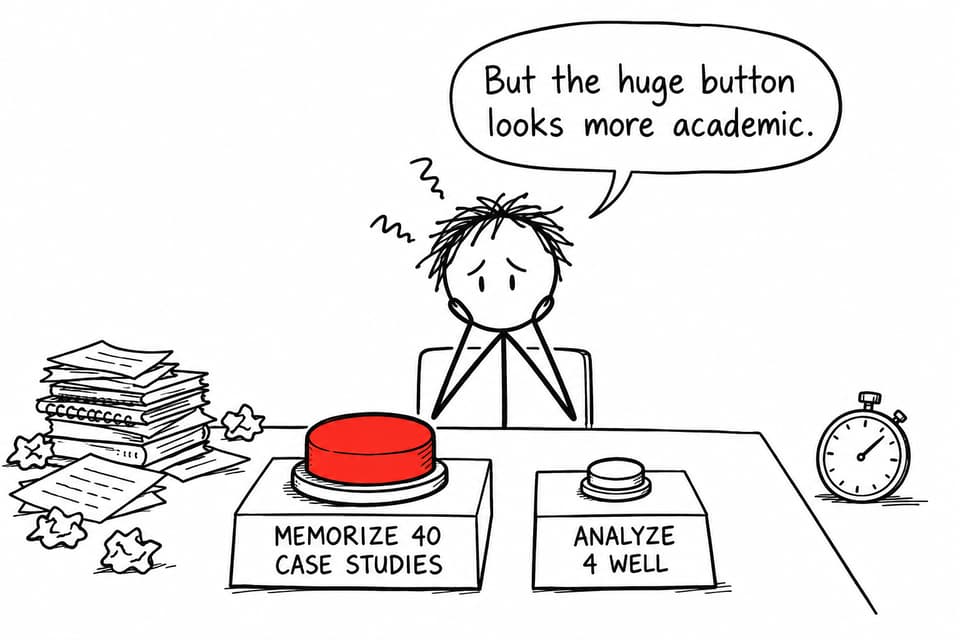
Global Politics rewards informed judgment. Knowing more examples helps, but only when you can connect them to power, agency, legitimacy, sovereignty, interdependence and the course's prescribed content. The student who memorizes 40 cases may be less prepared than the student who can analyse four cases from several perspectives.
This article follows the Global Politics course first assessed in 2026. As of October 2026, that is the current official syllabus for the May 2028 cohort. The exact May 2028 examination timetable, session-specific questions, markschemes and grade boundaries have not yet been published. No responsible guide can tell you the mark needed for a 7 in that session, so prepare against the published assessment demands rather than an invented boundary.
Your 7-level checklist
A strong May 2028 candidate should be able to:
- explain political concepts precisely without relying on memorized dictionary definitions
- connect concepts to contemporary political issues and actors
- extract claims, assumptions and perspectives from textual and non-textual sources
- construct an argument that answers the command term throughout
- compare cases rather than presenting isolated blocks of knowledge
- evaluate evidence, perspectives, policy options and limitations
- complete an authentic engagement project grounded in research and stakeholder engagement
- write under timed conditions while preserving analysis and structure
Begin with the RevisionDojo IB Global Politics resource hub, where Study Notes, Flashcards, case studies, AI Chat and exam-style practice can be used as one connected revision system.
Know the assessment model for May 2028
The official guide first assessed in 2026 establishes the following structure. These details remain applicable to the May 2028 cohort unless the IB subsequently publishes an amendment.
| Component | SL | HL | What it assesses |
|---|---|---|---|
| Paper 1 | 1 hour 15 minutes, 25 marks, 30% | 1 hour 15 minutes, 25 marks, 20% | Source analysis, application, comparison and synthesis with own knowledge |
| Paper 2 | 1 hour 45 minutes, 30 marks, 40% | 1 hour 45 minutes, 30 marks, 30% | Two essays based on thematic studies, including one integrating question |
| Paper 3 | Not applicable | 1 hour 30 minutes, 28 marks, 30% | Stimulus analysis, recommendations and evaluation using researched HL cases |
| Engagement project | 24 marks, 30% | 30 marks, 20% | Research, political engagement, analysis, synthesis and reflection |
The engagement project has a maximum report length of 2,000 words at both levels. HL students also formulate a recommendation in a separate section of no more than 400 words. Your school sets internal deadlines, which will normally arrive well before the final IB submission process.
Weighting changes strategy. An SL student cannot treat the engagement project as an accessory because it represents 30% of the subject result. An HL student faces a wider examination burden, but Paper 3 also provides an opportunity to turn sustained case-study research into 30% of the final result.
What a 7-level Paper 1 response looks like
Paper 1 contains four compulsory questions. Question 1 tests source understanding for 3 marks. Question 2 applies knowledge to analyse a source for 4 marks. Question 3 compares or contrasts two sources for 6 marks, while Question 4 evaluates and synthesizes the sources with your own knowledge for 12 marks.
The progression matters. Early questions require precision; later questions require judgment. The RevisionDojo Paper 1 answering guide explains how to adapt your structure to those changing demands.
Illustrative annotated Paper 1 example
Suppose a source claims that humanitarian intervention protects rights but weakens state sovereignty.
Descriptive version: “Humanitarian intervention can weaken sovereignty because other states become involved.”
Stronger analytical version: “The claim treats sovereignty as control over internal affairs, but intervention exposes a conflict between non-interference and the protection of rights. Its persuasiveness therefore depends partly on whether legitimacy is understood as legal authorization, state consent or protection of affected populations.”
The stronger version earns its value through three moves:
- Conceptual precision: it identifies competing interpretations of sovereignty and legitimacy.
- Analysis: it explains why the tension exists rather than merely repeating it.
- Qualification: it shows that the conclusion depends on the standard being applied.
For a comparison question, use a running comparison. “Source A emphasizes institutional legitimacy, whereas Source B emphasizes outcomes” is stronger than summarizing A in one paragraph and B in another. For Question 4, weave source evidence and contextual knowledge into the same argument instead of attaching memorized information at the end.
Build Paper 2 around judgment, not information
Paper 2 requires two essays: one from section A, focused on a thematic study, and one integrating question from section B. The thematic studies are rights and justice, development and sustainability, and peace and conflict.
A 7-level essay does not simply contain many political examples. It establishes a defensible answer, tests that answer against contrasting evidence, and returns to the exact wording of the question. The Paper 2 essay structure guide can help you turn that principle into a repeatable timed method.
Illustrative annotated Paper 2 paragraph
Consider the proposition that economic development necessarily advances rights.
Claim: Economic development can expand the material capacity needed to realize social and economic rights, but increased national income does not automatically produce equitable access or political accountability.
Evidence and analysis: A relevant case could show expanded public services alongside unequal regional access. The useful point is not merely that both occurred. It is that aggregate development indicators can conceal how institutions distribute resources and whose claims receive recognition.
Counter-perspective: A government may defend centralized decision-making as necessary for rapid development, while civil society actors may judge legitimacy through participation and accountability.
Judgment: Development is therefore better treated as an enabling condition whose political effects depend on distribution, institutions and agency, rather than as a sufficient cause of stronger rights.
This paragraph works because each part changes the argument. The case is not decoration; it tests the proposition. Build a reusable evidence bank through RevisionDojo's Global Politics case-study hub, recording the actors, contested concepts, perspectives, evidence and limitations for each case.
Prepare differently for HL Paper 3
HL students investigate global political challenges through topic areas such as borders, security, identity, environment, technology, health, equality and poverty. The official guide requires research on at least two different case studies and at least two different topic areas.
Paper 3 consists of stimulus-based tasks: Question 1 is worth 3 marks, Question 2a is worth 4, Question 2b is worth 6, and Question 3 is worth 15. Together they test analysis, political knowledge, a possible recommendation, synthesis and evaluation.
For the recommendation task, “the government should improve cooperation” is too vague. A stronger answer identifies an actor, action, mechanism, intended effect and limitation:
A regional organization could establish a shared reporting mechanism monitored by an independent technical body. This may reduce information gaps between member states, although compliance would remain constrained if governments perceive reporting as a threat to sovereignty.
The annotation is simple. Actor: regional organization. Action: establish reporting. Mechanism: independent monitoring reduces information gaps. Limitation: sovereignty may weaken compliance. That chain turns aspiration into political analysis.
For Question 3, select cases that can speak to one another. Comparing how technology affects security and equality is more valuable than memorizing unrelated timelines. Use RevisionDojo Study Notes for conceptual foundations, Flashcards for retrieval, and AI Chat to challenge your reasoning with alternative perspectives.
Make the engagement project analytical and authentic
The engagement project investigates power and agency at a local or community level through research and experiential learning. It is not simply a research essay, a volunteering diary or a campaign report. The assessed report must connect your political issue, methodology, engagement, course content, stakeholder perspectives, analysis and reflection.
Start with a political issue, not an impressive activity. Choosing an appropriate engagement activity becomes easier when the issue is focused enough to reveal conflicting interests and accessible enough for meaningful engagement.
A weak topic might be “climate change in my city.” A more workable issue could examine how competing actors influence access to a specific local climate-adaptation measure. The narrower framing creates identifiable stakeholders, visible power relationships and a realistic route to engagement.
The report should not claim that one interview proves what an entire community believes. Instead, explain what that engagement revealed, compare it with complementary research, and acknowledge whose perspective remains absent. Reflection means examining how the process changed or complicated your interpretation, not merely saying that the experience was interesting.
Use the Global Politics engagement project criteria guide to audit your draft. RevisionDojo's Coursework Library and grading tools can help you recognize structural weaknesses, but your submitted work must remain your own and must follow your school's academic integrity guidance.
Follow a two-year plan instead of a revision sprint
August-December 2026: build the language of analysis
Learn the core concepts and begin a case-study ledger. For each case, record the issue, actors, forms of power, competing perspectives, useful evidence and limitations. Complete short source exercises every two weeks. Use Study Notes to establish understanding and Flashcards to retrieve concepts without prompts.
January-June 2027: connect themes and choose the project
Start linking cases across rights and justice, development and sustainability, and peace and conflict. Write one timed paragraph each week and one complete essay each month. Identify a viable engagement project issue, assess ethical and practical access, and consult your teacher before arranging activities. The guide to choosing Global Politics IA topics can help you test scope without choosing the issue for you.
August-December 2027: produce and diagnose
Complete engagement and drafting according to your school's deadline. Increase timed work to alternating Paper 1 and Paper 2 tasks. HL students should organize at least two cases across at least two global-challenge topic areas, then practise recommendation chains and comparative evaluation.
This is also when feedback becomes valuable. RevisionDojo's AI grading tools can identify patterns to review, while a teacher or RevisionDojo Tutor can help you understand persistent reasoning problems. Treat feedback as diagnosis, not as a substitute for rewriting.
January-May 2028: simulate and refine
Move from topic practice to full timed performance. Use Mock Exams and Predicted Papers as simulations, not forecasts of exact questions. Review mistakes by category: misunderstood command term, thin evidence, descriptive paragraph, missing perspective, unsupported judgment or poor timing.
The goal is not to eliminate uncertainty. Politics is built from uncertainty. The goal is to construct a reasoned answer when the wording, sources and political context are unfamiliar.
A 7 comes from repeated judgment
The IB Global Politics top grade is not reserved for students with the longest notes. It belongs to work that is conceptually precise, evidence-aware and willing to make qualified judgments. RevisionDojo brings the Questionbank, Study Notes, Flashcards, AI Chat, grading tools, Predicted Papers, Mock Exams, Coursework Library and Tutors into one IB-focused system, so your practice can progress from learning to feedback to performance.
Your next step is specific: open the RevisionDojo Global Politics Questionbank, complete one Paper 1 source set under timed conditions, and rewrite the weakest answer after identifying where description replaced analysis.