

Realism vs liberalism: the two lenses you keep meeting in IB Global Politics
The night before an exam, global politics can start to feel like weather: chaotic, loud, and completely out of your control. Then you meet two theories that promise a bit of order. Realism says: “Assume rivalry, plan for fear.” Liberalism replies: “Assume cooperation is possible, then build it.” In IB Global Politics, that contrast is everywhere: Paper 1 source analysis, Paper 2 essays, and any question that asks you to compare perspectives.
If you can explain how realism and liberalism see the same event differently, you stop writing summaries and start writing arguments. That is what earns marks in IB Global Politics.
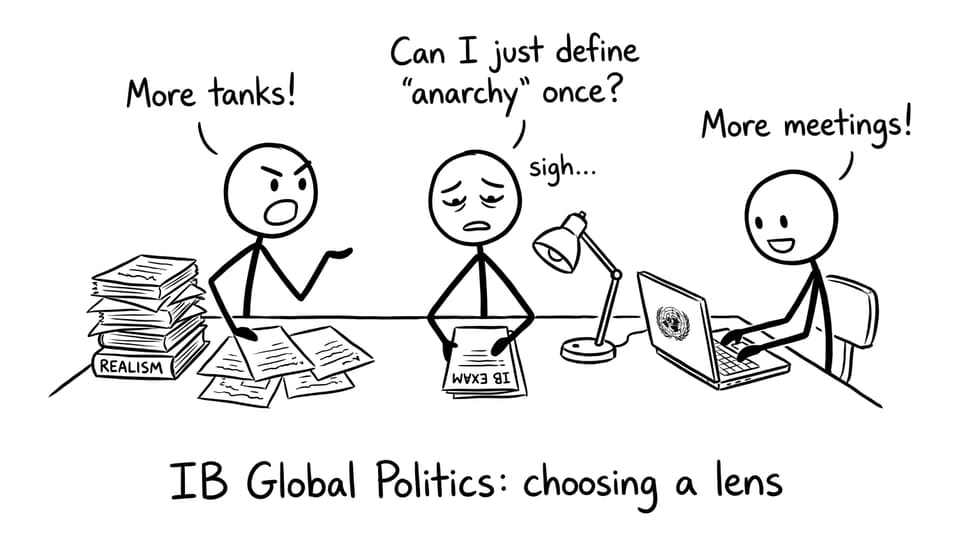
Quick exam checklist for IB Global Politics (realism vs liberalism)
Before you write, run this quick grid:
-
System: Is the international system mainly competitive (realism) or manageable through rules (liberalism)?
-
Main actors: Mostly states (realism) or states plus institutions and non-state actors (liberalism)?
-
Power: Hard power and relative gains (realism) or also soft power and mutual gains (liberalism)?
-
Cooperation: Short-term and risky (realism) or sustainable via institutions (liberalism)?
-
Change: Slow, driven by shifts in power (realism) or possible through norms, democracy, and governance (liberalism)?
For topic-by-topic support, keep your home base open: IB Global Politics Resources.
The international system: why “anarchy” matters in IB Global Politics
Realists start with a blunt assumption: the international system is anarchic (no world government). That does not mean chaos every day; it means no authority can reliably protect states. So states lean toward self-help, deterrence, alliances, and worst-case thinking.
Liberals also accept anarchy, but they treat it like bad traffic, not the end of civilisation. Rules, repeated interaction, and institutions can reduce uncertainty and make cooperation rational. In IB Global Politics, this becomes a clean exam move: define anarchy once, then show how each theory interprets its consequences.
If you need fast definitions that match examiner language, use the IB Global Politics Glossary.
Actors and power: who matters most in IB Global Politics?
Realism is state-centric. States are the main actors because they control borders, law, and force. Even when organisations exist, realists often treat them as tools of powerful states.
Liberalism zooms out. It still takes states seriously, but it adds international institutions, NGOs, firms, courts, and domestic politics. That broader cast helps explain why cooperation sometimes survives even when trust is low.
To sharpen your power paragraphs, revise the concept directly with Power in IB Global Politics and the companion notes Types and definitions of power.
Cooperation, conflict, and change: what each theory predicts
A reliable comparison for IB Global Politics essays is this:
-
Realism expects cooperation to be fragile because states worry about cheating, dependency, and relative losses (who benefits more?). Conflict is always “available” as a tool, and change tends to follow shifts in the balance of power.
-
Liberalism expects cooperation to be more durable when institutions reduce uncertainty, when trade raises the cost of conflict, and when shared norms shape behaviour. Change is not guaranteed, but it is possible.
This is where evaluation wins marks. Realism can explain security dilemmas and rivalry clearly, but it can miss how norms and institutions constrain behaviour. Liberalism explains rules and governance well, but it can underestimate coercion and inequality.
For an examiner-style discussion of trade-offs, see Strengths and Weaknesses of Global Politics Theories.
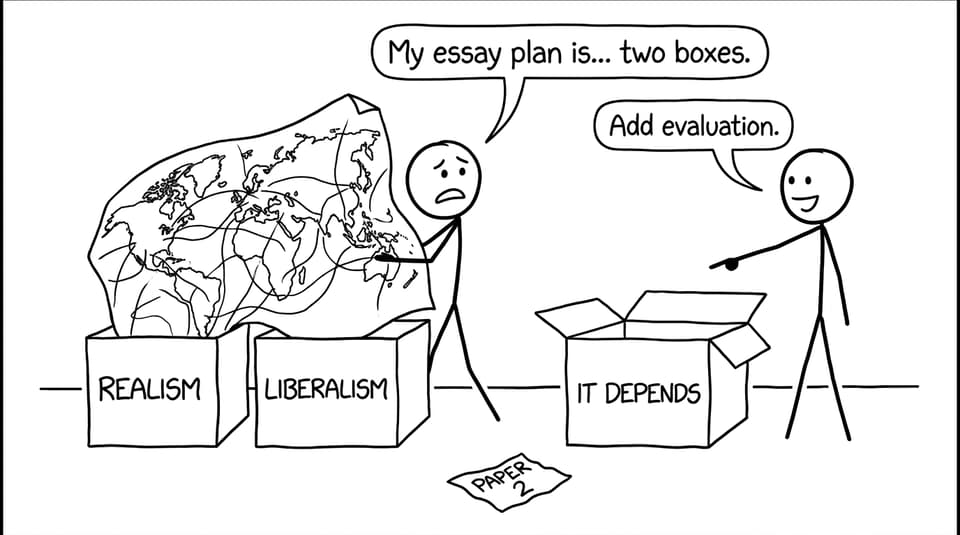
How to use realism and liberalism in IB Global Politics exam answers
In IB Global Politics, you do not “pick a side.” You apply a lens, then judge its fit.
Try this paragraph pattern:
-
Claim: Answer the question directly.
-
Lens 1 (realism): Explain the behaviour through power/security.
-
Lens 2 (liberalism): Explain the behaviour through institutions/interdependence.
-
Mini-evaluation: Which lens explains more, and what does each miss?
For practice that feels like the real thing, drill theory prompts in Theoretical perspectives Questionbank, then strengthen your evidence work using IB Global Politics: Using Case Studies for Top Marks.
RevisionDojo makes this loop practical: revise with Study Notes, lock it in with Flashcards, test it in the Questionbank, and use AI Chat plus Grading tools to fix what examiners actually mark. When you want pressure training, switch to Mock Exams and Predicted Papers (and keep your coursework organised with the Coursework Library and Tutors).
Closing: make IB Global Politics feel smaller
Realism and liberalism do not shrink the world because the world is simple. They shrink it because they give you disciplined ways to argue. In IB Global Politics, that discipline is the point: define the system, identify actors, explain power, and evaluate cooperation.
Build that skill with RevisionDojo: start at the IB Global Politics Notes, practise with the Questionbank feature, and pressure-test your planning using How to Revise Effectively for IB Global Politics. Then walk into the exam knowing you can look at the same event through two lenses and still sound like one clear thinker in IB Global Politics.