Practice IB Global Politics Topic Interdependence with authentic exam-style questions for both SL and HL students. This question bank focuses on the exact syllabus content for Interdependence and mirrors Paper 1, 2, 3 style where relevant.
Get instant solutions, detailed explanations, and build confidence with questions aligned to IB examiner expectations.
Source A
Adapted from "Rules for the Powerful? International Institutions and State Interest," World Order Studies, 2022.
International institutions are often presented as neutral referees, yet their design reflects the power of those who built them. The permanent members of the UN Security Council hold vetoes; voting weight at the International Monetary Fund and World Bank is tied to financial contributions, giving wealthy states disproportionate influence. Critics argue that powerful states obey international rules when convenient and ignore them when core interests are at stake, pointing to interventions launched without Security Council authorisation. On this view, global governance is less a constraint on the powerful than a tool they use to legitimise their preferences.
Source B
Adapted from "Even Great Powers Are Bound," Journal of International Law and Politics, 2021.
It is too simple to say that international institutions merely serve the strong. Powerful states invest heavily in maintaining rules because predictable order serves their long-term interests, and they pay real reputational and economic costs when they break them. Trade rulings at the World Trade Organization have gone against the United States and the European Union, and both have complied. Sanctions, diplomatic isolation and loss of credibility follow visible violations of international norms, as Russia found after 2022. Institutions constrain even their most powerful members, this argument holds, because the alternative, a world without shared rules, would be worse for everyone, including the strong.
Using both sources and your own knowledge, evaluate the claim that global governance institutions do little to constrain the world's most powerful states.
Source A
Source B
Adapted from “The Humanitarian Impact of War” by Médecins Sans Frontières (Doctors Without Borders), www.msf.org (2019).
War zones create devastating humanitarian crises that disproportionately affect civilian populations. Médecins Sans Frontières (MSF) reports that in conflict-affected regions like Syria, indiscriminate airstrikes and ground offensives have destroyed vital infrastructure, including hospitals, schools, and water supplies. These attacks not only cause immediate loss of life but also leave millions of people without access to healthcare, clean water, and shelter, driving large-scale displacement both within countries and across borders.
MSF highlights the essential need for humanitarian corridors, secure routes that allow aid organizations to reach populations in need and permit civilians to escape dangerous areas. However, the organization points out that maintaining these corridors is extremely challenging. Warring parties often use access to aid as a bargaining tool, intentionally block humanitarian assistance, or manipulate relief efforts for political gain. The threat of violence against aid workers further restricts operations, placing both civilians and humanitarian staff at constant risk.
The organization calls for stronger enforcement of international humanitarian law, emphasizing that all parties to conflict are obligated to protect civilians and ensure access to humanitarian aid. MSF urges the international community to hold violators accountable, support the neutrality of aid organizations, and prioritize civilian protection to prevent further human suffering in war zones.
Source C
Adapted from “The Limits of Peace Agreements” by the International Peace Institute, www.ipinst.org (2021).
While peace agreements are often celebrated as milestones in conflict resolution, their effectiveness depends on long-term implementation and addressing the root causes of conflict. The International Peace Institute (IPI) examines the 2016 Colombian peace agreement between the government and the FARC rebels, considered a landmark deal at the time. However, IPI notes that achieving lasting peace in Colombia has proved difficult, as challenges remain in reintegrating former combatants, delivering promised reforms, and addressing structural inequalities such as land distribution and rural poverty.
IPI points out that many peace agreements worldwide suffer from a gap between signed commitments and actual change on the ground. In Colombia, violence has persisted in some regions due to the emergence of new armed groups and ongoing disputes over resources and territory. The institute warns that without sustained political will, adequate funding, and mechanisms for accountability, peace agreements risk being only symbolic. Ensuring justice for victims, guaranteeing security, and building trust among divided communities are highlighted as key prerequisites for genuine reconciliation.
The report concludes that for peace agreements to have a transformative impact, they must be accompanied by comprehensive policies that address historical grievances, promote inclusion, and support social and economic development alongside political solutions.
Source D
Adapted from “The Role of Regional Organizations in Conflict Resolution” by the African Union Peace and Security Council, www.au.int (2020).
Regional organizations such as the African Union (AU) are increasingly recognized as essential actors in managing and resolving conflicts on the continent. The African Union Peace and Security Council (AUPSC) describes how regional organizations offer valuable local knowledge, quicker response capabilities, and political legitimacy in peace operations. The AU has played a critical role in mediating conflicts and deploying peacekeeping missions, such as the African Union Mission in Somalia (AMISOM) and the United Nations–African Union Mission in Darfur (UNAMID), to stabilize regions, protect civilians, and facilitate humanitarian aid.
Despite these achievements, the AUPSC identifies several persistent challenges. Funding shortfalls, limited logistical capacity, and dependence on external donors (such as the European Union or United Nations) constrain the scope and effectiveness of regional missions. In addition, political divisions among member states and varying levels of commitment can undermine unified action. The council also highlights the complexity of some conflicts, which often require close collaboration with international partners and national governments.
Nevertheless, the report argues that regional organizations, given their proximity and understanding of local dynamics, are well-positioned to take a lead role in conflict prevention and resolution. The AUPSC calls for stronger institutional support, sustainable financing, and increased cooperation between regional, continental, and global actors to achieve lasting peace in Africa.

Identify what Source A tells us about the challenges of using sanctions as a tool for conflict resolution.
With explicit reference to Source B and one example you have studied, explain the challenges of providing humanitarian aid in conflict zones.
Compare and contrast what Source C and Source D tell us about the factors that influence the success of conflict resolution efforts.
Using at least three sources and your own knowledge, evaluate the effectiveness of international and regional approaches to conflict resolution.
Source A
Source B
Adapted from "The Architecture of Cooperation: Why States Build Institutions," Global Governance Review, 2021.
States are not condemned to act alone. Over the past century they have constructed a dense web of intergovernmental organisations, treaties and rules that allow them to pursue shared goals more effectively than any could alone. The United Nations coordinates responses to crises; the World Trade Organization provides a forum to settle trade disputes under agreed rules; the World Health Organization pools disease surveillance across borders. These institutions lower the cost of cooperation by providing information, setting standards and creating expectations that agreements will be honoured. Because states expect to interact repeatedly, the reputational cost of breaking commitments encourages compliance even without a global enforcer. Interdependence, on this account, does not merely constrain states; it enables them to solve problems no single government could manage.
Source C
Adapted from "The Veto and Its Discontents: The Limits of the Security Council," Journal of International Institutions, 2023.
The promise of collective action through the United Nations repeatedly collides with the structure of the Security Council. Its five permanent members each hold a veto, and where their interests diverge, decisive action stalls. Russia's veto shielded the Syrian government from Council resolutions during that country's civil war, and after 2022 the Council was unable to condemn Russia's own invasion of Ukraine because Russia sat among those with a veto. Critics argue that an institution designed in 1945 to reflect the victors of the Second World War now entrenches the interests of a handful of powers and paralyses the body precisely when its action is most needed. Reform proposals recur, but any change to the Council's composition can itself be vetoed.
Source D
Adapted from "The Double Edge of Interdependence: Energy, Trade and Vulnerability," International Economy Quarterly, 2022.
Interdependence binds states together, but the same bonds can be turned into weapons. Before 2022, several European economies depended heavily on Russian natural gas, a relationship long presented as mutually beneficial. When war broke out, that dependence became a source of leverage and vulnerability: supplies were cut, prices surged, and governments scrambled for alternatives. Similar concerns drive the rivalry between the United States and China over semiconductors and critical minerals, where each seeks to reduce reliance on the other. Deep economic ties can raise the cost of conflict and encourage restraint, but they also create choke points that powerful states can exploit. Interdependence, this suggests, is a source of both cooperation and coercion.
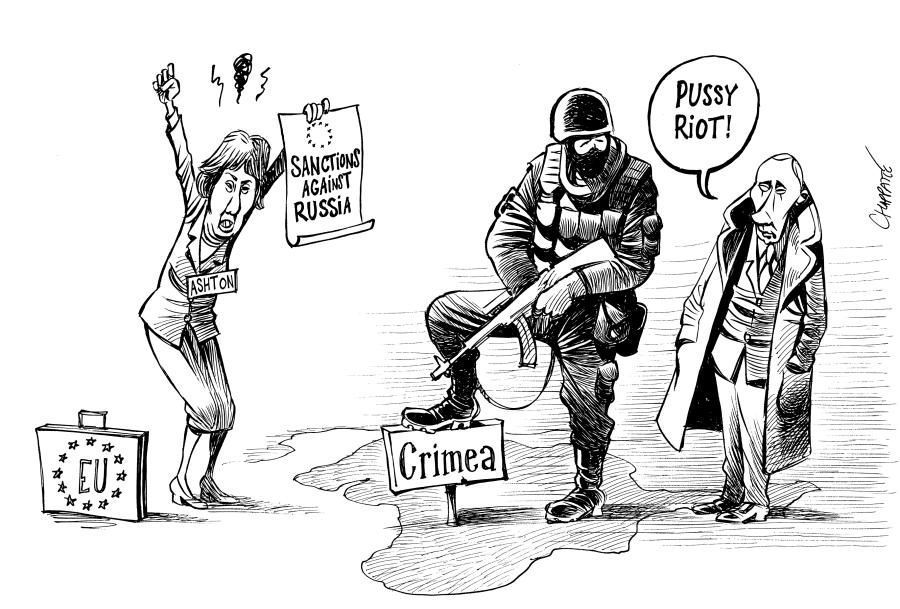
Using Source A, identify three things the cartoon suggests about the limitations of the UN Security Council.
With explicit reference to Source B and one example you have studied, explain how intergovernmental organisations help states cooperate.
Compare and contrast what Source C and Source D reveal about the challenges of interdependence in global politics.
Using at least three of the sources and your own knowledge, evaluate the claim that interdependence does more to constrain conflict between states than to enable their cooperation.
Source A
Global Power Indicators (2023 Rankings)
| Country | Military Expenditure Rank | Soft Power Index Rank | GDP (Nominal) Rank |
|---|---|---|---|
| United States | 1 | 1 | 1 |
| United Kingdom | 6 | 2 | 6 |
| Germany | 7 | 3 | 4 |
| Japan | 10 | 4 | 3 |
| China | 2 | 5 | 2 |
| France | 8 | 6 | 7 |
| India | 4 | 28 | 5 |
| Russia | 3 | 13 | 11 |
| South Korea | 9 | 15 | 13 |
| Saudi Arabia | 5 | 19 | 18 |
Source B
Adapted from “Digital Sovereignty and the New Global Order,” International Relations Review, www.irreview.org (2022).
The traditional Westphalian notion of state sovereignty is increasingly challenged by the rise of transnational technology corporations. These non-state actors—often referred to as “Big Tech”—possess resources and influence that rival many medium-sized nations. They control the infrastructure of the digital age, from data storage to communication platforms, effectively governing the “digital commons.”
Unlike states, which derive power from territory and military force, these entities wield power through data algorithms and economic networks. This creates a shift in how power is exercised: rather than coercion (hard power) or attraction (soft power), they use “structural power” to shape the environments in which states and individuals operate. For example, during political crises, the decisions of social media companies to de-platform leaders or restrict information can have greater immediate impact than diplomatic sanctions. Governments are now struggling to regulate these entities, leading to a tension between national laws and the borderless nature of corporate power. The ability of a state to protect its citizens and maintain internal authority now depends heavily on its capacity to negotiate with these non-state behemoths.
Source C
Adapted from “The Hallyu Effect: Cultural Diplomacy in the 21st Century,” Global Affairs Journal, www.globalaffairs.org (2021).
South Korea has transformed itself from a recipient of foreign aid into a global cultural powerhouse. This phenomenon, known as Hallyu or the “Korean Wave,” has become a cornerstone of the country’s soft power strategy. By exporting music (K-pop), television dramas, and cinema, South Korea has built a positive national brand that transcends traditional political boundaries.
This cultural influence translates directly into diplomatic and economic advantages. It attracts millions of tourists, boosts the demand for Korean consumer goods, and fosters a favorable image that makes foreign audiences more receptive to South Korean policy goals. The government’s proactive support for “Cool Korea” demonstrates a strategic understanding that in an interconnected world, the ability to win hearts and minds is as vital as economic or military strength. For many developing nations, the South Korean model provides a blueprint for how a “middle power” can punch above its weight on the global stage through cultural attraction rather than military or economic coercion.
Source D
Adapted from “The Limits of Attraction,” by Professor Mark Sterling, Strategic Studies Institute, www.ssi-reports.edu (2023).
While the concept of soft power has dominated academic circles for decades, recent geopolitical events suggest that hard power remains the ultimate currency of international relations. The idea that cultural influence or economic interdependence could render military force obsolete has been repeatedly disproven by the return of territorial aggression and great-power competition.
Critics of soft power argue that it is secondary and dependent; cultural attraction can only flourish within a security framework provided by hard power. For instance, when state survival or core territorial interests are at stake, nations invariably turn to their military capabilities, not their cultural exports. In the South China Sea or Eastern Europe, diplomatic posturing and cultural branding have done little to deter states from pursuing hard interests through military buildup and intimidation. Furthermore, soft power is slow to build and easily destroyed by a single unpopular foreign policy decision. Ultimately, in a realist world characterized by anarchy, a state’s influence is measured by its capacity for defense and its ability to project force, suggesting that the “soft” elements of power are merely luxuries that exist at the mercy of “hard” realities.
Identify what Source A tells us about the relationship between military strength and soft power influence.
With explicit reference to Source B and one example you have studied, explain how non-state actors can challenge the power of the state.
Compare and contrast what Source C and Source D tell us about the effectiveness of soft power in global politics.
Using at least three sources and your own knowledge, evaluate the claim that the traditional military and economic power of the state is being replaced by new forms of power in the 21st century.
Evaluate the extent to which military alliances strengthen or undermine state sovereignty.